Facts
The plaintiffs instituted a suit in 1970 seeking an injunction against interference with land alleged to have been used as a Muslim graveyard for more than 300 years. The plaint stated that the suit was filed in a representative capacity under Order I Rule 8 CPC. The disputed property was identified as Plot No. 262/4/1, measuring 18.14 acres. The defendant claimed rights over the land on the basis of purchase and contended that it had never been used, or had only been partly used, as a graveyard
Source reference: paras. 3–5The Trial Court initially partly decreed the suit, but the matter was remanded by the First Appellate Court. On rehearing, the Trial Court held that the entire 18.14 acres had historically been used as a graveyard and decreed the suit in full. The defendant’s appeal was dismissed by the First Appellate Court on 2 March 1981.
Source reference: paras. 7–8, 10In the second appeal, the defendant challenged the concurrent findings and contended, for the first time, that the suit was not maintainable because no permission under Order I Rule 8 CPC had been sought or granted.
Source reference: paras. 11–14Issues
1. Whether, on the facts pleaded and found by the courts below, the entire disputed plot could be held to be a graveyard?
Source reference: para. 1(i)2. Whether the courts below failed to determine the actual extent of the graveyard according to the correct legal principles?
Source reference: para. 1(ii)3. Whether the absence of permission under Order I Rule 8 CPC rendered the suit, filed purportedly in a representative capacity, liable to dismissal?
Source reference: para. 124. Whether the appeal involved any substantial question of law warranting interference under Section 100 CPC?
Source reference: paras. 2, 16–18Law Applied
Section 100 CPC permits interference in a second appeal only where a substantial question of law arises; under Hero Vinoth v. Seshammal, a question is substantial when it is real, arguable, and directly affects the parties’ rights, but not where settled principles merely require application to the facts.
Source reference: para. 16The Court also relied on Rabindranath Panigrahi v. Surendra Sahu, holding that the existence of a substantial question of law must first be examined and, if none exists, the second appeal may be dismissed without framing a question.
Source reference: para. 2Under Order I Rule 8 CPC, court permission is necessary for a suit to operate as a representative suit binding the represented class; however, under Kalyan Singh v. Smt. Chhoti and Hari Ram v. Jyoti Prasad, a member of a community may independently sue to protect community property or prevent encroachment, and failure to comply with Order I Rule 8 does not necessarily make such a suit non-maintainable.
Source reference: para. 19In the absence of permission, the decree operates only between the parties to the suit and not against the entire community.
Source reference: paras. 20–21Reasoning
The courts below had concurrently found, on the basis of the oral and documentary evidence and the spot-inspection report, that the entire disputed land had been used as a Muslim graveyard for more than 300 years.
Source reference: para. 17The High Court found no illegality in those factual findings and held that the original questions concerning the extent and character of the graveyard involved, at most, the application of settled legal principles to the evidence and therefore did not constitute substantial questions of law.
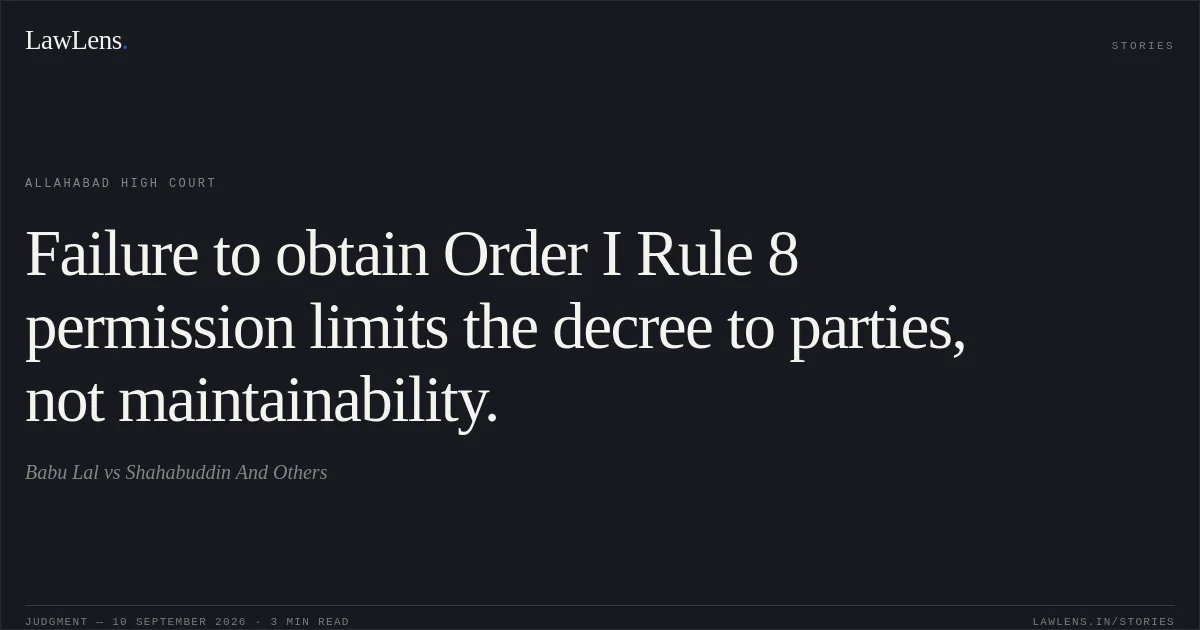
Source reference: para. 17As to Order I Rule 8 CPC, the Court noted that no permission had been sought or granted. Applying Hari Ram and Kalyan Singh, it held that this did not require dismissal of the suit: the plaintiffs could maintain the action as individual members seeking protection of community property, although the decree would bind only the parties and would not operate as a representative decree against the entire Muslim community.
Source reference: paras. 18–21Consequently, the defendant’s proposed question was not a substantial question of law under Section 100 CPC.
Source reference: para. 21Holding
The High Court held that no substantial question of law arose in the second appeal.
The concurrent finding that the entire 18.14-acre disputed property constituted a Muslim graveyard was not open to interference in second appeal.
Source reference: para. 22The absence of permission under Order I Rule 8 CPC did not make the suit liable to dismissal; it merely restricted the effect of the decree to the parties to the suit.
Source reference: para. 22The second appeal was accordingly dismissed.
Source reference: para. 22Acts & Sections Cited
2 provisions across 1 statute referred to in this judgment. Each provision opens on LawLens.
Code of Civil Procedure, 19082
Original Court PDF
Babu LalvsShahabuddin And Others
Click to open original judgment
Original judgment, available to read, download and summarize on LawLens.in