Facts
Respondent No. 2 alleged that, under a registered sale agreement dated 25 April 2011, he agreed to purchase 4 acres and 2 guntas from petitioner No. 1 for ₹2,60,000.
Source reference: p. 4–5, para. 4–5Although the sale deed was not executed, he claimed that possession remained with him.
Source reference: p. 4–5, para. 4–5In 2023, petitioner No. 1 gifted the land to petitioner No. 2.
Source reference: p. 4–5, para. 4–5Respondent No. 2’s complaint led to registration of a case against the petitioners under Section 420 read with Section 149 IPC; petitioners Nos. 4 and 5 were added on the basis of a further statement.
Source reference: p. 4–5, para. 4–5The petitioners sought quashing of the proceedings in C.C. No. 73/2025, arguing that the dispute was civil in nature and that the agreement was time-barred.
Source reference: p. 5–6, para. 5Issues
1. Whether the alleged failure to execute a sale deed pursuant to the 2011 sale agreement disclosed a prima facie offence of cheating under Section 420 IPC
Source reference: p. 6–8, para. 6–82. Whether continuation of the criminal proceedings against the petitioners amounted to an abuse of process warranting quashing under Section 528 BNSS
Source reference: p. 8, para. 8Law Applied
The Court considered Section 420 IPC, read with Section 149 IPC, and its inherent jurisdiction under Section 528 of the Bharatiya Nagarik Suraksha Sanhita, 2023 (corresponding to Section 482 Cr.P.C.).
Source reference: p. 6–7, para. 6Relying on Kunti and Another v. State of Uttar Pradesh and Another, (2023) 6 SCC 109, it reiterated that mere failure to keep a promise does not, without more, justify criminal proceedings; courts should exercise caution where the dispute is essentially civil, and criminal prosecution should not be used to pressure parties in civil disputes.
Source reference: p. 6–7, para. 6Reasoning
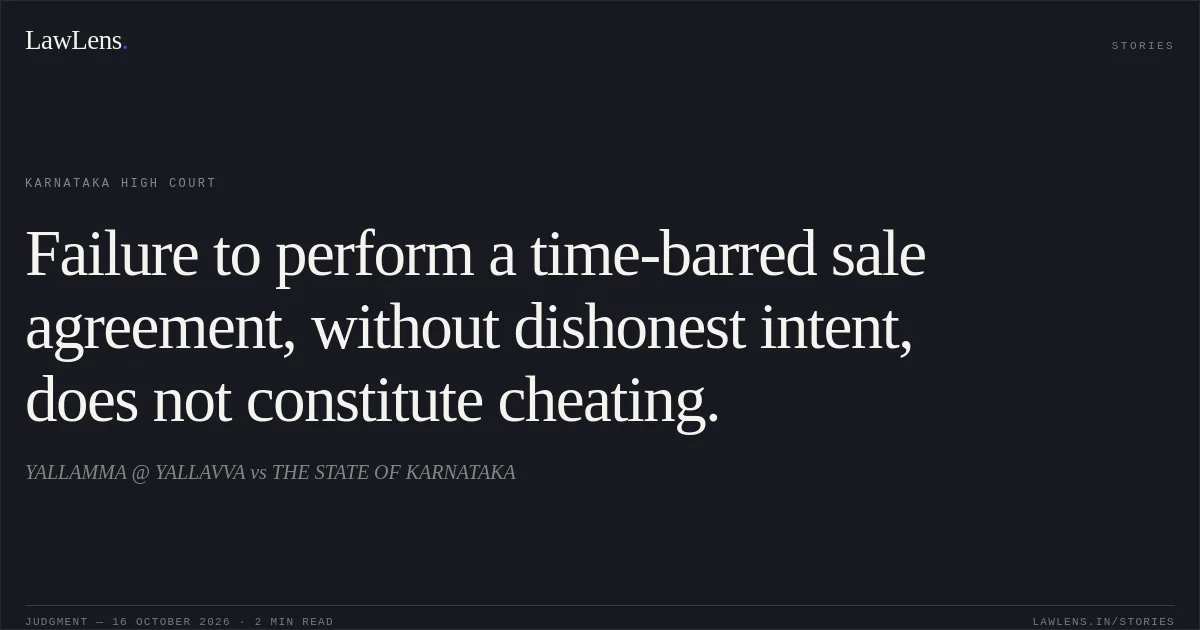
The Court treated the complaint as resting on petitioner No. 1’s alleged failure to perform the sale agreement, rather than on material showing a prima facie case of cheating.
Source reference: p. 7, para. 7It noted that the agreement dated 25 April 2011 was time-barred and that respondent No. 2 had not pursued specific performance within the limitation period.
Source reference: p. 5, 7–8, para. 5, 8The Court also found no material connecting petitioners Nos. 4 and 5 with the agreement.
Source reference: p. 8, para. 8On those facts, it concluded that the allegations did not make out a prima facie offence under Section 420 IPC and that continuing the prosecution would constitute an abuse of process.
Source reference: p. 8, para. 8Holding
The Court answered the issues in favour of the petitioners and allowed the petition.
It quashed the proceedings in C.C. No. 73/2025, arising from Crime No. 60/2024, for the offence under Section 420 read with Section 149 IPC, insofar as they concerned petitioners/accused Nos. 1 to 5.
Source reference: p. 8–9, para. 9Acts & Sections Cited
9 provisions across 3 statutes referred to in this judgment. Each provision opens on LawLens.
Bharatiya Nagarik Suraksha Sanhita, 20231
Code of Criminal Procedure, 19731
Indian Penal Code, 18607
Original Court PDF
YALLAMMA @ YALLAVVAvsTHE STATE OF KARNATAKA
Click to open original judgment
Original judgment, available to read, download and summarize on LawLens.in