Facts
The appellant was tried for wrongful restraint and voluntarily causing hurt under Sections 341 and 323 IPC, and for an offence under Section 3(1)(x) of the SC/ST (Prevention of Atrocities) Act, 1989, arising from an alleged attack on Suresh, who belonged to a Scheduled Caste.
Source reference: para. 2, 6, 10The trial court convicted the appellant and imposed sentence, including one year’s rigorous imprisonment under the SC/ST Act.
Source reference: para. 8On appeal under Section 374(2) CrPC, the High Court reviewed the conviction and sentence.
Source reference: para. 1, 9Issues
Whether the prosecution proved beyond reasonable doubt that the appellant committed the offences under Sections 341 and 323 IPC.
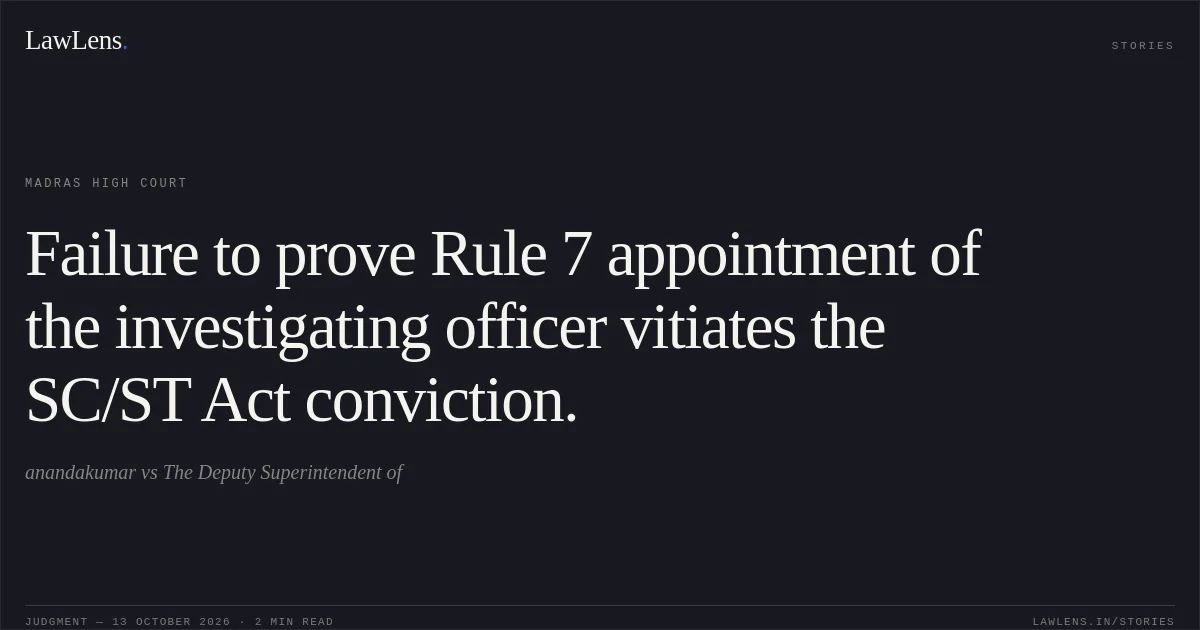
Source reference: para. 9, 19–27Whether the conviction under Section 3(1)(x) of the SC/ST Act could stand where the investigation was not shown to have been conducted by an officer appointed in accordance with Rule 7(1) of the SC/ST (Prevention of Atrocities) Rules, 1995.
Source reference: para. 9, 24Law Applied
Sections 341 and 323 IPC address wrongful restraint and voluntarily causing hurt, respectively; Section 3(1)(x) of the SC/ST Act was the provision charged in this case.
Source reference: para. 2, 6The prosecution must establish guilt beyond reasonable doubt.
Source reference: para. 27Rule 7(1) of the SC/ST (Prevention of Atrocities) Rules, 1995 requires the Superintendent of Police to appoint an appropriately qualified officer to investigate an offence under the Act; relying on State of M.P. v. Chunnilal @ Chunni Singh (CDJ 2009 SC 750), the Court stated that an investigation by an officer not appointed in accordance with that Rule vitiates the investigation insofar as the SC/ST Act offence is concerned.
Source reference: para. 24Reasoning
The Court found material discrepancies between PW1’s account and the Accident Register: the medical record referred to an attack by three persons, while PW1 attributed the assault to the appellant alone; the Court also considered the recorded timing inconsistent with PW1’s account and treated the Accident Register as the earlier record.
Source reference: para. 22–23The occurrence witnesses turned hostile, and the Court found reason to doubt the presence of PW6 and PW7; the injured witness was also not examined, which the Court considered fatal in the circumstances.
Source reference: para. 12, 19–20, 25–26Separately, the prosecution did not produce the Superintendent of Police’s appointment order for the investigating officer, so the Court held that the statutory investigation requirement had not been established for the SC/ST Act charge.
Source reference: para. 24Taken together, these deficiencies left the prosecution’s case unproved beyond reasonable doubt.
Source reference: para. 27Holding
The High Court answered the appeal in the appellant’s favour, allowed it, and set aside the conviction and sentence imposed in S.C.No.171 of 2011.
It discharged the appellant’s bail bond and ordered that any fine paid be refunded.
Source reference: para. 28Acts & Sections Cited
6 provisions across 3 statutes referred to in this judgment. Each provision opens on LawLens.
Code of Criminal Procedure, 19733
Indian Penal Code, 18602
Scheduled Castes and the Scheduled Tribes (Prevention of Atrocities) Act, 19891
Original Court PDF
anandakumarvsThe Deputy Superintendent of
Click to open original judgment
Original judgment, available to read, download and summarize on LawLens.in