Facts
The appellant was prosecuted in connection with Goreswar P.S. Case No. 122/2019 for allegedly raping the victim on 10 October 2019 near the Deosunga River.
Source reference: no citationThe prosecution alleged that the victim was below 18 years of age and that the appellant forcibly had sexual intercourse with her.
Source reference: no citationThe victim deposed that the appellant dragged her into a jungle and raped her; PWs 4 and 6 claimed to have witnessed the occurrence, while PW 5 saw the appellant being restrained and thereafter fleeing.
Source reference: pp. 3–6, paras. 3, 7–10The medical examination disclosed a tear in the hymen with bleeding and evidence of recent penetration.
Source reference: pp. 3–6, paras. 3, 7–10The Trial Court convicted the appellant under Section 4 of the Protection of Children from Sexual Offences Act, 2012 (“POCSO Act”) and sentenced him to 20 years’ rigorous imprisonment with fine, but did not record a finding on the separately framed charge under Section 376(1) IPC.
Source reference: p. 3, para. 5In appeal, the appellant challenged the credibility of the victim and eyewitnesses, the proof of age, and the legality of the conviction.
Source reference: pp. 7–8, paras. 14–15Issues
1. Whether the prosecution proved beyond the requisite standard that the victim was below 18 years of age so as to sustain the conviction under Section 4 of the POCSO Act.
Source reference: pp. 11–14, paras. 22–282. Whether the evidence of the victim, the eyewitnesses, and the medical officer established that the appellant had raped the victim.
Source reference: pp. 9–11, paras. 18–213. Whether the High Court could sustain or record a conviction under Section 376(1) IPC notwithstanding the Trial Court’s failure to return a finding on that charge.
Source reference: pp. 14–15, paras. 29–314. Whether the alleged inconsistencies in the victim’s testimony and the relationship of PWs 4, 5 and 6 with the victim rendered the prosecution evidence unreliable.
Source reference: pp. 9–11, 16, paras. 19–21, 32Law Applied
The Court applied Section 4 of the POCSO Act, which criminalises penetrative sexual assault upon a “child,” namely a person below 18 years; and Section 376(1) IPC relating to punishment for rape.
Source reference: pp. 3, 14–16, paras. 5, 28–33For age determination, the Court relied on Section 94 of the Juvenile Justice (Care and Protection of Children) Act, 2015, under which the school or matriculation certificate and, failing that, the birth certificate are preferred, with ossification or other medical testing being used only in their absence.
Source reference: pp. 12–13, para. 26Narender Kumar v. State (NCT of Delhi), (2012) 7 SCC 171, establishes that a credible prosecutrix’s testimony can itself support conviction and that minor discrepancies do not destroy an otherwise reliable prosecution case.
Source reference: p. 10, para. 20Malay Kumar Ganguly v. Sukumar Mukherjee, (2009) 9 SCC 221, holds that the contents of a document are not proved merely by its exhibition or absence of objection to admissibility.
Source reference: pp. 11–12, para. 24Pawan Kumar v. State of U.P., (2023) 15 SCC 683, and Akula Raghuram v. State of A.P., (2025) 4 SCC 209, recognise that ossification or radiological age assessment is not exact and may involve a margin of two years on either side.
Source reference: pp. 13–14, paras. 27–28Under Raj Kumar v. State of M.P., (2014) 5 SCC 353, an accused’s failure to explain incriminating circumstances under Section 313 Cr.P.C. may permit an adverse inference where otherwise legally permissible.
Source reference: pp. 14–15, para. 31Relationship with the victim, by itself, is not a ground to reject testimony unless there is evidence of motive to falsely implicate the accused, as held in State of U.P. v. Saman Das, AIR 1972 SC 67.
Source reference: p. 16, para. 32Reasoning
The Court found the occurrence of rape proved through the consistent core of the victim’s testimony, the accounts of PWs 4 and 6 claiming to have witnessed the act, PW 5’s evidence that the appellant fled after being restrained, and the medical evidence of recent penetration and hymenal injury.
Source reference: pp. 9–11, paras. 18–21The discrepancies concerning whether the victim knew the appellant and whether she had gone to defecate or fetch water were treated as minor and unrelated to the factum of rape.
Source reference: pp. 9–10, para. 19The relationship of PWs 4, 5 and 6 with the victim did not justify rejecting their evidence in the absence of proof of enmity or a motive to falsely implicate the appellant.
Source reference: p. 16, para. 32However, the School Certificate and Birth Certificate referred to in the seizure list had neither been produced nor exhibited, and the seizure list itself did not prove their contents.
Source reference: pp. 11–12, paras. 22–24The only admissible age-related evidence was the radiological assessment placing the victim between 14 and 16 years.
Source reference: no citationApplying the permissible two-year margin in favour of the accused, the Court treated her age as potentially 18 years at the time of the occurrence, thereby holding that the prosecution had not established that she was a “child” under the POCSO Act.
Source reference: pp. 13–14, paras. 25–28Nevertheless, the proved act of rape, together with the appellant’s blanket denial under Section 313 Cr.P.C. and failure to explain his presence and flight, justified conviction under Section 376(1) IPC.
Source reference: pp. 14–15, paras. 29–31Holding
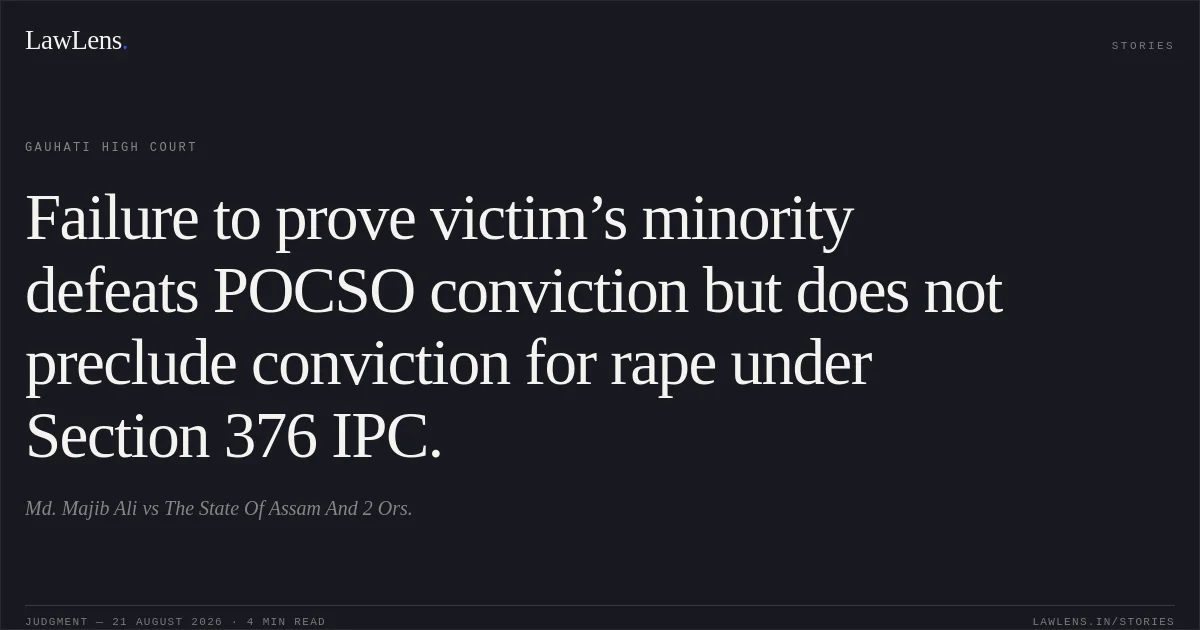
The High Court held that the conviction under Section 4 of the POCSO Act was not sustainable because the victim’s age below 18 years had not been proved in accordance with law.
It nevertheless held that the prosecution proved the commission of rape by the appellant and convicted him under Section 376(1) IPC.
Source reference: no citationThe sentence was modified from 20 years’ rigorous imprisonment under the POCSO Act to 12 years’ rigorous imprisonment under Section 376(1) IPC, with a fine of ₹20,000 and, in default, six months’ rigorous imprisonment.
Source reference: p. 16, paras. 33–35The appeal was dismissed subject to this modification, and the Trial Court Record was directed to be returned.
Source reference: p. 16, paras. 33–35Acts & Sections Cited
6 provisions across 4 statutes referred to in this judgment. Each provision opens on LawLens.
Code of Criminal Procedure, 19733
Indian Penal Code, 18601
Protection of Children from Sexual Offences Act, 20121
Juvenile Justice (Care and Protection of Children) Act, 2015.1
Original Court PDF
Md. Majib AlivsThe State Of Assam And 2 Ors.
Click to open original judgment
Original judgment, available to read, download and summarize on LawLens.in