Facts
An FIR was registered on 18 April 2025 at Police Station Gunnour, District Sambhal, alleging that the petitioner had taken away and confined the informant’s wife.
Source reference: paras. 1–5The petitioner was arrested on 20 April 2025 at 8:50 a.m. in connection with offences under Sections 87, 127(4), 64(1) and 143(2) of the Bharatiya Nyaya Sanhita, 2023 (“BNS”) and was produced before the Remand Magistrate on the same day.
Source reference: paras. 1–5The petitioner challenged the remand order, contending that he had not been informed of the specific grounds of arrest, either orally or in writing, in violation of Article 22(1) of the Constitution.
Source reference: paras. 6–7The State relied on the arrest memo and General Diary Entry No. 27, asserting that the grounds of arrest had been communicated to him.
Source reference: paras. 9–10, 14, 16The remand order was passed on a printed pro forma with blanks filled in, without recording the Magistrate’s satisfaction regarding compliance with Article 22(1).
Source reference: paras. 15, 34Issues
Whether the petitioner’s arrest was rendered illegal because the specific grounds of arrest were not communicated to him in writing, or otherwise effectively, at the time of arrest or as soon as may be thereafter, as required by Article 22(1) of the Constitution?
Source reference: paras. 3–4, 18–21, 31–33Whether the remand order was invalid because the Magistrate failed to ascertain compliance with Article 22(1) before authorising the petitioner’s detention?
Source reference: paras. 13, 34–35Whether the petitioner could challenge the legality of his arrest and remand despite the seriousness of the allegations and the rejection of his bail application?
Source reference: paras. 7, 29–30Law Applied
Article 22(1) of the Constitution mandates that an arrested person must be informed, as soon as may be, of the grounds of arrest; this safeguard is reinforced by the right to personal liberty under Article 21.
Source reference: paras. 17–18Section 47 of the Bharatiya Nagarik Suraksha Sanhita, 2023 (“BNSS”) requires communication of the particulars of the offence and other grounds of arrest, but cannot dilute the independent constitutional protection under Article 22(1).
Source reference: para. 21In Pankaj Bansal v. Union of India, the Supreme Court emphasised meaningful communication of the grounds of arrest and treated written communication as the appropriate course.
Source reference: para. 18Prabir Purkayastha v. State (NCT of Delhi) held that the grounds of arrest must be communicated in writing, must be personal and specific to the accused, and cannot be equated with general “reasons for arrest”; breach vitiates the arrest and remand.
Source reference: para. 19Vihaan Kumar v. State of Haryana held that the grounds must convey sufficient knowledge of the basic facts in a language understood by the arrestee, that the burden of proving compliance lies on the police, and that the Magistrate must ascertain compliance before remand.
Source reference: para. 21Mihir Rajesh Shah v. State of Maharashtra, though further requiring written grounds at least two hours before production for remand, was held to operate prospectively and therefore not to apply to the petitioner’s arrest of 20 April 2025.
Source reference: paras. 23–28State of Madhya Pradesh v. Kusum Sahu was distinguished as involving an impermissible attempt to use habeas corpus to reassess the merits after repeated rejection of bail, rather than a direct challenge to an unconstitutional arrest.
Source reference: paras. 22, 29–30Reasoning
The arrest memo did not record any specific facts constituting the grounds of arrest.
Source reference: para. 32Its relevant column merely contained general and standard reasons such as preventing further offences, facilitating investigation, preventing tampering with evidence, and securing the accused’s presence; these were “reasons for arrest,” not the personal and specific “grounds of arrest” required by Article 22(1).
Source reference: para. 32General Diary Entry No. 27 likewise recorded only that the petitioner had been informed of the offences under the BNS and had been taken into custody; it did not set out the factual basis necessitating his arrest or establish that such grounds had been communicated to him.
Source reference: para. 33Since the petitioner consistently denied receiving the grounds, the burden lay on the police to prove compliance, which they failed to discharge.
Source reference: paras. 21, 33The seriousness of the allegations and the prior rejection of bail could not validate an arrest that was unconstitutional at inception, because the challenge concerned legality of custody and not the merits of the prosecution or entitlement to bail.
Source reference: paras. 3–4, 29–30The Magistrate also failed to independently inquire into compliance with Article 22(1) and passed a mechanical remand order on a printed pro forma.
Source reference: paras. 34–35Consequently, the remand and ensuing custody were vitiated.
Source reference: paras. 34–35Holding
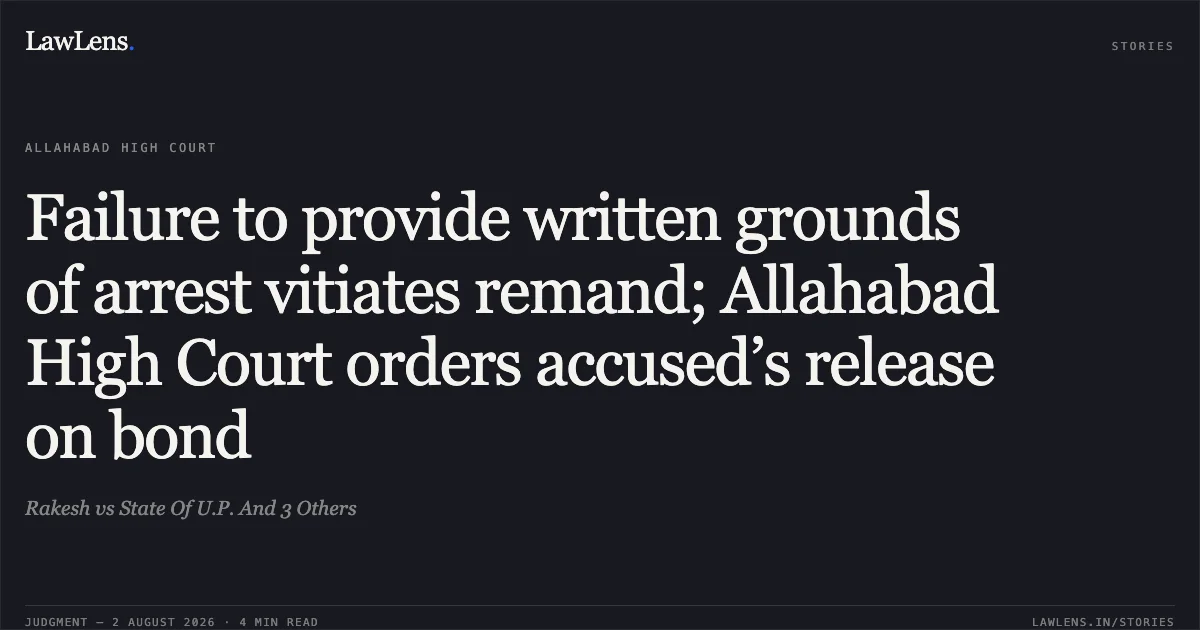
The High Court held that the petitioner’s arrest violated Article 22(1) of the Constitution because the specific grounds of arrest were not communicated to him in writing or otherwise effectively before his production for remand.
The remand order dated 20 April 2025 was therefore quashed, and the petitioner was directed to be produced before the Magistrate or Trial Court and released upon furnishing a bond under Section 91 BNSS, undertaking to appear regularly and not seek adjournments.
Source reference: para. 36The Court clarified that the order did not affect the investigation, pending trial, or merits of the prosecution.
Source reference: para. 36The Sessions Judge, Sambhal, was directed to ensure that subordinate Magistrates do not grant remand mechanically on printed pro formas and first ascertain compliance with the constitutional requirement regarding communication of grounds of arrest.
Source reference: paras. 36–37Acts & Sections Cited
17 provisions across 5 statutes referred to in this judgment. Each provision opens on LawLens.
Bharatiya Nyaya Sanhita, 20234
Prevention of Money-Laundering Act, 20022
Code of Criminal Procedure, 19733
Indian Penal Code, 18605
Bharatiya Nagarik Suraksha Sanhita, 20233
Original Court PDF
RakeshvsState Of U.P. And 3 Others
Click to open original judgment
Original judgment, available to read, download and summarize on LawLens.in