Facts
The petitioner was appointed as Assistant Grade-III in the Public Health Engineering Department, Jabalpur, on compassionate grounds by order dated 12 August 2021.
Source reference: p.1, para. 2The appointment order required her to possess a recognised computer qualification and to qualify the CPCT examination, including the prescribed typing requirement, within three years, extendable by one year depending on her attempts and typing capacity.
Source reference: p.1, para. 2The petitioner possessed a Bachelor of Computer Application degree and claimed that she had made repeated attempts to qualify the CPCT examination, but had not fully succeeded.
Source reference: p.2, para. 3She also relied on arthritis and a representation dated 12 June 2026 seeking further extension of time.
Source reference: p.2, para. 3The respondents terminated her services by order dated 2 July 2026 for failure to obtain the mandatory qualification within the permissible four-year period.
Source reference: p.1, para. 1; p.1, para. 2The petitioner challenged the termination under Article 226 of the Constitution, contending that her BCA degree substantially satisfied the requirement, that the Recruitment Rules did not mandate termination, and that the order was passed without an opportunity of hearing.
Source reference: p.2, para. 3The State relied on the appointment condition and on Amit Singh Baghel v. State of Madhya Pradesh, W.P. No. 20035 of 2025, affirmed in W.A. No. 2195 of 2025.
Source reference: p.2, paras. 4–5Issues
1. Whether the respondents were justified in terminating the petitioner’s services for failure to qualify the CPCT examination within the stipulated period.
Source reference: p.10, para. 82. Whether possession of a BCA degree, repeated attempts, medical difficulties, compassionate appointment, or the alleged absence of a prior hearing entitled the petitioner to continuation in service despite non-compliance with the CPCT condition.
Source reference: p.2, para. 3; p.10, para. 8Law Applied
Article 226 of the Constitution empowers the High Court to judicially review administrative action but does not permit it to waive or dilute essential eligibility conditions prescribed by service rules or expressly incorporated into an appointment order.
Source reference: p.10, para. 8A mandatory appointment condition accepted by an appointee is binding, and failure to fulfil it within the prescribed period can justify termination.
Source reference: p.10, para. 8A recognised computer qualification and successful completion of the CPCT examination are distinct requirements; a higher academic degree in computer applications cannot automatically substitute for the separately prescribed CPCT qualification.
Source reference: p.10, para. 8The Court relied on the coordinate Bench decision in Amit Singh Baghel v. State of Madhya Pradesh, as affirmed by the Division Bench in W.A. No. 2195 of 2025, which held that failure to acquire CPCT qualification within the initial three-year period and the additional one-year grace period justified removal from service.
Source reference: pp.3–9, paras. 11–16The compassionate nature of the appointment does not dispense with an essential qualification.
Source reference: p.2, para. 3; pp.8–9, paras. 13–16Reasoning
The Court found that the petitioner’s appointment order expressly required her to qualify the CPCT examination within three years, with a maximum permissible extension of one year.
Source reference: p.1, para. 2She accepted the appointment with knowledge of this condition and admittedly failed to qualify even after repeated attempts and expiry of the full four-year period.
Source reference: p.10, para. 8The Court rejected the argument that the BCA degree was equivalent to CPCT, holding that the computer qualification and the CPCT examination constituted separate requirements.
Source reference: p.10, para. 8The reasoning of the Division Bench in Amit Singh Baghel was directly applicable: even a higher computer degree does not satisfy the distinct typing/CPCT requirement, and the Court cannot extend the stipulated period or waive an essential condition.
Source reference: pp.5–9, paras. 12–14Consequently, the petitioner’s medical condition, compassionate appointment, and request for further extension did not establish grounds for interference under Article 226.
Source reference: p.10, para. 8Holding
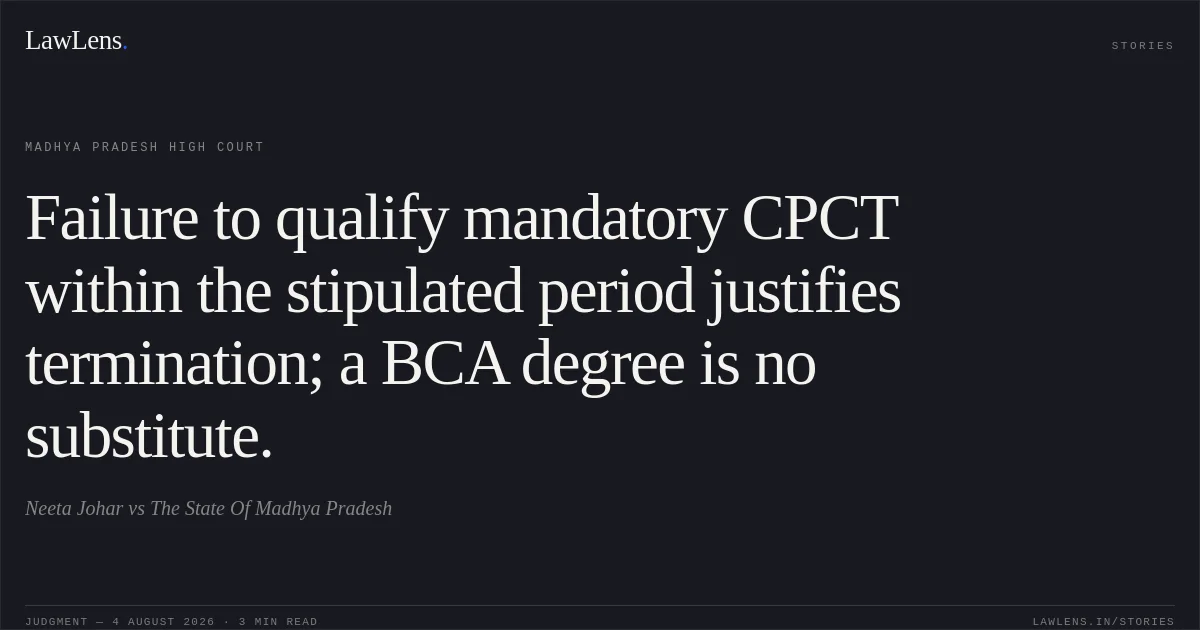
The High Court held that termination of the petitioner’s services for failure to qualify the CPCT examination within the prescribed four-year period was lawful.
Her BCA degree did not substitute for the mandatory CPCT qualification, and no ground was made out for judicial interference.
Source reference: p.10, para. 8The writ petition was dismissed, with no order as to costs.
Source reference: p.10, paras. 9–10Acts & Sections Cited
1 provisions across 1 statute referred to in this judgment. Linked provisions open on LawLens.
M.P. Uchcha Nyayalaya (Khand Nyayapeeth Ko Appeal) Adhiniyam, 20051
Original Court PDF
Neeta JoharvsThe State Of Madhya Pradesh
Click to open original judgment
Original judgment, available to read, download and summarize on LawLens.in