Facts
The petitioner, a Fair Price Shop licence-holder, alleged that excess food grains remained undistributed in her shop after January 2022 because many consumers had shifted to other Fair Price Shops or a Primary Co-operative Samiti.
Source reference: pp. 2–4; paras. 3–5She claimed that, despite repeated representations requesting adjustment of the balance stock under Clause 22 of the Bihar Targeted Public Distribution System (Control) Order, 2016, the authorities failed to reconcile or adjust the stock, resulting in deterioration and financial loss.
Source reference: pp. 2–4; paras. 3–5The respondents contended that allotment had been stopped from February to April 2022 pursuant to the petitioner’s request and that proportionate allotments were thereafter made after taking the balance stock into account.
Source reference: pp. 6–8; paras. 9–10During the proceedings, the petitioner challenged the orders dated 6 March 2025 and 8 March 2025, by which allotment to her Fair Price Shop for April 2023 to March 2025 was stopped/closed.
Source reference: pp. 3–5; paras. 3 and 6A later inspection dated 7 February 2026 recorded that substantial quantities of wheat and rice remained undistributed and had become rotten.
Source reference: pp. 14–16; para. 20Issues
Whether the respondents’ action in stopping/proportionately regulating allotments and taking account of the petitioner’s undistributed stock was contrary to Clause 22 of the Bihar Targeted Public Distribution System (Control) Order, 2016?
Source reference: pp. 10–12; paras. 15–18Whether the respondents could be held liable for the deterioration or loss of food grains lying undistributed in the petitioner’s Fair Price Shop?
Source reference: pp. 10, 14–16; paras. 15 and 20Whether the orders dated 6 March 2025 and 8 March 2025, stopping/closing allotments to the petitioner’s Fair Price Shop, warranted interference under Article 226 of the Constitution?
Source reference: pp. 3–5, 16–17; paras. 3, 6 and 20–21Law Applied
Clause 22(i) of the Bihar Targeted Public Distribution System (Control) Order, 2016, requires the Sub-Divisional Officer, while making subsequent allocations, to take into account any balance stock lying undistributed with the Fair Price Shop owner.
Source reference: p. 10; para. 16Clause 17 of the Bihar Gazette Notification dated 14 March 2016 places a duty on the licence-holder to preserve essential commodities properly and protect them from moisture, rainfall, insects, birds, fire and other causes of loss.
Source reference: pp. 14–15; para. 20The Court further accepted the FIFO principle—“First in, First out”—as the appropriate method for distributing older stock before newer allotments.
Source reference: pp. 12, 16–17; paras. 18 and 20Under the One Nation One Ration Card scheme, consumers cannot be compelled to obtain food grains from any particular Fair Price Shop.
Source reference: pp. 12–13; para. 18Reasoning
The Court held that the respondents had substantially complied with Clause 22 because allotments were stopped from February to April 2022 at the petitioner’s request, thereafter made proportionately while considering the existing stock, and ultimately stopped from April 2023 onward.
Source reference: pp. 11–12; para. 18The petitioner’s distribution records showed continued distribution between February and July 2022, while the September 2022 inspection found the grains to be in good condition, undermining her assertion that the stock had already become rotten.
Source reference: pp. 7–8, 13–14; paras. 10 and 19The Court further reasoned that the petitioner remained responsible under Clause 17 for preserving the stock and should have used the FIFO method, irrespective of whether the stock was normal or excessive.
Source reference: pp. 12, 15–17; paras. 18 and 20The continued presence of large quantities of rotten grains in February 2026, nearly three years after allotments had stopped, was treated as demonstrating the petitioner’s failure to distribute and preserve the stock properly.
Source reference: pp. 14–17; para. 20Since consumers were legally free to obtain supplies from other Fair Price Shops, their shift away from the petitioner’s shop did not make the respondents liable for the resulting deterioration.
Source reference: pp. 12–13; para. 18Holding
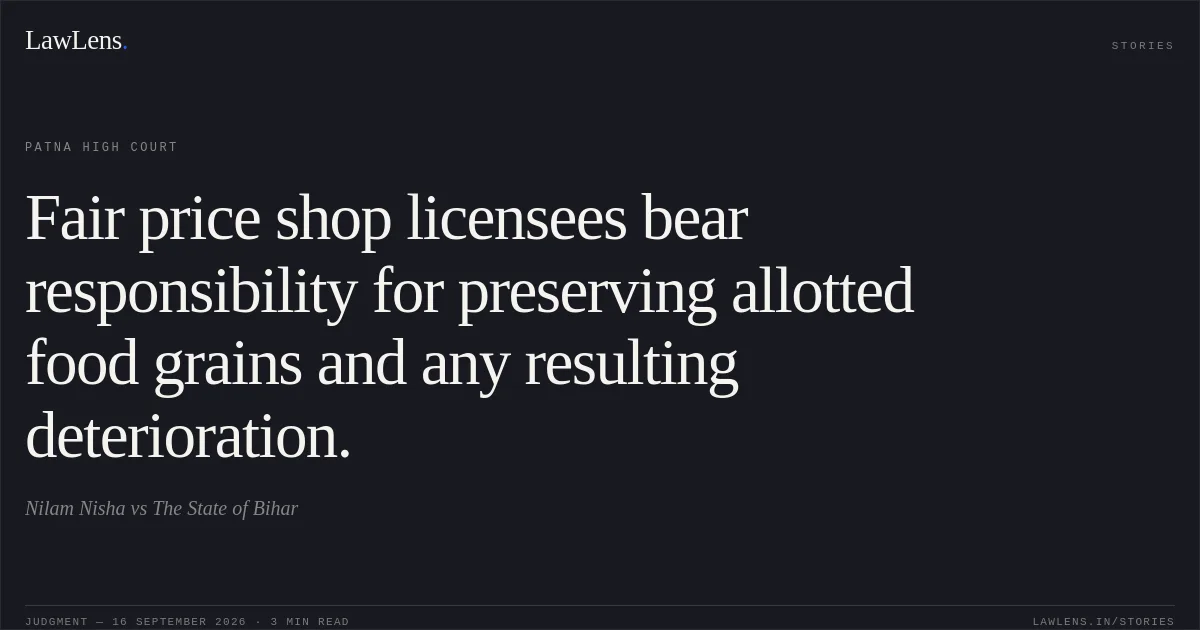
The Court held that the respondents had acted consistently with Clause 22 and could not be held liable for the deterioration of food grains caused by the petitioner’s failure to preserve or distribute them properly.
The writ petition was accordingly dismissed, and the orders dated 6 March 2025 and 8 March 2025 were not interfered with.
Source reference: p. 17; paras. 20–21However, the Court directed that, if the petitioner continued to hold a valid Fair Price Shop licence and her allotment had been stopped only for the period from April 2023 to March 2025, the respondents should sanction further allotments in accordance with the applicable law.
Source reference: p. 17; para. 22Original Court PDF
Nilam NishavsThe State of Bihar
Click to open original judgment
Original judgment, available to read, download and summarize on LawLens.in