Facts
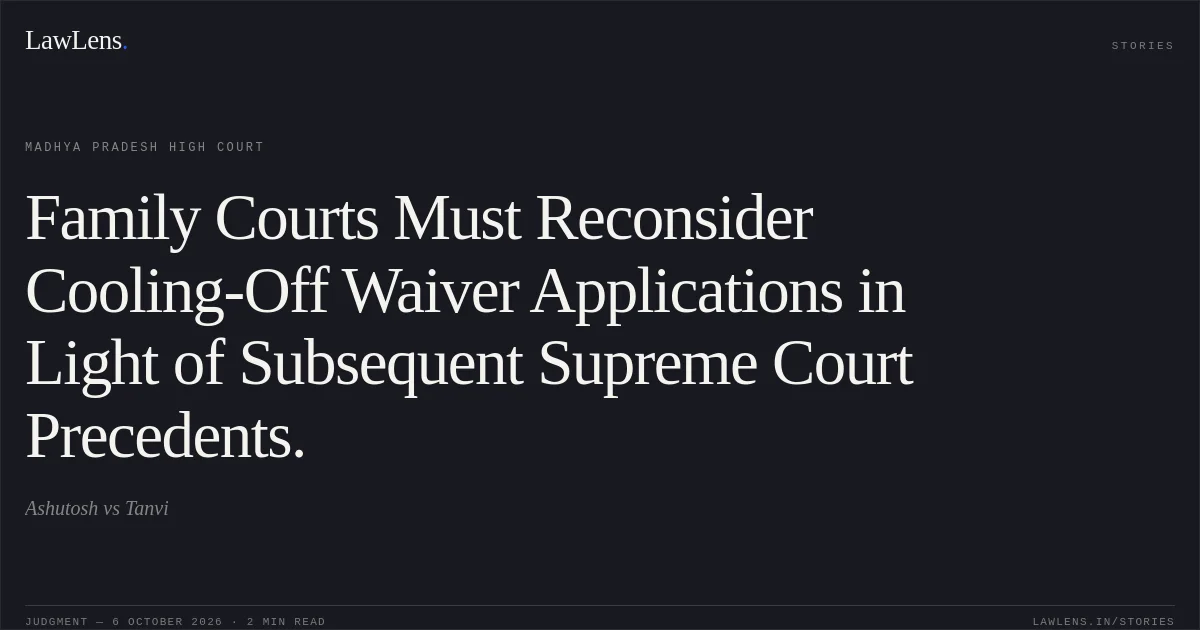
The parties jointly petitioned for divorce by mutual consent under Section 13B of the Hindu Marriage Act, 1955.
Source reference: para. 2–4, 6The Family Court fixed the matter after six months and dismissed an application seeking waiver of the waiting period.
Source reference: para. 2–4, 6The petitioner challenged that dismissal under Article 227, relying on decisions concerning waiver of the statutory period.
Source reference: para. 2–4, 6The High Court noted that the parties had been living separately since April–May 2025.
Source reference: para. 2–4, 6Issues
Whether the Family Court’s order refusing waiver of the six-month period under Section 13B(2) should be set aside for reconsideration in light of the governing precedents.
Source reference: para. 5–7Whether the High Court should itself waive the waiting period or remit the waiver application to the Family Court for fresh consideration.
Source reference: para. 7Law Applied
Section 13B(2) of the Hindu Marriage Act provides for a six-month interval before the second motion in a mutual-consent divorce petition.
Source reference: para. 5In Amardeep Singh v. Harveen Kaur, the Supreme Court held that the period is directory and may be waived where the court is satisfied that waiver is warranted, having regard to factors including the parties’ separation, efforts at mediation or conciliation, settlement of their differences, and whether waiting would prolong their agony.
Source reference: para. 5In Amit Kumar v. Suman Beniwal, the Supreme Court clarified that these factors are illustrative, not exhaustive, and that the court must exercise discretion on the facts of each case.
Source reference: para. 5The High Court also referred to Shiksha Kumari v. Santosh Kumar and its earlier order in M.P. No. 4122 of 2026.
Source reference: para. 5Reasoning
The High Court considered that the dispute concerned waiver of the statutory cooling-off period and that the parties had been living separately since April–May 2025.
Source reference: para. 5–7It found that the Family Court’s order required reconsideration in light of the cited Supreme Court decisions and the principles applied in the earlier High Court order.
Source reference: para. 5–7Rather than determining the waiver application itself, the Court remitted it to the Family Court to decide afresh under those authorities.
Source reference: para. 5–7Holding
The petition was allowed, and the impugned Family Court order was quashed.
The waiver application was remanded to the Family Court for fresh consideration in light of the judgments referred to in M.P. No. 4122 of 2026, preferably within 15 days of receipt of the certified copy of the High Court’s order.
Source reference: para. 7–8The High Court did not itself waive the six-month period.
Source reference: para. 7–8Acts & Sections Cited
3 provisions across 1 statute referred to in this judgment. Linked provisions open on LawLens.
Hindu Marriage Act, 19553
Original Court PDF
AshutoshvsTanvi
Click to open original judgment
Original judgment, available to read, download and summarize on LawLens.in