Facts
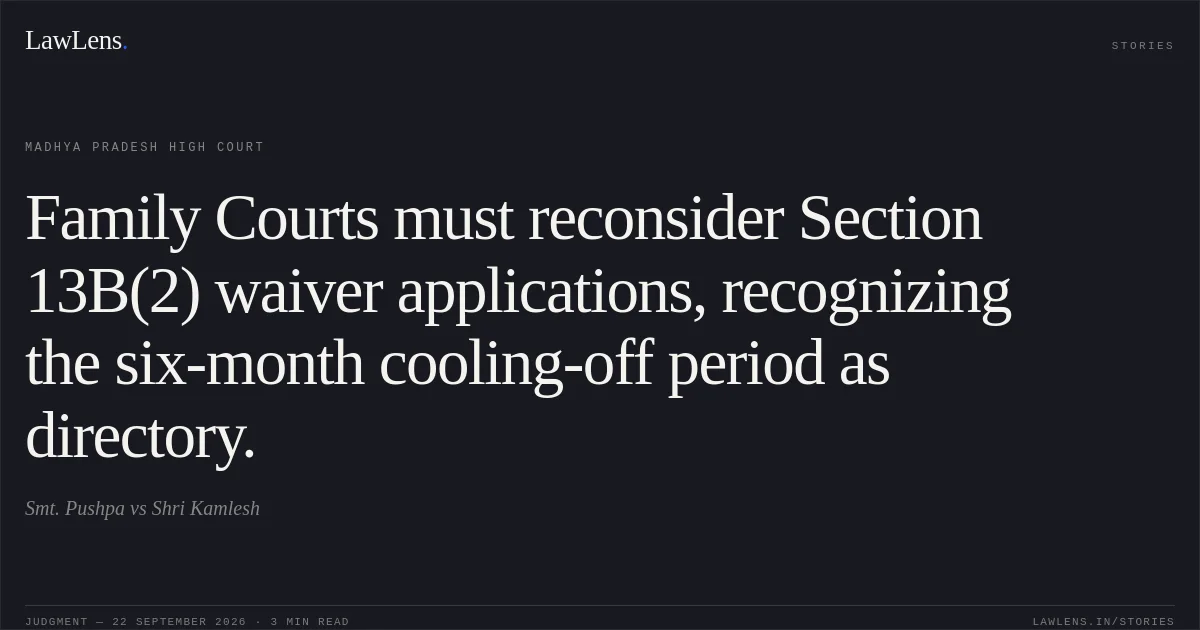
The petitioner and respondent jointly instituted proceedings under Section 13B of the Hindu Marriage Act, 1955, seeking divorce by mutual consent. They also jointly sought waiver of the statutory six-month cooling-off period under Section 13B(2). The Family Court rejected the waiver application by order dated 15 July 2026 in RCS H.M. No. 942/2026.
Source reference: para. 1–3The petitioner consequently invoked the High Court’s supervisory jurisdiction under Article 227 of the Constitution, relying on decisions permitting waiver of the cooling-off period where the marriage had irretrievably broken down and the parties had no possibility of reconciliation. The parties were stated to have been living separately for approximately six years.
Source reference: para. 1–3, 6Issues
Whether the Family Court erred in rejecting the parties’ application for waiver of the six-month cooling-off period under Section 13B(2) of the Hindu Marriage Act, 1955, without considering the law laid down in subsequent Supreme Court decisions?
Source reference: para. 2–6Whether the High Court should itself grant the waiver or remand the matter to the Family Court for reconsideration in accordance with the applicable legal principles?
Source reference: para. 6–7Law Applied
Section 13B(1) of the Hindu Marriage Act, 1955, permits parties to jointly seek dissolution of marriage by mutual consent where they have lived separately for at least one year, have been unable to live together, and mutually agree to dissolve the marriage.
Source reference: para. 5The six-month period under Section 13B(2) is directory rather than mandatory and may be waived in appropriate cases. In Amardeep Singh v. Harveen Kaur, the Supreme Court held that waiver may be considered where the statutory period has substantially elapsed, reconciliation and mediation efforts have failed, the parties have genuinely settled issues such as alimony and custody, and continuation of the waiting period would only prolong their agony.
Source reference: para. 5In Amit Kumar v. Suman Beniwal, the Supreme Court clarified that these factors are illustrative and not exhaustive, and that the court must exercise discretion based on the facts of each case; the conditions in Amardeep Singh are not rigidly mandatory. The High Court also referred to Shiksha Kumari v. Santosh Kumar, a decision of the Delhi High Court, as part of the subsequent legal position on waiver.
Source reference: para. 5Reasoning
The High Court found that the Family Court’s rejection of the waiver application appeared to have been based on the earlier understanding of the law, without considering the subsequent decisions in Amardeep Singh and Amit Kumar, which recognize that the six-month period is directory and may be waived where reconciliation is unlikely and the parties have genuinely settled their disputes.
Source reference: para. 6The fact that the parties had lived separately for approximately six years supported reconsideration of the waiver request. However, instead of granting the waiver directly, the High Court quashed the impugned order and directed the Family Court to reconsider the application in light of the applicable Supreme Court judgments.
Source reference: para. 6–7Holding
The petition was allowed. The Family Court’s order rejecting the application for waiver of the cooling-off period was quashed.
The matter was remanded to the Family Court with a direction to reconsider and decide the waiver application in accordance with Amardeep Singh v. Harveen Kaur, Amit Kumar v. Suman Beniwal, and the principles referred to in the High Court’s earlier order, preferably within fifteen days from receipt of the certified copy of the High Court’s order. The High Court did not itself grant the waiver; it directed expedited reconsideration by the Family Court.
Source reference: para. 7–8Acts & Sections Cited
1 provisions across 1 statute referred to in this judgment. Linked provisions open on LawLens.
Hindu Marriage Act, 19551
Original Court PDF
Smt. PushpavsShri Kamlesh
Click to open original judgment
Original judgment, available to read, download and summarize on LawLens.in