01Facts
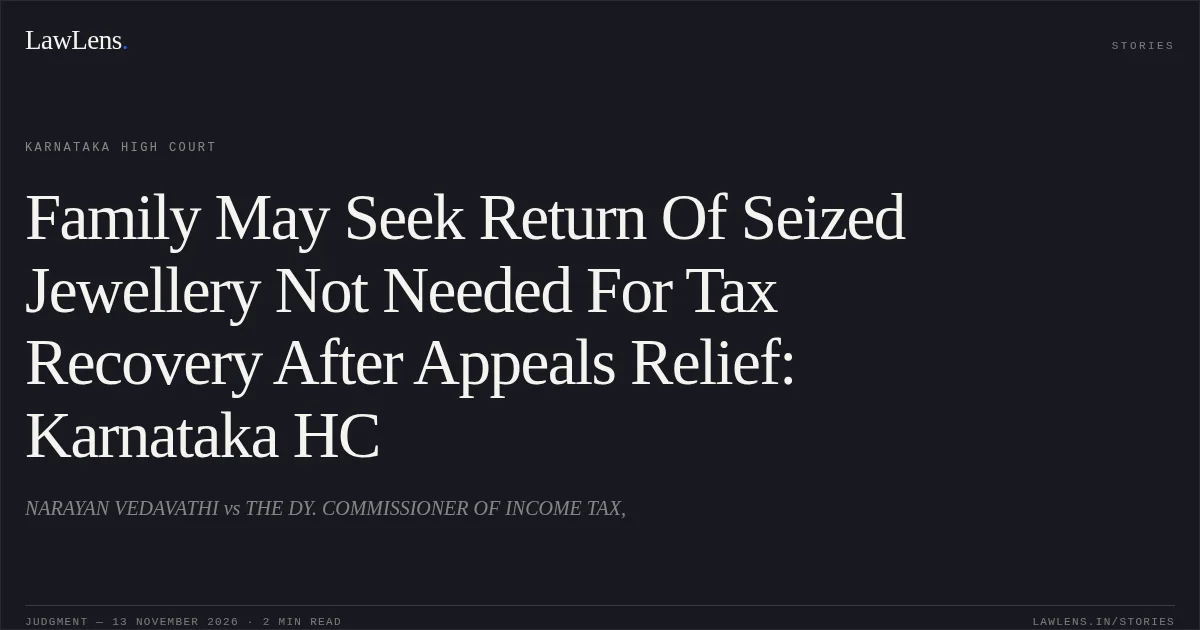
The petitioners sought release of gold, silver and diamond articles seized during Income Tax Act searches in June 2022.
pp. 14–17Their petitions also challenged a CBDT instruction and, in one petition, an assessment order and corrigendum.
pp. 14–17During the proceedings, the petitioners received substantial relief from the CIT (Appeals) and the Income Tax Appellate Tribunal.
pp. 14–17The parties submitted that the petitions could be disposed of by permitting the petitioners to apply to the Principal Commissioner for release of articles, subject to the assessment’s “giving effect to” process and any Revenue appeal.
pp. 14–17The Court did not consider the other grounds raised in the petitions.
p. 2002Issues
i.1. Whether the Court could direct release of the seized articles before the Assessing Officer passed an order giving effect to the appellate decisions, where the articles might be enforced against under Section 132B of the Income Tax Act, 1961.
pp. 17–18ii.2. Whether the petitioners could seek release of articles not required for enforcement by applying to the Principal Commissioner, having regard to the appellate relief granted and the Revenue’s remaining grievance.
pp. 18–1903Law Applied
Section 132B of the Income Tax Act, 1961 governs the application of seized assets towards tax liabilities and permits enforcement against seized articles in accordance with the provision.
p. 17Where the statute allows the Assessing Officer time to pass an order giving effect to appellate decisions, the Court should not restrict that statutory timeline; release of seized assets cannot be directed before that process is completed where the assets may be required for enforcement.
pp. 17–18Provisions in the judgment · 2
Income Tax Act, 1961 Section 132Section 132B
04Reasoning
The Court declined to order immediate release because the Assessing Officer had not yet passed the giving-effect order, and the seized articles might be required for enforcement under Section 132B.
p. 17It also held that the statutory time available to the Assessing Officer could not be curtailed.
p. 18However, given the relief granted by the CIT (Appeals) and the Tribunal, the Principal Commissioner was to consider whether articles not required for enforcement could be released, taking account of the Revenue’s grievance.
pp. 18–19The Court left the petitioners’ other grounds undecided.
p. 2005Holding
The petitions were disposed of without an immediate release direction.
p. 19The petitioners were granted liberty to apply to the Principal Commissioner for release of seized articles that may not be required for enforcement, in light of the appellate relief and the Revenue’s position.
p. 19If an application is made within one week of receipt of a certified copy of the order, the Principal Commissioner must consider it in accordance with the Court’s observations and communicate the decision within two months from receipt of the certified copy.
p. 20The petitioners may also provide the order to the jurisdictional Assessing Officer for the giving-effect process.
p. 20The other grounds were not considered.
p. 20Original Court PDF
NARAYAN VEDAVATHIvsTHE DY. COMMISSIONER OF INCOME TAX,
Click to open original judgment
Original judgment, available to read, download and summarize on LawLens.in