01Facts
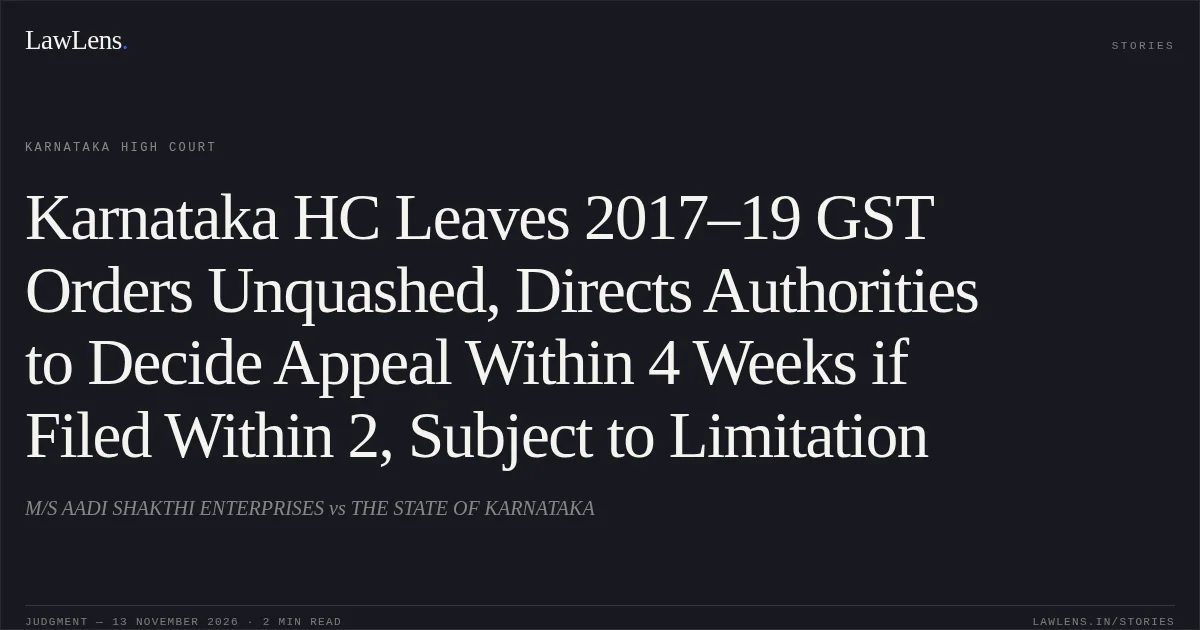
The petitioner challenged adjudication orders under Section 73 of the CGST/KGST Acts for 2017–18 and 2018–19, a DRC-07 demand for 2018–19, and a DRC-13 recovery demand for 2017–18.
pp. 2–4, 10–11It contended that the turnover reflected in Form 26AS included pre-GST transactions and relied on this Court’s directions in Chandrashekharaiah v. State of Karnataka concerning the tax adjustment for works spanning the pre-GST and GST periods.
pp. 2–4, 10–11The petitioner also sought liberty to appeal under Section 107.
p. 1102Issues
i.1. Whether the petitioner was entitled to the benefit of the directions in Chandrashekharaiah concerning the calculation of pre-GST and post-GST work and the consideration of representations.
pp. 4–10ii.2. Whether the petitioner could pursue a statutory appeal against the impugned assessment orders, and on what terms.
p. 1103Law Applied
Section 73 of the CGST/KGST Acts provides the basis for adjudication of tax demands, while Section 107 provides the statutory appeal mechanism.
p. 2, 11In Chandrashekharaiah v. State of Karnataka (order dated 11 April 2023), the Court set out directions for identifying pre-GST work and payments, calculating the balance work after 1 July 2017, and considering representations on the resulting tax difference.
pp. 6–8The Division Bench in Office of Principal Commissioner GST and Central Excise v. R. Chandrashekhar held that GST liability must be determined under the applicable statutes and set aside directions to tax authorities concerning matters such as revised returns, waiver of interest or penalty, and limitation; directions concerning reimbursement of incremental tax were confined to the contractual relationship between the contractor and the employer.
pp. 9–10Provisions in the judgment · 4 · Linked ones open on LawLens
Central Goods and Services Tax Act, 2017 Section 73Section 107
KARNATAKA GOODS AND SERVICES TAX ACT, 2017 Section 73Section 107
04Reasoning
In light of the Division Bench decision, the Court applied only the surviving directions from Chandrashekharaiah: those concerning calculation of pre- and post-GST work, submission and consideration of representations, and liberty to challenge subsequent decisions.
pp. 10–11It did not grant the directions that the Division Bench had set aside or determine the merits of the petitioner’s challenge to the assessment orders.
pp. 10–11Instead, it preserved the petitioner’s statutory remedy under Section 107, subject to the applicable limitation requirements.
pp. 10–1105Holding
The writ petition was disposed of by extending to the petitioner the applicable directions in Chandrashekharaiah, as limited by the Division Bench ruling.
pp. 10–11The petitioner was given liberty to file a Section 107 appeal within two weeks; the authorities were directed to consider an appeal filed within that period within four weeks, subject to the Act and its limitation requirements.
pp. 10–11The petitioner remained at liberty to challenge the assessment orders in appropriate proceedings, and the time spent pursuing the writ petition was not to be taken into account for that purpose.
pp. 10–11Original Court PDF
M/S AADI SHAKTHI ENTERPRISESvsTHE STATE OF KARNATAKA
Click to open original judgment
Original judgment, available to read, download and summarize on LawLens.in