01Facts
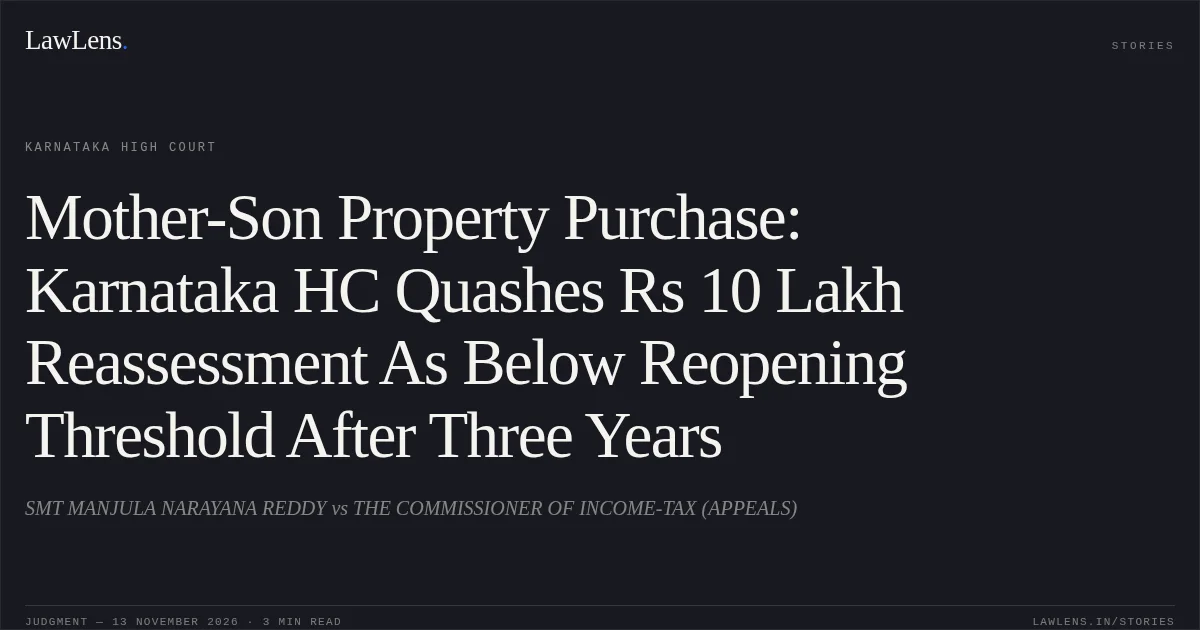
The petitioner and her son jointly purchased an immovable property for approximately ₹60 lakh under a sale deed dated 24 March 2016.
pp. 4–6, 8–9In response to a notice under Section 142(1), the petitioner stated that her son had funded ₹50 lakh through a salary-based loan and that the remaining ₹10 lakh came from family savings.
pp. 4–6, 8–9She did not respond to subsequent notices or provide supporting documents during the assessment proceedings.
pp. 4–6, 8–9The Assessing Officer made a best-judgment assessment under Sections 147 and 144 read with Section 144B on 12 March 2024, adding ₹10 lakh as unexplained; the assessment did not treat the full ₹60 lakh as escaped income.
pp. 4–6, 8–9The petitioner’s appeal was rejected as delayed by 189 days, with the appellate authority relying in part on her having answered “NO” to the Form 35 question about delay.
p. 7The petitioner filed these writ petitions challenging the appellate order and a penalty order.
pp. 7–8The judgment gives inconsistent dates for the penalty order: its narrative refers to 29 September 2025 and 29 September 2026, while the operative table identifies 27 August 2024.
pp. 7–8, 1102Issues
i.1. Whether the Court should restore the appeal for reconsideration in light of the dismissal of the appeal as time-barred.
pp. 7–8ii.2. Whether the reassessment under Sections 147 and 144 read with Section 144B could stand when the assessment ultimately treated only ₹10 lakh—not the initially alleged ₹60 lakh—as escaped income, an amount below the threshold the Court considered applicable for reassessment after three years.
pp. 8–10iii.3. Whether the consequential penalty order should also be quashed.
pp. 7–8, 1103Law Applied
The Court considered Sections 147, 144, 144B and 149 of the Income-tax Act, 1961.
pp. 8–10It treated Section 149 as limiting reassessment after three years where the amount of income chargeable to tax that had escaped assessment fell below the applicable threshold.
pp. 8–10Applying that principle, the Court reasoned that the reassessment could not stand where the assessment ultimately concerned only ₹10 lakh, although the proceedings had initially been commenced on the basis of alleged escaped income of approximately ₹60 lakh.
pp. 8–10The appellate authority had invoked Section 249(3) in considering whether sufficient cause existed to condone the appeal delay, but the Court did not decide that issue on its merits.
p. 7No precedent is cited in the order.
Provisions in the judgment · 9
Income Tax Act, 1961 9 provisions
Section 250Section 25Section 147Section 144Section 144BSection 148Section 142Section 249Section 14904Reasoning
The Court noted that the reassessment proceedings began on the footing that ₹60 lakh had escaped assessment, but the Assessing Officer accepted that ₹50 lakh was funded by the petitioner’s son and assessed only the remaining ₹10 lakh.
pp. 8–9Because that assessed amount was below the threshold which, in the Court’s view, permitted reassessment after three years, the Court considered it preferable to resolve the matter directly rather than restore the appeal for reconsideration.
pp. 9–10The Court also referred to material placed before the appellate authority, including a joint bank-account statement and cheque details relating to payments to the seller, in reaching its conclusion.
pp. 10–1105Holding
The Karnataka High Court allowed both writ petitions and quashed the assessment order dated 12 March 2024 under Sections 147 and 144 read with Section 144B, as well as the penalty order under Section 271(1)(c) identified in the operative table as dated 27 August 2024.
p. 11The Court therefore did not remit the matter for reconsideration of the delayed appeal.
p. 11Original Court PDF
SMT MANJULA NARAYANA REDDYvsTHE COMMISSIONER OF INCOME-TAX (APPEALS)
Click to open original judgment
Original judgment, available to read, download and summarize on LawLens.in