Facts
Smt. Shashi applied under Section 372 of the Indian Succession Act for a certificate concerning her claimed share in the service benefits of late Sushil Kumar.
Source reference: para. 2She claimed to be his legally wedded wife; the opposing parties asserted that minor Dev Sehgal was the deceased’s son.
Source reference: para. 2The trial court found Shashi to be the legally wedded wife and Dev to be the deceased’s son, directed family pension to be paid for Dev through his guardian, and allocated other benefits among Shashi, Sona Devi and Dev.
Source reference: para. 3Shashi appealed the order insofar as it recognised Dev’s entitlement to the benefits.
Source reference: para. 1, 4Issues
1. Whether a court deciding an application under Section 372 of the Indian Succession Act may finally determine entitlement to family pension and other service or retiral benefits by reference to the parties’ status as legal heirs
Source reference: para. 82. Whether the finding that Dev was the deceased’s son, by itself, entitled him to family pension or other service benefits, irrespective of the applicable service rules
Source reference: para. 20–21Law Applied
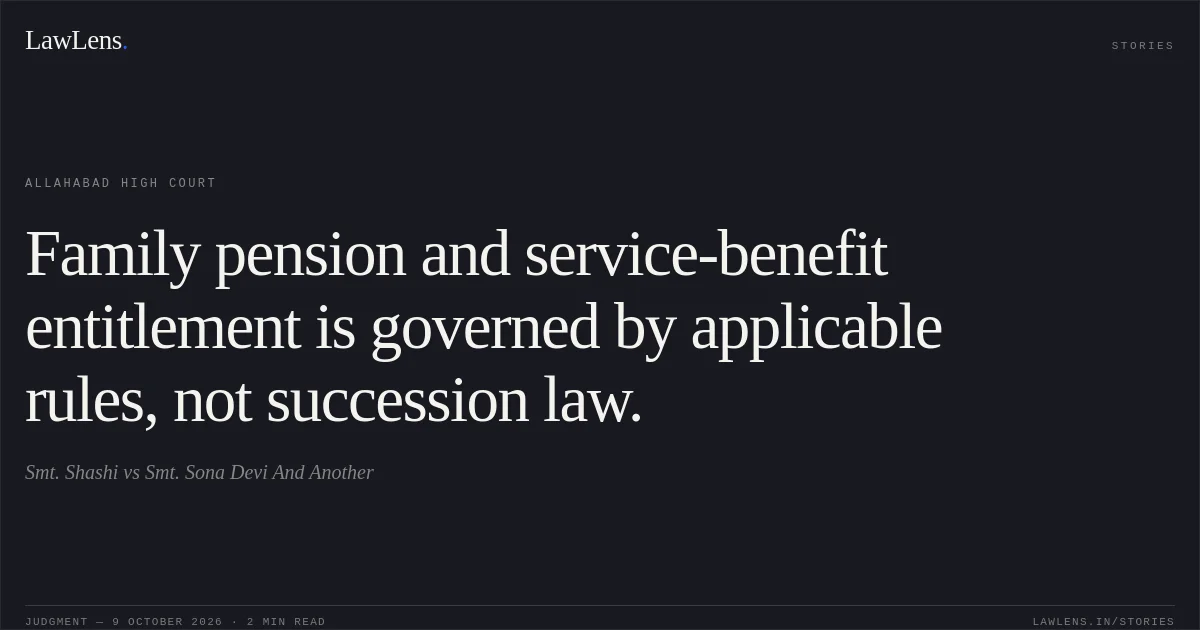
A succession certificate under Part X of the Indian Succession Act principally concerns debts and securities; where a benefit is created and regulated by statutory service rules, entitlement must be determined under those rules rather than solely by general succession law.
Source reference: para. 10, 18Family pension is not part of the deceased’s estate and is payable to the person designated by the applicable rules (Jodh Singh v. Union of India, AIR 1980 SC 2081; Smt. Violet Issac v. Union of India, (1991) 1 SCC 725).
Source reference: para. 13–14, 19Section 6(g) of the Transfer of Property Act, 1882, reflects the special character of specified pensions, while Section 7(4) of the Payment of Gratuity Act, 1972, provides for determination of disputes about the person entitled to gratuity by the competent authority.
Source reference: para. 15–16The court also referred to the meaning of “debt” in Dina Nath v. Balkrishna, AIR 1963 All 46.
Source reference: para. 18A person’s status as a legal heir does not, without more, establish entitlement to each service benefit.
Source reference: para. 12, 17Reasoning
The trial court’s findings that Shashi was the deceased’s wife and Dev his son did not determine who was eligible for each benefit under the governing service rules.
Source reference: para. 20In particular, Dev’s status as the deceased’s son could not, by itself, confer a right to family pension contrary to those rules.
Source reference: para. 20Because the trial court was exercising jurisdiction under Section 372, it was not justified in finally allocating family pension and other service benefits solely on the basis of heirship.
Source reference: para. 18, 20–21The competent department must decide the rival claims under the rules applicable to each benefit.
Source reference: para. 18, 20–21Holding
The appeal was allowed.
The trial court’s order was set aside to the extent that it finally determined entitlement to family pension and other service benefits.
Source reference: para. 21–22The competent authority was directed to reconsider the claims under the applicable rules, independently and uninfluenced by the trial court’s findings on ultimate entitlement; aggrieved claimants may pursue remedies available in law.
Source reference: para. 21–22Acts & Sections Cited
5 provisions across 4 statutes referred to in this judgment. Each provision opens on LawLens.
Hindu Marriage Act, 19552
Code of Criminal Procedure, 19731
Indian Succession Act, 19251
Transfer of Property Act, 18821
Original Court PDF
Smt. ShashivsSmt. Sona Devi And Another
Click to open original judgment
Original judgment, available to read, download and summarize on LawLens.in