Facts
Opposite Party No. 2, Tumpa Pramanick, initiated proceedings under Section 125 CrPC in 2005 seeking maintenance for herself and her minor son, Sudipta Pramanick (Opposite Party No. 3). Although the wife’s claim was rejected because her marriage with the petitioner was held void due to the petitioner’s subsisting prior marriage, the Trial Court granted the son maintenance of Rs. 3,000 per month, recognising his entitlement as a minor child with disability.
Source reference: para. 3–4The petitioner’s challenge to that order was dismissed by the High Court in CRR No. 77 of 2014 on 22 November 2016.
Source reference: para. 4After the son attained majority, the mother filed an application under Section 127 CrPC in Misc. Case No. 388 of 2018 seeking continuation or modification of maintenance, asserting that the son suffered from 70%–75% orthopaedic disability and remained unable to maintain himself.
Source reference: para. 5The petitioner sought dismissal of the proceedings on the grounds that the son’s majority terminated the earlier entitlement, that the mother lacked locus standi to represent him, and that the son’s education, ITI training, and ability to move independently demonstrated capacity for self-support.
Source reference: para. 5, 7, 9The Magistrate rejected these objections by orders dated 31 March 2022 and 10 January 2023. The petitioner challenged those orders in the present revision under Sections 407 and 482 CrPC.
Source reference: para. 6Issues
Whether the father’s obligation to maintain a child under Section 125(1)(c) CrPC automatically terminates upon the child attaining majority despite the child’s established physical disability and inability to maintain himself?
Source reference: para. 16Whether the mother could maintain an application under Section 127 CrPC on behalf of a major son suffering from substantial physical disability?
Source reference: para. 16, 19Whether the absence of affidavits of assets and liabilities under Rajnesh v. Neha and Aditi alias Mithi v. Jitesh Sharma vitiated the interlocutory orders concerning maintainability of the Section 127 proceedings?
Source reference: para. 16, 20Whether the impugned orders suffered from illegality, material irregularity, perversity, or jurisdictional error warranting revisional interference?
Source reference: para. 16, 23Law Applied
The Court applied Section 125(1)(c) CrPC, including the statutory protection available to a major child who, owing to physical or mental abnormality or injury, is unable to maintain himself.
Source reference: para. 18Section 127 CrPC permits alteration, continuation, or cancellation of a maintenance allowance upon a change in circumstances; attainment of majority accompanied by continuing disability may therefore be considered in a Section 127 proceeding rather than requiring an entirely fresh claim.
Source reference: para. 18, 22The Court further applied the principle that a parent or close relative may act as a next friend or representative of a disabled adult to secure access to justice.
Source reference: para. 19The disclosure requirements recognised in Rajnesh v. Neha, (2021) 2 SCC 324, and Aditi alias Mithi v. Jitesh Sharma, (2024) 14 SCC 355, principally govern assessment of financial capacity and quantum in maintenance disputes and do not automatically invalidate a threshold order concerning continuation of an already adjudicated maintenance entitlement.
Source reference: para. 20Revisional jurisdiction is warranted only where the subordinate court’s order discloses patent illegality, material irregularity, perversity, or jurisdictional error.
Source reference: para. 22–23Reasoning
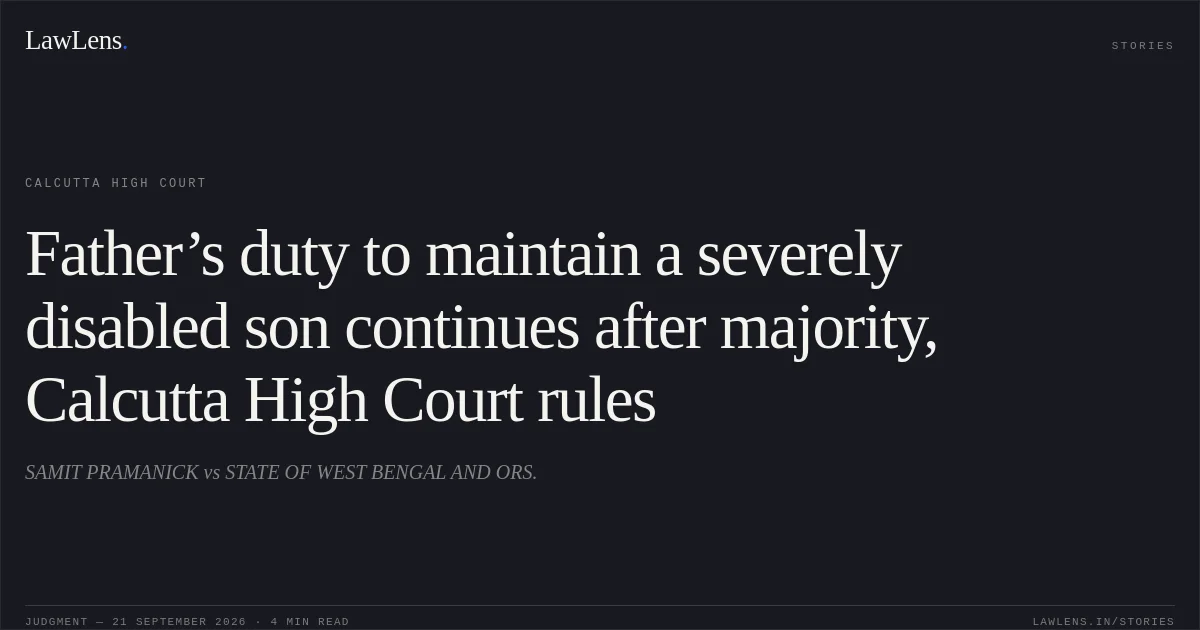
The Court held that majority did not, by itself, extinguish the son’s entitlement because Section 125(1)(c) expressly protects a major child unable to maintain himself due to physical abnormality or injury.
Source reference: para. 18The son’s recorded 70%–75% orthopaedic disability constituted substantial material supporting continuation of maintenance.
Source reference: para. 18–19His ability to walk independently, complete Higher Secondary education, or pursue ITI training did not establish gainful employment or financial self-sufficiency.
Source reference: para. 18–19The mother was therefore competent to prosecute the claim as the son’s next friend, particularly in view of his substantial disability.
Source reference: para. 19The Court also found that the Rajnesh and Aditi disclosure requirements could not be used to defeat the maintainability of the Section 127 proceeding, which concerned continuation of the previously fixed maintenance of Rs. 3,000 per month rather than a fresh determination based on increased income.
Source reference: para. 20The petitioner’s repeated objections were treated as obstructive and insufficient to demonstrate any jurisdictional or legal error in the Magistrate’s orders.
Source reference: para. 21–22Holding
The Court answered the issues against the petitioner. It held that maintenance under Section 125(1)(c) CrPC may continue after majority where the child remains physically disabled and unable to maintain himself; the mother may represent such a disabled adult in proceedings under Section 127 CrPC; and the absence of fresh assets-and-liabilities affidavits did not invalidate the impugned interlocutory orders.
The revision was dismissed, and the orders dated 31 March 2022 and 10 January 2023 were affirmed.
Source reference: para. 23–25Interim orders, if any, were vacated, and the Trial Court was directed to expedite the pending execution proceedings, secure payment of arrears and costs, and proceed with the evidence without granting unwarranted adjournments.
Source reference: para. 26–28There was no order as to costs.
Source reference: para. 29Acts & Sections Cited
5 provisions across 1 statute referred to in this judgment. Each provision opens on LawLens.
Code of Criminal Procedure, 19735
Original Court PDF
SAMIT PRAMANICKvsSTATE OF WEST BENGAL AND ORS.
Click to open original judgment
Original judgment, available to read, download and summarize on LawLens.in