01Facts
The Food Corporation of India (FCI) awarded the petitioner a contract for handling and transporting food grains from Cossimbazar Railway siding. After a rice consignment was found to have a transit shortage, FCI deducted ₹2,73,040 from the petitioner’s bills.
¶ 2–5, 13–16FCI relied on its tender terms, a joint verification and a subsequent investigation, but the petitioner was neither invited to participate in the verification nor given a show-cause notice or hearing before the deduction.
¶ 2–5, 13–16The petitioner challenged the deduction by writ petition; FCI argued that the General Manager’s decision was final under the contract and that the petitioner should first have approached the contractual Dispute/Grievance Redressal Committee.
¶ 6–802Issues
i.Whether FCI’s decision to deduct the alleged transit-loss amount, made without notice or an opportunity to be heard, violated the principles of natural justice
¶ 14–17ii.Whether the contractual provisions making the General Manager’s decision final, and providing for a grievance committee, justified the deduction or required the petitioner to pursue that remedy before seeking writ relief
¶ 8, 11, 17, 2403Law Applied
Under Clause X of the tender, FCI could recover losses attributed to the contractor, and the General Manager was designated to determine liability and quantify the loss; Clause XVIII provided for referral of contractual disputes to a Dispute/Grievance Redressal Committee.
¶ 11Those provisions did not dispense with natural justice: an administrative decision with civil consequences must ordinarily be preceded by notice and a meaningful opportunity to be heard. The Court relied on Mohinder Singh Gill v. Chief Election Commissioner on the scope of civil consequences;
¶ 18Central Inland Water Transport Corporation v. Brojo Nath Ganguly on the impermissibility of unguided decision-making that excludes a hearing;
¶ 19Dharampal Satyapal Ltd. v. CCE on the application of natural justice to administrative action and the relevance of prejudice.
¶ 20–22It also relied on H.L. Trehan v. Union of India concerning the inadequacy of post-decisional hearings.
¶ 23Provisions in the judgment · 1
the Act (alias, unresolved) Section 29
04Reasoning
Although the contract empowered the General Manager to assess and quantify loss, FCI conducted the verification and investigation without involving the petitioner and made the deduction without issuing notice or affording a hearing.
¶ 13–17The decision therefore violated natural justice; the contractual finality provision did not authorise FCI to bypass that requirement.
¶ 17The Court found no applicable exception to the hearing requirement.
¶ 22Nor would remand for a later hearing or referral to the grievance committee cure the prejudice: after the passage of time, the grain had been used and the relevant evidence irretrievably lost, making a fresh determination an idle formality.
¶ 2405Holding
The Court held that FCI’s decision-making process was procedurally improper and set aside the decision contained in the letter dated 3 April 2024, together with consequential steps.
¶ 26FCI was directed to release ₹2,73,040 to the petitioner within two weeks of communication of the order, with interest at 8% per annum from the date of deduction until payment. The writ petition was allowed, with costs of ₹10,000 payable to the petitioner.
¶ 26–27Original Court PDF
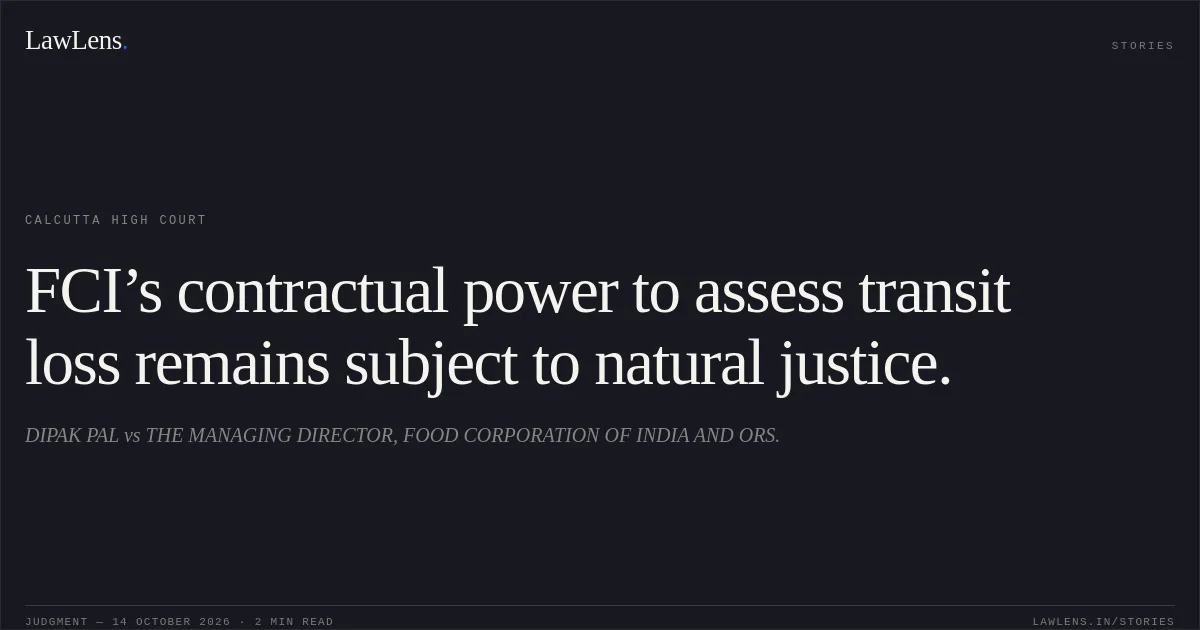
DIPAK PALvsTHE MANAGING DIRECTOR, FOOD CORPORATION OF INDIA AND ORS.
Click to open original judgment
Original judgment, available to read, download and summarize on LawLens.in