Facts
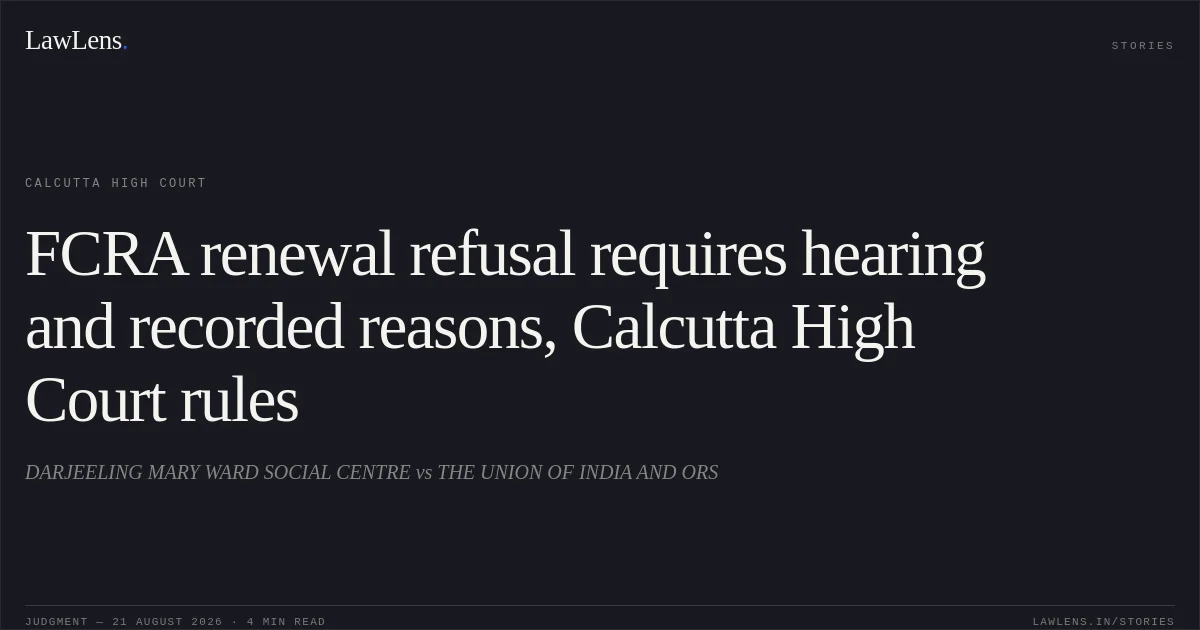
The petitioner, a society registered under the West Bengal Societies Registration Act, 1961, held a certificate of registration under Section 12 of the Foreign Contribution (Regulation) Act, 2010 (“FCRA”), dated 6 August 2021, valid for five years.
Source reference: para. 1–2Before expiry of the certificate, it applied for renewal under Section 16 of the FCRA.
Source reference: para. 3, 18By order dated 28 July 2026, the competent authority refused renewal, purportedly under Section 12(2), relying on grounds concerning the petitioner’s organisational character and its memorandum of association, and further directed that unutilised foreign contribution and assets created from such contribution would vest in the prescribed authority until a fresh certificate was obtained.
Source reference: para. 3, 7, 10, 27The petitioner challenged the refusal, alleging non-application of mind, reliance on an inapplicable statutory provision, absence of a reasoned determination under Section 16, and lack of jurisdiction to direct vesting of funds and assets.
Source reference: para. 12–17The Union of India opposed the writ petition on the ground of an alternative statutory remedy under Section 32 and defended the order as reasoned and lawful.
Source reference: para. 12–17Issues
1. Whether the writ petition was maintainable despite the alternative remedy of revision under Section 32 of the FCRA?
Source reference: para. 13, 29–312. Whether the competent authority could refuse renewal under Section 16 without conducting a proper inquiry, recording satisfaction on the statutory requirements, and affording the petitioner an opportunity of hearing?
Source reference: para. 20–243. Whether refusal of renewal could validly be made under Section 12(2), rather than Section 16, and whether the authority had jurisdiction to direct vesting of unutilised foreign contribution and assets in the prescribed authority?
Source reference: para. 26–28Law Applied
The Court applied Section 16 of the FCRA, which governs renewal of certificates, requires the Central Government to examine whether the applicant satisfies the conditions under Section 12(4), and permits refusal of renewal where the applicant has violated the Act or Rules, subject to a reasoned determination.
Source reference: para. 19–24The Court held that where an inquiry is undertaken affecting the applicant’s valuable statutory entitlement, the principles of natural justice—including notice and an opportunity of hearing—are implicit in the provision.
Source reference: para. 21It further held that statutory discretion must be exercised on relevant materials with recorded satisfaction and reasons.
Source reference: para. 20, 24–26The Court distinguished the consequences of non-renewal from those arising upon cancellation or surrender, holding that vesting of foreign contribution and assets is governed by Section 15 in the context of cancellation under Section 14 or surrender under Section 14A, and is not a consequence prescribed by Section 16 merely because renewal is refused.
Source reference: para. 27On alternative remedy, the Court relied on Godrej Sara Lee Ltd. v. Excise and Taxation Officer-cum-Assessing Authority, 2023 SCC OnLine SC 95, and the exceptions recognised in State of U.P. v. Mohd. Nooh, Whirlpool Corporation v. Registrar of Trade Marks, and Assistant Commissioner of State Tax v. Commercial Steel Ltd., under which a writ may be entertained where there is a jurisdictional error, violation of natural justice, or an order wholly contrary to statute.
Source reference: para. 30Reasoning
The Court found that the petitioner had held a valid FCRA certificate and had applied for renewal within the prescribed period, and that the matter was neither one of suspension nor cancellation.
Source reference: para. 18Since Section 16 required the authority to assess the statutory conditions afresh and permitted refusal only upon a finding of violation supported by reasons, the authority was required to conduct a meaningful inquiry and provide the petitioner an opportunity to explain the relevant materials.
Source reference: para. 20–24The impugned order contained only vague findings and failed to record the requisite satisfaction based on the statutory criteria.
Source reference: para. 26Its reference to Section 12(2) for refusing renewal demonstrated a clear non-application of mind, while the direction regarding vesting of funds and assets imposed consequences belonging to the cancellation or surrender framework under Section 15, not to non-renewal under Section 16.
Source reference: para. 27These defects constituted an apparent jurisdictional error and illegality requiring no further factual investigation; consequently, the alternative remedy under Section 32 did not bar the writ petition.
Source reference: para. 28–31Holding
The writ petition was held maintainable notwithstanding the alternative statutory remedy.
The order dated 28 July 2026 refusing renewal was quashed and set aside as jurisdictionally erroneous and illegal.
Source reference: para. 32The competent authority was directed to reconsider the petitioner’s renewal application, after granting an opportunity of hearing and passing a reasoned order strictly in accordance with law, within six weeks from communication of the judgment.
Source reference: para. 33The Court expressly left the merits of the renewal application open and permitted the petitioner to rely on relevant records and documents within the scope of its existing application.
Source reference: para. 34The writ petition was accordingly allowed without costs.
Source reference: para. 36Acts & Sections Cited
8 provisions across 1 statute referred to in this judgment. Each provision opens on LawLens.
Foreign Contribution (Regulation) Act, 20108
Original Court PDF
DARJEELING MARY WARD SOCIAL CENTREvsTHE UNION OF INDIA AND ORS
Click to open original judgment
Original judgment, available to read, download and summarize on LawLens.in