01Facts
The petitioner, Chandrashekar P. Kuppi, is the Principal of Sharada Ayurvedic Medical College and Hospital, Yadgir, and is also described as Secretary of Shri Basava Education Charitable and Social Welfare Trust.
pp. 1–2 · p. 3The College operates a bank account (No. 718402010004107) with Respondent No. 1, Union Bank of India.
p. 2Respondent No. 3, Smt. Nagaratna Kuppi, claims to be a trustee-cum-Vice President, and there is a dispute among the trustees.
¶ 5 · pp. 9–10The petitioner claims that the earlier Principal was removed and that he alone should operate the account as Principal.
¶ 7 · p. 12The Bank, by communications dated 25.08.2023 and 22.07.2024, stated that the account had earlier been operated on two signatures and remained frozen. The petitioner did not challenge these communications.
¶ 8 · pp. 12–13By order dated 11.09.2024, the Court permitted the petitioner to operate the account to disburse salaries to 23 staff as certified by a Chartered Accountant, subject to conditions. Those conditions included an indemnity from Respondent No. 2 and a direction not to pay disputed past dues.
¶ 5 · pp. 7–11On 07.01.2025, the Court restrained the petitioner from drawing any amount from the account in his own name, noting that he was allegedly exploiting the interim order.
¶ 6 · pp. 11–12WP No. 200241/2025 seeks a mandamus directing the State and the Deputy Commissioner to take over the College's management by appointing an administrator pending resolution of the trustees' dispute.
pp. 3–4 · ¶ 11 · p. 1402Issues
i.1. Whether the petitioner, acting alone as Principal, is entitled to a writ of mandamus directing the Bank to de-freeze the College account and to operate it, and whether the Bank may be restrained from utilising its funds to clear a trust loan.
¶ 4 · pp. 6–7 · ¶ 8–9 · pp. 13–14ii.2. Whether a writ of mandamus can issue to the State to take over the management of a privately run trust college by appointing an administrator pending resolution of inter-trustee disputes.
¶ 11–12 · pp. 14–1503Law Applied
The judgment cites no statute or binding precedent by name.
The writ petitions were filed under Article 226 of the Constitution of India.
pp. 2–3The monies in the trust's bank accounts belong to the trust, and the dispute among trustees is to be resolved inter se.
¶ 5, order dated 11.09.2024 · ¶ 8 · p. 10Where trustees are in serious dispute, a single trustee should not be permitted to operate the account alone; joint operation by the trustees, with the Bank's consent, is the appropriate course.
¶ 9 · p. 14A writ of mandamus cannot issue to the State to appoint an administrator where the trust is purely private.
¶ 12 · p. 1504Reasoning
The Court first noted that the petitioner did not challenge the Bank's letters maintaining the freeze, and that the account had historically required two signatories.
¶ 8 · pp. 12–13Given the "serious dispute between the Trustees," the Court held that it would not be appropriate for the petitioner to operate the account alone.
¶ 9 · p. 14The Court left the operational route open: the petitioner and Respondent No. 3 may jointly approach the Bank, which must consider the request and permit joint operation. This resolved WP No. 202175/2024 without granting the relief the petitioner sought.
¶ 9 · p. 14The Court's earlier interim orders, which treated the trust's funds as trust property and permitted only certified salary payments, supported this result.
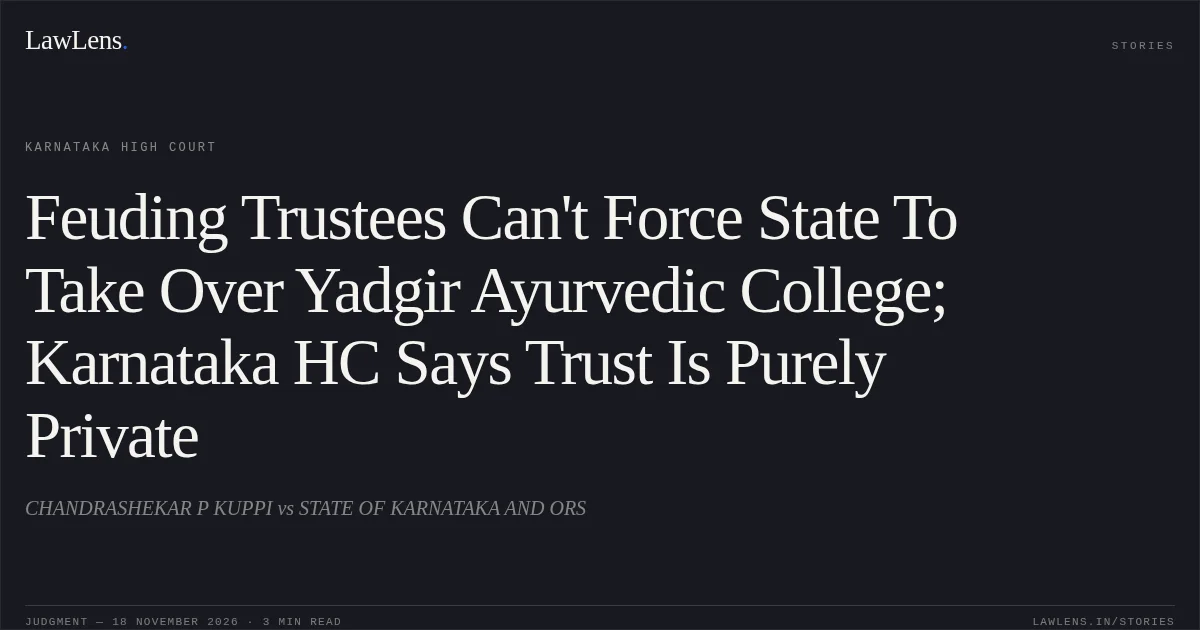
¶ 5 · pp. 10–11 · ¶ 6 · pp. 11–12On WP No. 200241/2025, the Court held that no mandamus could issue to the State to appoint an administrator because the trust was "purely a private Trust."
¶ 12 · p. 15The Court rejected the petition and left the petitioner to pursue remedies available in law.
¶ 13 · p. 1505Holding
The Court held that the petitioner could not operate the College account alone given the trustees' dispute.
¶ 9–10 · p. 14WP No. 202175/2024 was disposed of with liberty to the petitioner and Respondent No. 3 to jointly seek the Bank's permission to operate the account, which the Bank was directed to consider.
¶ 9–10 · p. 14WP No. 200241/2025 was rejected, the Court holding that no writ of mandamus lies to the State to appoint an administrator for a purely private trust, and granting liberty to pursue remedies available in law.
¶ 12–13 · p. 15No order as to costs was made. The Court did not decide the merits of the trustees' inter se dispute.
¶ 13 · p. 15Original Court PDF
CHANDRASHEKAR P KUPPIvsSTATE OF KARNATAKA AND ORS
Click to open original judgment
Original judgment, available to read, download and summarize on LawLens.in