Facts
The petitioners claimed title over lands in S.F. Nos.447 and 483, Ariyalur, through an ancestral chain and a registered partition deed dated 16 July 1955. Their suits for declaration of title and consequential alteration of revenue records were decreed by the trial court on 30 April 2008; the decrees were affirmed by the first appellate court, the High Court in second appeal, and the Supreme Court, which dismissed the State’s Special Leave Petitions on 25 July 2022.
Source reference: pp.2–4Although the petitioners thereafter sought issuance of patta, the Commissioner of Land Administration rejected their request on 25 October 2023. That order was quashed by the High Court on 8 November 2024, with a direction to issue patta within two weeks. The writ appeal was dismissed on 23 April 2025, and a separate civil contempt petition alleging non-compliance remained pending.
Source reference: p.4During a four-week compliance period granted by the Division Bench on 12 March 2026, the respondents instituted a fresh civil suit seeking, inter alia, a declaration that the 2008 decrees were null and void on grounds of fraud and that the quashed rejection order was valid. After the plaint was returned twice, the High Court directed its numbering in C.R.P. No.2317 of 2026.
Source reference: pp.5–6The petitioners approached the Advocate General under Section 15(1)(b) of the Contempt of Courts Act, 1971, seeking consent to initiate criminal contempt proceedings. The matter was referred to the Bench without consent being granted or refused.
Source reference: p.6Issues
Whether the respondents’ alleged failure to issue patta, despite the civil decrees and writ directions, constituted criminal contempt under the Contempt of Courts Act, 1971, rather than civil contempt?
Source reference: p.7Whether the institution of a fresh civil suit challenging the final decrees and a quashed executive order amounted to criminal contempt by scandalising the court, prejudicing judicial proceedings, or obstructing the administration of justice?
Source reference: pp.6–7Whether the petitioners should instead pursue the civil remedy of rejection of the plaint under Order VII Rule 11 of the Code of Civil Procedure, 1908?
Source reference: p.8Law Applied
The Court applied Section 2(b) of the Contempt of Courts Act, 1971, which defines civil contempt as wilful disobedience of a judgment, decree, direction, order, writ, or undertaking; such non-compliance is distinct from criminal contempt.
Source reference: p.7Section 2(c) defines criminal contempt as conduct that scandalises or lowers the authority of a court, prejudices or interferes with judicial proceedings, or obstructs the administration of justice.
Source reference: p.7Section 15(1)(b) governs initiation of criminal contempt proceedings on a motion by a private person with the written consent of the Advocate General.
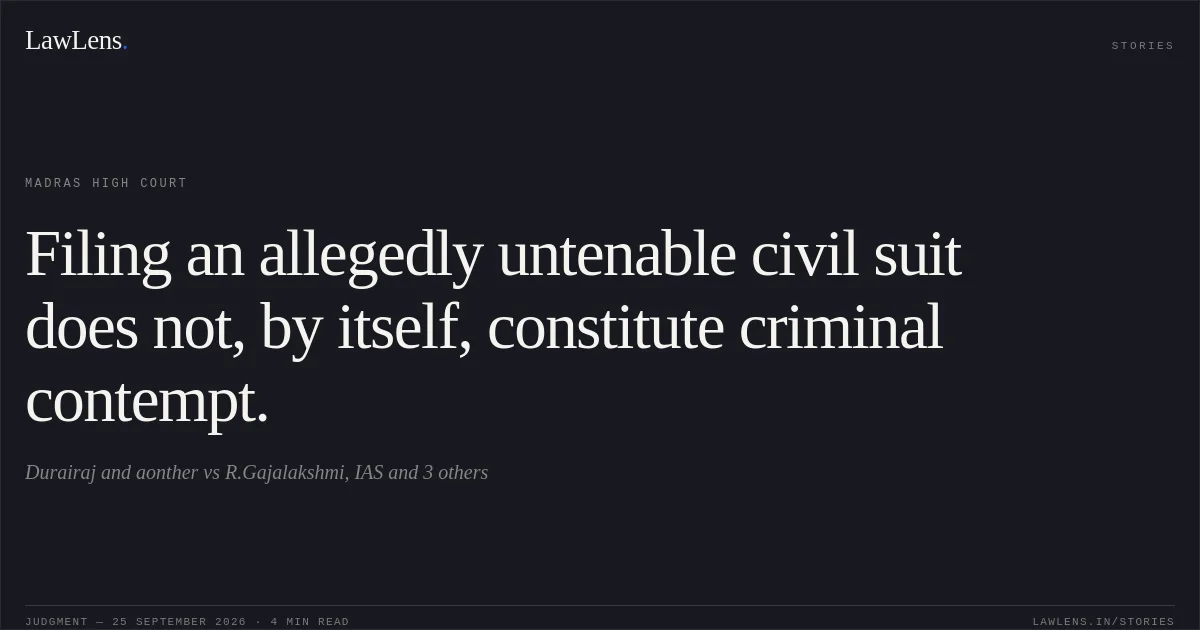
Source reference: p.6The Court further applied the principle that instituting a civil proceeding, even on erroneous or legally untenable grounds, does not by itself constitute criminal contempt. Where a plaint is allegedly barred by res judicata, limitation, or absence of a valid cause of action, the appropriate remedy is an application for rejection under Order VII Rule 11 CPC.
Source reference: p.8Reasoning
The Court held that the core allegation—failure to issue patta in compliance with the decrees and writ directions—was, in substance, one of wilful non-compliance and therefore fell within civil contempt under Section 2(b), for which Contempt Petition No.1926 of 2025 was already pending.
Source reference: p.7The filing of the subsequent suit did not, without more, scandalise the Court or obstruct the administration of justice. It was treated as an invocation of a civil legal remedy, notwithstanding the suit’s apparent conflict with decrees that had attained finality up to the Supreme Court and with the High Court’s quashing of the rejection order.
Source reference: pp.7–8The Court therefore declined to convert the alleged abuse or impropriety in instituting the suit into criminal contempt and directed the petitioners to pursue the procedural remedy of seeking rejection of the plaint under Order VII Rule 11 CPC.
Source reference: p.8Holding
The Court dismissed the petition seeking consent and initiation of criminal contempt proceedings against the respondents. It held that the alleged non-compliance was appropriately addressed, if at all, through civil contempt proceedings, while the filing of the fresh suit did not independently constitute criminal contempt.
The petitioners were granted liberty to file an application under Order VII Rule 11 CPC before the Principal District Munsif Court, Ariyalur. The trial court was directed to decide any such application independently on its merits and in accordance with law, while keeping in view the finality of the earlier decrees. No order as to costs was made, and the connected interim application was closed.
Source reference: p.8Acts & Sections Cited
2 provisions across 1 statute referred to in this judgment. Each provision opens on LawLens.
Contempt of Courts Act, 19712
Original Court PDF
Durairaj and aonthervsR.Gajalakshmi, IAS and 3 others
Click to open original judgment
Original judgment, available to read, download and summarize on LawLens.in