Facts
The CBI registered a case against the Respondent, a Superintendent of Customs, alleging he demanded a bribe of ₹3,00,000 to shield a company from drug seizure implications
Source reference: para. 2During a trap operation, the Respondent and others were apprehended, and the bribe amount was recovered
Source reference: para. 3On July 17, 2013, the CBI issued a direction under Section 102 of the CrPC to freeze the Respondent’s savings account and Locker No. 68 at Allahabad Bank
Source reference: para. 5A charge-sheet was filed on December 30, 2013
Source reference: para. 4Subsequently, the Respondent's wife applied for de-freezing the account and locker
Source reference: para. 6On August 21, 2014, the Special Judge allowed the prayer, holding that the CBI lacked authority to inspect or retain control over the locker once the charge-sheet was submitted
Source reference: para. 1, 9The CBI assailed this order, arguing that the locker keys were never recovered and further investigation was necessary
Source reference: para. 5-7Issues
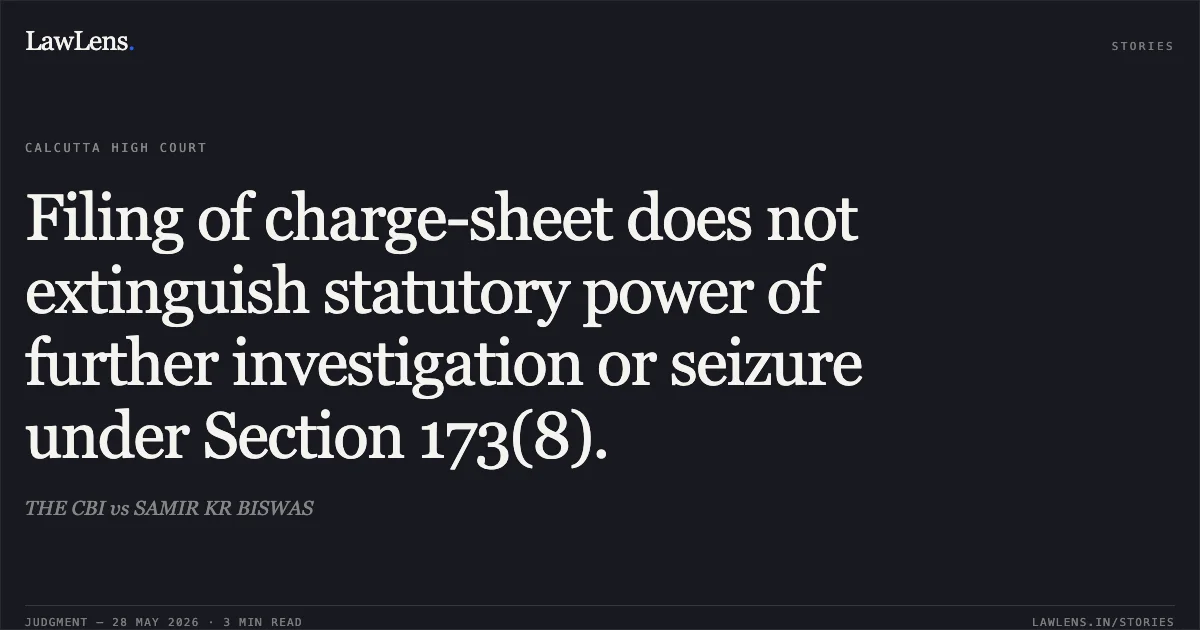
1. Whether the filing of a charge-sheet under Section 173(2) CrPC extinguishes the authority of an investigating agency to conduct further investigation or maintain restraint over frozen assets
Source reference: para. 9, 382. Whether the Special Judge was legally justified in directing the de-freezing of the bank account and locker solely because they were not listed as "relied upon" articles in the initial charge-sheet
Source reference: para. 31, 72Law Applied
Section 173(8) of the Code of Criminal Procedure (CrPC), which preserves the statutory competence of an agency to conduct "further investigation" even after a final report under Section 173(2) has been forwarded
Source reference: para. 45, 48The principle from Vinay Tyagi v. Irshad Ali, distinguishing "further investigation" (supplementary) from "fresh investigation" (re-investigation)
Source reference: para. 50The doctrine from Hasanbhai Valibhai Qureshi v. State of Gujarat, asserting that the discovery of truth is paramount and cannot be precluded by the mere filing of a charge-sheet
Source reference: para. 55Section 102 CrPC regarding the power to seize property, noting such power must bear a reasonable nexus to the investigation
Source reference: para. 65Reasoning
The Court reasoned that Section 173(8) CrPC creates a clear distinction between the culmination of one stage of investigation and the ongoing statutory competence to collect additional evidence
Source reference: para. 45It found that the Special Judge erred in treating the charge-sheet as a jurisdictional embargo
Source reference: para. 58The High Court observed that in corruption cases, assets are often concealed, and the CBI had explicitly notified the trial court that the locker could not be inspected earlier because the keys were not recovered
Source reference: para. 59, 64While the Respondent argued that the locker was not a "relied upon" document in the charge-sheet, the Court held that Section 173(8) exists precisely to allow for the inclusion of subsequently discovered evidence
Source reference: para. 72The Court balanced this with the Respondent’s proprietary rights, noting that freezing cannot be indefinite and must be subject to judicial supervision
Source reference: para. 65, 71Holding
The Court held that the submission of a charge-sheet does not deprive the CBI of its competence to pursue further investigation under Section 173(8) CrPC
It modified the impugned order, allowing the CBI to conduct a time-bound inspection of the locker and bank account in the presence of the account holders. The CBI was directed to submit a supplementary report post-inspection, after which the Trial Court must reconsider the necessity of continued freezing based on any new materials recovered.
Source reference: para. 75-76Acts & Sections Cited
11 provisions across 3 statutes referred to in this judgment. Each provision opens on LawLens.
Indian Penal Code, 18603
Prevention of Corruption Act, 19882
Code of Criminal Procedure, 19736
Original Court PDF
THE CBIvsSAMIR KR BISWAS
Click to open original judgment
Original judgment, available to read, download and summarize on LawLens.in