Facts
The petitioner was arrayed as Accused No. 3 in Crime No. 29/2014 registered by Hebbal Police Station for offences under Sections 4, 5 and 7 of the Immoral Traffic (Prevention) Act, 1956, Section 14 of the Foreigners Act, 1946, Section 67 of the Information Technology Act, 2000, and Sections 370, 370A(2) and 292 of the IPC.
Source reference: para. 3The case was committed to the Sessions Court and tried as S.C. No. 547/2015. By judgment dated 28 March 2019, the petitioner and the other accused were acquitted, and the acquittal attained finality.
Source reference: para. 4; p. 8The petitioner subsequently obtained refugee status and permanent residence in Sweden.
Source reference: para. 6Despite the final acquittal, her name continued to appear in online court records and legal databases, including Google and Indian Kanoon, in a manner suggesting that she remained connected with the criminal prosecution.
Source reference: paras. 7–9She asserted that these digital references adversely affected her employment prospects, reputation and ability to live with dignity.
Source reference: paras. 7–9She therefore invoked Article 226 of the Constitution read with Section 528 of the BNSS and sought masking of her name from the digital records relating to S.C. No. 547/2015 and the connected criminal proceedings.
Source reference: p. 3; para. 1Issues
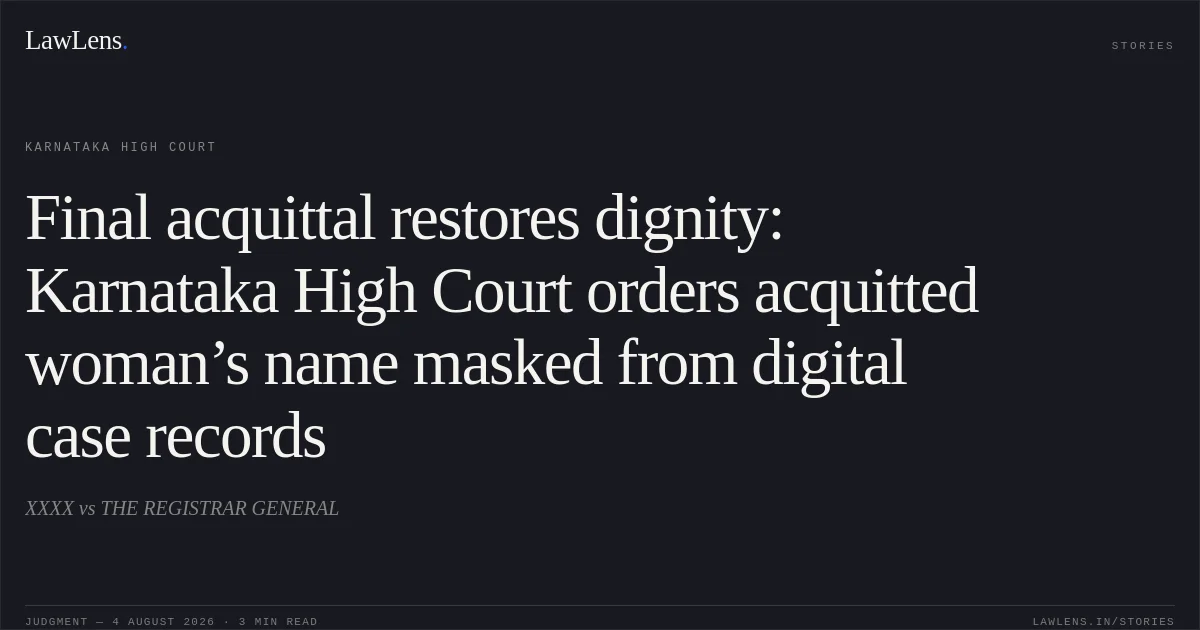
Whether a person whose acquittal in a criminal case has attained finality is entitled to have her name masked from digital court records and searchable legal databases where continued online identification as an accused adversely affects her dignity, reputation and professional prospects.
Source reference: paras. 7–9, 14–16Whether the right to privacy, informational privacy and the right to be forgotten under Article 21 require balancing the public’s right of access to judicial information against the petitioner’s right to dignity and rehabilitation after final acquittal.
Source reference: paras. 14–16Whether the apprehension that granting such relief would open the floodgates of similar claims justified refusal of the petitioner’s relief.
Source reference: paras. 18–22Law Applied
The Court exercised its jurisdiction under Article 226 of the Constitution read with Section 528 of the BNSS to protect the petitioner’s fundamental rights.
Source reference: p. 3It relied on Justice K.S. Puttaswamy (Retd.) v. Union of India, (2017) 10 SCC 1, particularly the principles that informational privacy includes an individual’s ability to control personal data and aspects of their existence on the internet, and that the right to be forgotten is not absolute but must be balanced against freedom of expression, public information, legal obligations and legitimate public interests.
Source reference: paras. 16; pp. 12–16The Court also relied on SJ v. Union of India, 2023 SCC OnLine Del 3309, and the principles recognised in Zulfiqar Ahman Khan v. Quintillion Business Media (P) Ltd. and Subhranshu Rout v. State of Odisha, which support removal, blocking or de-indexing of online material where its continued publication causes disproportionate prejudice despite acquittal or quashing of criminal proceedings.
Source reference: para. 17; pp. 17–21A final acquittal restores the presumption of innocence and requires that judicial vindication not be defeated by persistent and misleading digital records.
Source reference: paras. 13–15Reasoning
The Court found that the petitioner’s acquittal was unequivocal and had become final, with the prosecution having failed to prove the charges beyond reasonable doubt.
Source reference: para. 12; p. 8Nevertheless, digital records continued to associate her with the criminal case as an accused, thereby creating an ongoing civil and professional disability despite the termination of the prosecution.
Source reference: paras. 13–15Applying the informational-privacy and right-to-be-forgotten principles in Puttaswamy, the Court held that the continued accessibility of obsolete criminal allegations could not be permitted to render the acquittal merely a “paper declaration”.
Source reference: para. 14It distinguished masking from total obliteration of judicial history: the relief was directed at protecting the petitioner’s identity and dignity in the digital sphere while recognising that the right to be forgotten is subject to legitimate public-interest limitations.
Source reference: para. 16The Court rejected the respondents’ floodgates objection, holding that possible future claims could not justify denying constitutionally warranted relief in the petitioner’s individual circumstances.
Source reference: paras. 18–22Holding
The writ petition was allowed.
The Court issued a mandamus directing Respondent Nos. 1 to 5 to forthwith mask the petitioner’s name in the digital records relating to S.C. No. 547/2015 and Criminal Petition No. 1628/2014 connected with Criminal Petition Nos. 1637/2014 and 1979/2014.
Source reference: para. 23(i)–(ii); pp. 23–24The Court held that, after a final acquittal, continued online identification of the petitioner as an accused infringed her rights to dignity, reputation and informational privacy under Article 21.
Source reference: para. 23(ii); p. 24It further directed that, in the event of non-compliance, the petitioner would be at liberty to initiate appropriate coercive proceedings.
Source reference: para. 23(ii); p. 24Original Court PDF
XXXXvsTHE REGISTRAR GENERAL
Click to open original judgment
Original judgment, available to read, download and summarize on LawLens.in