Facts
The petitioners-plaintiffs instituted a suit for eviction, recovery of rent and damages in respect of the disputed premises.
Source reference: para. 3The plaint was subsequently amended to plead that the construction had been raised after 26 April 1985 and was consequently exempt from the application of the U.P. Urban Buildings (Regulation of Letting, Rent and Eviction) Act, 1972.
Source reference: para. 3The plaintiffs’ evidence concluded on 3 July 2025 and the defendants’ evidence concluded on 20 January 2026; the suit thereafter proceeded to final arguments.
Source reference: para. 4The plaintiffs obtained the first municipal tax assessment relating to the premises on 13 February 2026 pursuant to a complaint made through a government portal.
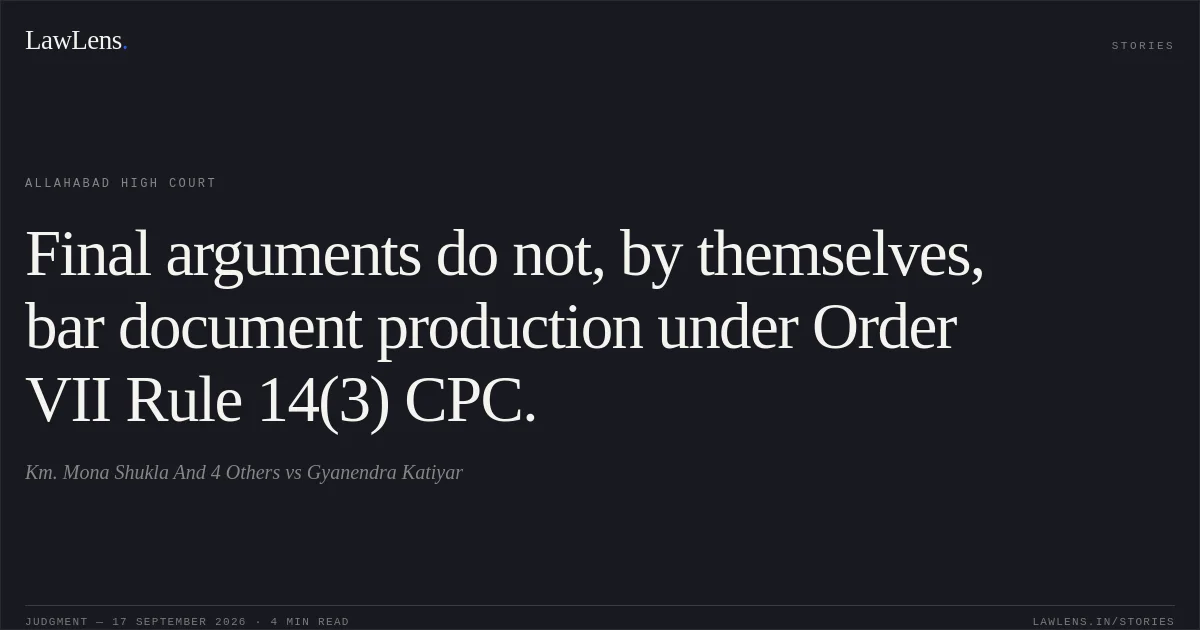
Source reference: para. 5They thereafter filed Application Paper No. 158-C under Order VII Rule 14(3) read with Section 151 CPC, seeking permission to produce the assessment document, the complaint and a sanctioned plan, contending that the assessment document was relevant to proving the date of construction.
Source reference: paras. 5–6The Additional District Judge rejected the application on 2 April 2026, principally because it was filed after completion of evidence and at the stage of arguments, without a sufficient explanation for the delay.
Source reference: para. 7The plaintiffs challenged that order under Article 227 of the Constitution.
Source reference: para. 11Issues
1. Whether the court below was justified in refusing permission under Order VII Rule 14(3) read with Section 151 CPC solely or principally because the evidence had concluded and the suit had reached the stage of final arguments?
Source reference: para. 252. Whether the plaintiffs had shown sufficient cause for the delayed production of the first municipal tax assessment, having regard to its alleged subsequent availability and its relevance to an existing plea regarding the date of construction?
Source reference: paras. 25, 32–353. Whether the respondents’ possible prejudice could be adequately addressed through procedural safeguards, including inspection, objections, further cross-examination or consequential evidence?
Source reference: paras. 36–38Law Applied
Order VII Rule 14(3) CPC permits a document not previously filed with the plaint to be received at a subsequent stage with the leave of the court; the provision is discretionary and does not create an absolute bar against belated production.
Source reference: paras. 26, 29The discretion must be exercised judicially by examining: (i) whether the earlier omission was bona fide, (ii) whether the document is relevant and necessary for effective adjudication, and (iii) whether its production would cause serious prejudice or irreparable injustice to the opposite party, as held in Mohammad Arif v. Laiq Ahmad, 2026 SCC OnLine All 2638.
Source reference: paras. 26–27Procedural law should ordinarily advance, rather than defeat, substantive justice, consistent with Sangram Singh v. Election Tribunal, Kotah, (1955) 1 SCC 323, and State of Punjab v. Shamlal Murari, (1976) 1 SCC 719.
Source reference: para. 28Reception of a document is distinct from its proof, admissibility, genuineness and evidentiary value, which remain matters for determination at the appropriate stage.
Source reference: paras. 30(vi), 35Section 151 CPC is complementary and may be used to issue consequential directions, but cannot enlarge or circumvent the express requirements of Order VII Rule 14(3), consistent with Padam Sen v. State of Uttar Pradesh, (1961) 1 SCR 884.
Source reference: para. 43Reasoning
The High Court held that the stage of final arguments was a relevant consideration requiring closer scrutiny, but could not by itself operate as an absolute bar under Order VII Rule 14(3) CPC.
Source reference: paras. 29, 40The first assessment document was stated to have been obtained from the Municipal Corporation only on 13 February 2026, and there was no material showing that it had earlier been in the plaintiffs’ possession or had deliberately been withheld.
Source reference: para. 32Further, the document supported an existing pleaded case regarding construction after 26 April 1985 and did not introduce a new factual foundation.
Source reference: para. 33Its relevance to the applicability of the 1972 Act was therefore material, although its ultimate probative value was left open.
Source reference: para. 34The Court also held that any prejudice to the defendants could be addressed by allowing them to inspect and contest the documents and, where necessary, seek further cross-examination or consequential evidence.
Source reference: paras. 36–38Documents already on the record did not require fresh production, but their presence could not justify rejection of the application in respect of the principal document obtained subsequently.
Source reference: para. 41Similarly, objections that documents were photocopies concerned admissibility and evidentiary value, not necessarily their reception on record.
Source reference: para. 42Holding
The High Court held that the trial court had erred in treating the closure of evidence and commencement of final arguments as determinative of the application without properly examining bona fides, relevance and curable prejudice.
The order dated 2 April 2026 was set aside, and Application Paper No. 158-C was allowed to the extent that documents not previously available to the plaintiffs were directed to be taken on record, subject to proof and admissibility in accordance with law.
Source reference: para. 46Documents already forming part of the record required no fresh production.
Source reference: para. 46The defendants were to receive a reasonable opportunity to inspect and respond to the documents and, where legally permissible and necessary, seek recall of witnesses or adduce consequential evidence.
Source reference: para. 47Such proceedings were to be regulated in a time-bound manner, after which the trial court was directed to decide the suit expeditiously in accordance with the earlier High Court directions.
Source reference: para. 48No order as to costs was made.
Source reference: para. 49Acts & Sections Cited
1 provisions across 1 statute referred to in this judgment. Each provision opens on LawLens.
Code of Civil Procedure, 19081
Original Court PDF
Km. Mona Shukla And 4 OthersvsGyanendra Katiyar
Click to open original judgment
Original judgment, available to read, download and summarize on LawLens.in