Facts
The appellant/complainant filed two complaints under Section 138 of the Negotiable Instruments (NI) Act, alleging he paid ₹35,00,000 in cash to the respondent/accused as an advance for a land purchase.
Source reference: para. 3When the transaction failed, the respondent allegedly issued two cheques (₹15,00,000 and ₹20,00,000) which were subsequently dishonored due to "insufficient funds".
Source reference: para. 1, 3The Judicial Magistrate First Class, Raipur, convicted the respondent, sentencing him to six months’ imprisonment and a compensation of ₹35,00,000.
Source reference: para. 1On appeal, the Additional Sessions Judge, Raipur, set aside the conviction and acquitted the respondent, leading the complainant to file the present acquittal appeals.
Source reference: para. 1, 4The respondent contended that the cheques were obtained under threat and that he had issued "stop payment" instructions to the bank prior to their presentation.
Source reference: para. 6, 10Issues
1. Whether the complainant successfully established the existence of a legally enforceable debt or liability as required under Section 138 of the NI Act.
Source reference: para. 9, 122. Whether the respondent successfully rebutted the statutory presumptions under Sections 118 and 139 of the NI Act through a "probable defense".
Source reference: para. 5, 11, 153. Whether the High Court should interfere with an order of acquittal when the view taken by the lower appellate court is a plausible one.
Source reference: para. 8, 14, 15Law Applied
The Court applied Sections 118 and 139 of the NI Act, 1881, which create rebuttable presumptions that a cheque is issued for consideration and in discharge of a debt.
Source reference: para. 5, 11Citing Kamla S. v. Vidhyadharan M.J., the court noted that the accused’s burden of proof is based on the "preponderance of probabilities".
Source reference: para. 11Regarding acquittal appeals, the court relied on Jafarudheen v. State of Kerala and Mallappa v. State of Karnataka, which establish that if two views are possible, the one favoring the accused must prevail, and interference is only permitted in cases of perversity or illegality.
Source reference: para. 8, 14Furthermore, D. Vinod Shivappa v. Nanda Belliappa was cited regarding the presumption of service of notice sent to the correct address.
Source reference: para. 12Reasoning
The Court found that while the respondent admitted his signatures on the cheques, the complainant failed to prove the underlying financial transaction.
Source reference: para. 9During cross-examination, the complainant admitted his annual income was only ₹3,50,000 and failed to produce income tax returns or bank records to prove the source of the alleged ₹35,00,000 cash advance.
Source reference: para. 9, 12The absence of a written agreement, witnesses, or specific details regarding the land (e.g., Khasra numbers) cast serious doubt on the complainant's case.
Source reference: para. 9, 12Conversely, the respondent probablised his defense by producing documentary evidence (Ex. D-1 to D-3) showing he had issued "stop payment" instructions to his bank on 29.08.2012, prior to the cheques being presented for encashment.
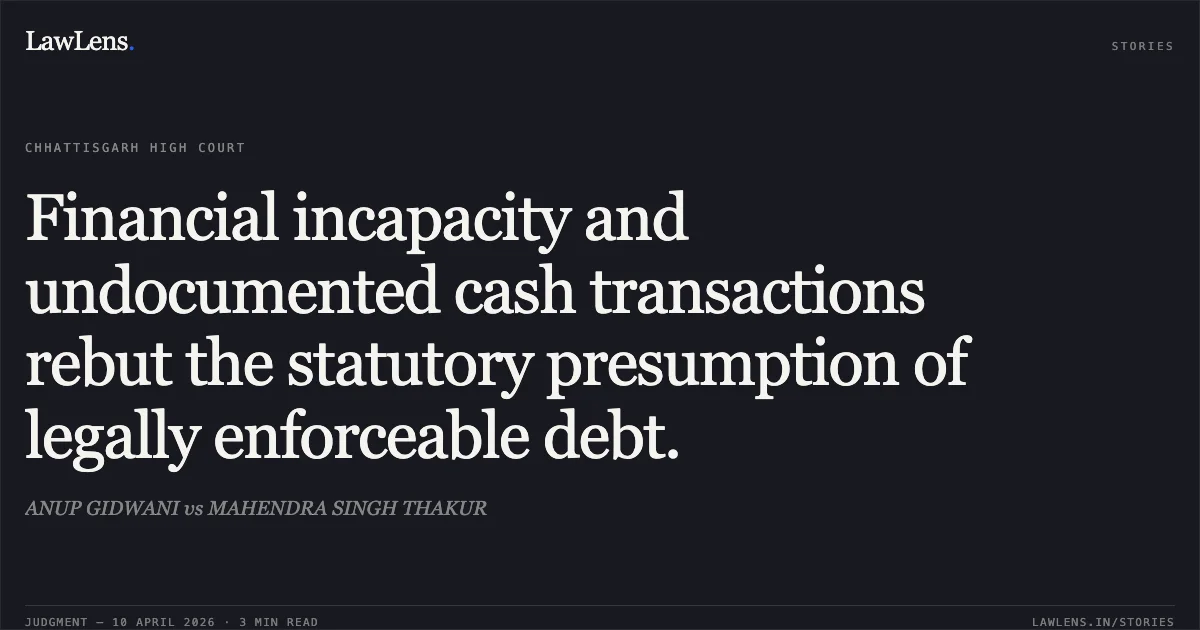
Source reference: para. 10The Court reasoned that the financial incapacity of the complainant and the lack of documentary evidence for a large cash transaction were sufficient to rebut the statutory presumptions.
Source reference: para. 12, 15Holding
The High Court dismissed the appeals and upheld the acquittal of the respondent.
It held that the complainant failed to establish a legally enforceable debt and that the respondent had successfully raised a probable defense to rebut the presumptions under Sections 118 and 139 of the NI Act.
Source reference: para. 15The Court concluded that the lower appellate court’s findings were plausible and did not suffer from perversity or illegality, thereby warranting no interference.
Source reference: para. 15Acts & Sections Cited
4 provisions across 2 statutes referred to in this judgment. Each provision opens on LawLens.
Negotiable Instruments Act, 18813
Code of Criminal Procedure, 19731
Original Court PDF
ANUP GIDWANIvsMAHENDRA SINGH THAKUR
Click to open original judgment
Original judgment, available to read, download and summarize on LawLens.in