Facts
The State of Gujarat, through the Deputy Executive Engineer, Roads and Buildings Department, Rajkot, acquired land in village Paddhari for construction of the Rajkot–Jamnagar four-lane State Highway.
Source reference: no citationNotifications under Sections 4 and 6 of the Land Acquisition Act were issued on 28.02.2008 and 08.05.2008 respectively.
Source reference: no citationThe Special Land Acquisition Officer passed an award dated 01.09.2009, fixing compensation at ₹26.50 per sq. metre for agricultural land and ₹229.75 per sq. metre for non-agricultural land.
Source reference: no citationOn references sought by the landowners, the Land Reference Court enhanced the compensation to ₹5,109 per sq. metre for agricultural land and ₹7,107 per sq. metre for non-agricultural land, together with statutory benefits and interest
Source reference: para. 3The Reference Court’s judgment and award was passed on 30/31.12.2019.
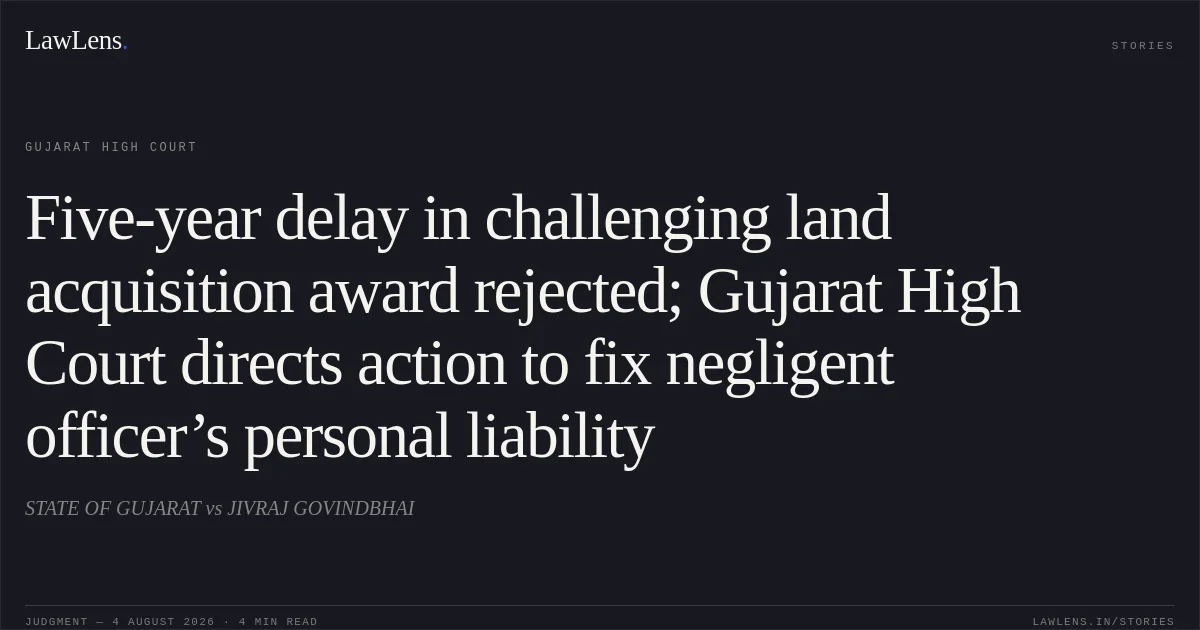
Source reference: paras. 2, 13The State filed the connected first appeals on 19.02.2025, accompanied by applications under Section 5 of the Limitation Act seeking condonation of a delay of 1,790 days, exceeding five years.
Source reference: paras. 2, 13The State attributed the delay to failure to communicate the award to the acquiring department, inter-departmental correspondence, obtaining legal opinions and sanctions, COVID-19-related difficulties, and arrangements for court fees and deposit of the awarded amount.
Source reference: paras. 5–6The landowners opposed the applications, contending that the delay resulted from gross negligence, failure of the Government Pleader to obtain and circulate the certified judgment, and prolonged inaction even after the State became aware of the award in February 2022.
Source reference: paras. 10–11Issues
1. Whether the State established “sufficient cause” under Section 5 of the Limitation Act, 1963 for condoning the delay of 1,790 days in filing the first appeals?
Source reference: para. 132. Whether governmental decision-making procedures, the COVID-19 pandemic, and the State’s asserted public interest constituted sufficient justification for condoning the delay despite the prolonged inaction of its officers?
Source reference: paras. 15–183. Whether the conduct of the concerned officers warranted a direction to the Secretary, Roads and Buildings Department, to fix personal responsibility for the delay?
Source reference: para. 20Law Applied
The Court applied Section 5 of the Limitation Act, 1963, under which delay may be condoned only when the applicant satisfies the Court that “sufficient cause” prevented timely filing.
Source reference: para. 14Relying principally on Shivamma (Dead) by LRs v. Karnataka Housing Board, 2025 INSC 1104, the Court held that “sufficient cause” is elastic but has limits: the explanation must be genuine, bona fide, plausible, and free from gross negligence, deliberate inaction, or casual indifference; the length of delay is less important than the acceptability of the explanation.
Source reference: para. 14The Court further relied on Postmaster General v. Living Media India Ltd., (2012) 3 SCC 563, State of Nagaland v. Lipok AO, (2005) 3 SCC 752, University of Delhi v. Union of India, (2020) 13 SCC 745, State of Madhya Pradesh v. Bherulal, (2020) 10 SCC 654, and other authorities to hold that the State is not automatically entitled to preferential treatment and must demonstrate reasonable diligence; bureaucratic procedure may constitute sufficient cause only when it reflects genuine efforts rather than inefficiency or inaction.
Source reference: paras. 8, 15–16Rules 51–53 of the Law Officers (Appointment and Conditions of Service) and Conduct of Legal Affairs of the Government Rules, 2009 require the Government Pleader to communicate the result of proceedings, obtain certified copies without delay, forward them to the concerned authorities, and provide an opinion on whether an appeal should be filed.
Source reference: para. 17(i)Reasoning
The Court found that the State’s explanation was not a bona fide account of unavoidable procedural delay but an “excuse” arising from gross negligence and inaction.
Source reference: para. 17(i)The In-charge Assistant Government Pleader knew the acquiring body but failed to communicate the judgment, obtain its certified copy, or comply with Rules 51–53 of the 2009 Rules.
Source reference: para. 17(i)Although the landowners informed the Deputy Executive Engineer about the award on 15.02.2022, the Rajkot-based departmental authorities continued unnecessary correspondence and raised non-material queries for more than a year before obtaining governmental sanction.
Source reference: para. 17(ii)Even after sanction from the Legal Department in August 2023, the appeals were not filed until 19.02.2025, leaving an unexplained period of approximately eighteen months.
Source reference: para. 17(ii)The COVID-19 exclusion period could not justify the subsequent inactivity, particularly since inter-departmental communications continued during the pandemic and modern communication methods were available.
Source reference: para. 17(ii)The Court also held that the asserted merits of the appeals and possible prejudice to the public exchequer were irrelevant to the Section 5 inquiry, which concerned only whether the delay was sufficiently explained.
Source reference: para. 18Applying the distinction between an acceptable “explanation” and an administrative “excuse,” the Court concluded that the State had not acted with reasonable diligence.
Source reference: paras. 16–19Holding
The Court held that the State failed to establish sufficient cause for condoning the 1,790-day delay.
All connected applications for condonation of delay were therefore dismissed, with the result that the accompanying first appeals could not proceed on merits.
Source reference: para. 20The Court noted that the awarded amounts, including statutory benefits, had already been withdrawn by the landowners and observed that prompt action could have prevented such withdrawal.
Source reference: para. 20The Secretary, Roads and Buildings Department, State of Gujarat, was directed to examine the matter and take necessary steps to fix personal liability on the officers responsible for the negligent conduct.
Source reference: paras. 20–21The Assistant Government Pleader was directed to bring the judgment to the Secretary’s notice.
Source reference: paras. 20–21Acts & Sections Cited
1 provisions across 1 statute referred to in this judgment. Each provision opens on LawLens.
Limitation Act, 19631
Original Court PDF
STATE OF GUJARATvsJIVRAJ GOVINDBHAI
Click to open original judgment
Original judgment, available to read, download and summarize on LawLens.in