Facts
On 24 June 2016, Dilipbhai Nagjibhai, aged approximately 15 years, was travelling as a pillion rider on a motorcycle driven by his paternal uncle.
Source reference: p.2, para. 2(i)The motorcycle collided with a school bus owned by respondent No. 3-Trust and insured with the appellant-insurer, resulting in the deceased’s death at the spot.
Source reference: p.2, para. 2(i)His parents instituted a claim petition before the Motor Accident Claims Tribunal, Banaskantha at Palanpur, seeking compensation of ₹11,20,000.
Source reference: p.1, para. 1The Tribunal partly allowed the claim and awarded ₹7,43,000 with interest at 9% per annum from the date of application, along with proportionate costs.
Source reference: p.1, para. 1The insurer preferred the present appeal, challenging only the quantum of compensation.
Source reference: p.3, para. 4It contended that the Tribunal had wrongly applied a 50% addition towards future prospects and a multiplier of 18.
Source reference: p.3, para. 4Issues
1. Whether the Tribunal erred in adding 50% towards future prospects while computing the deceased’s loss of dependency, and whether the addition ought to have been 40%?
Source reference: p.3, para. 4; p.4, para. 72. Whether the Tribunal applied an incorrect multiplier of 18, and whether the appropriate multiplier was 15 in the circumstances of the fatal accident claim?
Source reference: p.3, para. 4; p.4, para. 73. Whether the total compensation awarded by the Tribunal required reduction and recomputation under the applicable principles governing motor accident compensation?
Source reference: p.3, para. 6; pp.4–6, paras. 7–10Law Applied
The Court applied the principle of “just compensation” under the Motor Vehicles Act, requiring the compensation to be reassessed where the Tribunal’s computation is legally unsustainable.
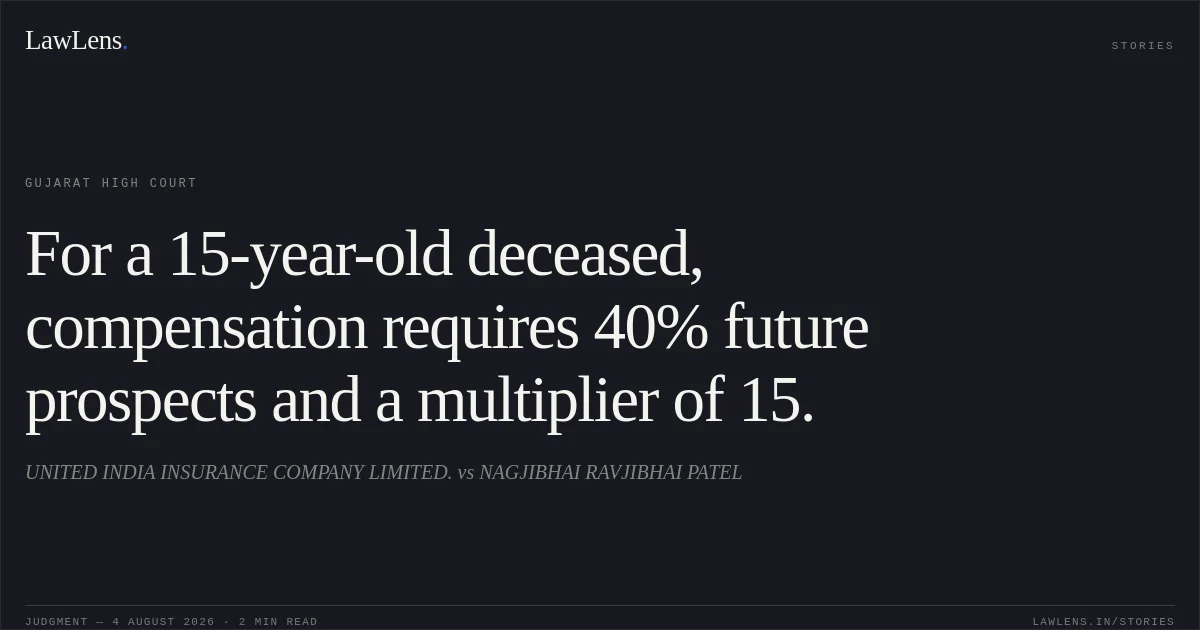
Source reference: p.3, para. 6Relying on National Insurance Co. Ltd. v. Pranay Sethi, AIR 2017 SC 5157, the Court held that 40% of the established income was to be added towards future prospects and that the claimants were entitled to conventional sums for funeral expenses and loss of estate.
Source reference: p.4, paras. 7–8The Court applied a deduction of one-half of the income towards the deceased’s personal expenses and adopted a multiplier of 15.
Source reference: p.4, para. 7Relying on Magma General Insurance Co. Ltd. v. Nanu Ram @ Chuhru Ram & Ors., (2018) 18 SCC 130, it awarded consortium to the deceased’s parents at ₹48,400 each, totalling ₹96,800.
Source reference: p.5, para. 9Reasoning
The Court found that the deceased’s monthly income of ₹4,000, as assessed by the Tribunal, was not under challenge.
Source reference: p.4, para. 7Applying the principles in Pranay Sethi, it added 40% towards future prospects, resulting in a monthly prospective income of ₹5,600.
Source reference: p.4, para. 7After deducting one-half towards personal expenses, the monthly contribution to the claimants was calculated at ₹2,800.
Source reference: p.4, para. 7Applying the multiplier of 15, the loss of dependency was fixed at ₹5,04,000.
Source reference: p.4, para. 7The Court further awarded ₹18,150 each for funeral expenses and loss of estate, and ₹96,800 towards parental consortium under Magma General Insurance.
Source reference: p.5, para. 8–9The total compensation was therefore recalculated at ₹6,37,100, as against the Tribunal’s award of ₹7,43,000.
Source reference: p.5, para. 9Holding
The appeal was partly allowed.
The Court reduced the compensation by ₹1,05,900 and modified the award to ₹6,37,100, with interest at the rate already granted by the Tribunal.
Source reference: p.6, para. 10The impugned judgment and award was modified accordingly, with no order as to costs; the Records and Proceedings were directed to be returned to the Tribunal.
Source reference: p.6, para. 10Original Court PDF
UNITED INDIA INSURANCE COMPANY LIMITED.vsNAGJIBHAI RAVJIBHAI PATEL
Click to open original judgment
Original judgment, available to read, download and summarize on LawLens.in