Facts
The claimants, the wife, son, mother and father of the deceased, sought compensation after he died from injuries sustained in a motorcycle–car collision on 23 November 2008.
Source reference: para. 1–5, 7The Motor Accident Claims Tribunal awarded ₹4,52,000, assessing the deceased’s monthly income at ₹3,000, deducting one-third for personal expenses, and applying a multiplier of 16.
Source reference: para. 1–5, 7The Tribunal’s finding that the accident resulted from the car driver’s rash and negligent driving was not challenged and had attained finality.
Source reference: para. 1–5, 7Issues
1. Whether the Tribunal correctly assessed the deceased’s income at ₹3,000 per month despite the claimants’ assertion that he earned ₹7,000 per month
Source reference: para. 9, 132. Whether the Tribunal correctly calculated the dependency loss, including deductions for personal expenses and addition for future prospects
Source reference: para. 9, 14–163. Whether the claimants were entitled to compensation under conventional heads, including consortium, and interest from the date of filing the claim petition
Source reference: para. 9, 17–21Law Applied
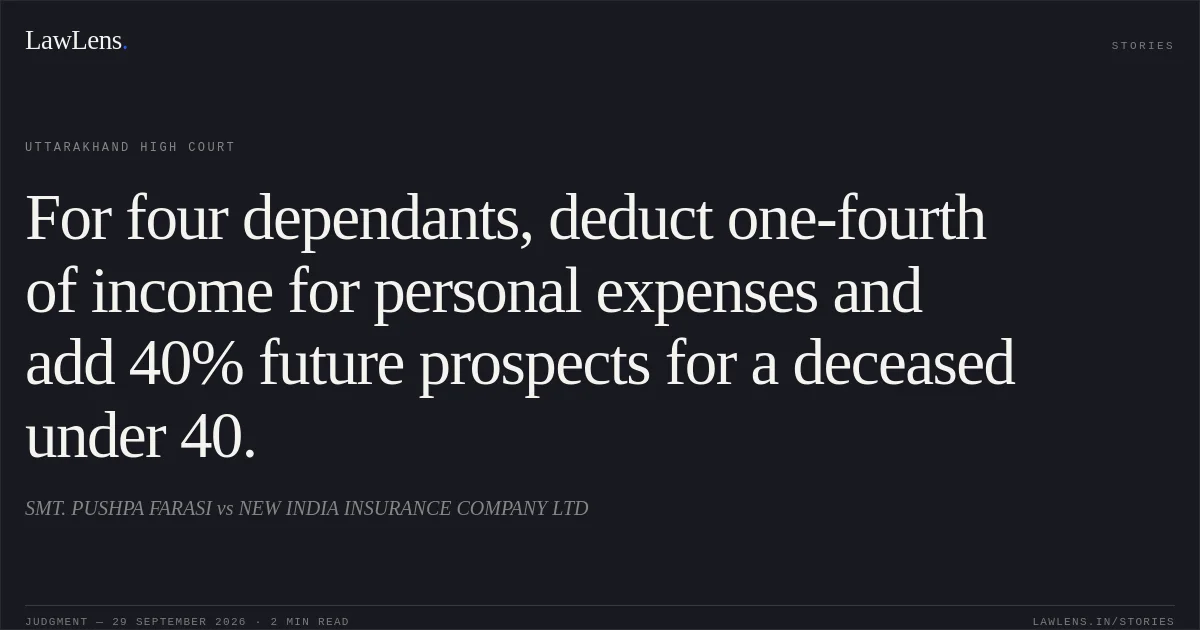
Under Sarla Verma v. Delhi Transport Corporation, (2009) 6 SCC 121, personal and living expenses are generally deducted at one-fourth where the deceased leaves four to six dependants.
Source reference: para. 14–18Under National Insurance Co. Ltd. v. Pranay Sethi, (2017) 16 SCC 680, a self-employed person or person on a fixed salary below 40 years of age is entitled to a 40% addition to established income for future prospects.
Source reference: para. 14–18New India Assurance Co. Ltd. v. Somwati, (2020) 9 SCC 644, recognises spousal, parental and filial consortium, and the applicable conventional heads include loss of estate and funeral expenses.
Source reference: para. 14–18The Court also referred to Neelam v. Ganga Singh, 2026 SCC OnLine SC 888, as reiterating the principles on consortium.
Source reference: para. 14–18Reasoning
The Court upheld the Tribunal’s ₹3,000 monthly income assessment because the claimants had not proved the asserted higher income and the amount was consistent with the minimum wage for a skilled worker at the relevant time.
Source reference: para. 13–20However, because the deceased left four dependants, the Tribunal should have deducted one-fourth, rather than one-third, for personal expenses. Given the deceased’s age of 36, a 40% addition for future prospects was also required.
Source reference: para. 13–20Applying these principles, the Court calculated dependency compensation using an annual income of ₹36,000, increased to ₹50,400, a multiplier of 16 and a one-fourth deduction. It then added consortium for four claimants, loss of estate and funeral expenses.
Source reference: para. 13–20Holding
The appeal was allowed and the compensation was enhanced to ₹7,94,800, comprising dependency compensation of ₹6,04,800, consortium of ₹1,60,000, loss of estate of ₹15,000 and funeral expenses of ₹15,000.
The enhanced amount was made payable with interest at 7% per annum from the date of filing the claim petition until realisation.
Source reference: para. 20–21The wife was allocated 50% of the compensation, with the remainder divided equally among the other three claimants; any amount already paid was to be adjusted. The insurer was directed to pay within two months.
Source reference: para. 20–21Original Court PDF
SMT. PUSHPA FARASIvsNEW INDIA INSURANCE COMPANY LTD
Click to open original judgment
Original judgment, available to read, download and summarize on LawLens.in