01Facts
The petitioner, a private security-services company, employed the respondents as security guards, armed guards, inspectors, head guards, supervisors and in related positions.
¶ 3–6 · pp. 3–5The respondents filed claims under Section 20 of the Minimum Wages Act, 1948, alleging that they had worked beyond normal working hours but had been paid overtime only at the ordinary rate instead of double the ordinary rate prescribed under Section 14 and Rule 25 of the Minimum Wages (Central) Rules, 1950.
¶ 3–6 · pp. 3–5The Authority under Section 20 condoned the delay to a limited extent, restricting the claims to approximately three years preceding their filing.
¶ 8–9 · pp. 6–8It accepted the overtime claims based principally on the duty rotas and the petitioner’s failure to produce attendance, overtime, payment and related employment records.
¶ 8–9 · pp. 6–8The petitioner challenged the awards under Articles 226 and 227 of the Constitution.
¶ 10 · p. 802Issues
i.Whether the Authority was justified in condoning the delay beyond the six-month limitation period prescribed under Section 20(2) of the Minimum Wages Act, 1948.
¶ 26–30 · pp. 13–15ii.Whether the respondents had sufficiently established that they had worked overtime, particularly where the duty rotas were disputed and the petitioner failed to produce statutory employment records.
¶ 33–42 · pp. 16–19iii.Whether the respondents’ employment as security personnel was covered by the Minimum Wages Act, 1948.
¶ 43–45 · pp. 19–20iv.Whether the computation of overtime wages, including the alleged treatment of every calendar day as a working day, was legally unsustainable.
¶ 46–49 · pp. 20–21v.Whether the Authority could award compensation equivalent to 50% of the overtime dues under Section 20(3) of the Minimum Wages Act, 1948.
¶ 50–57 · pp. 21–2603Law Applied
The Court applied Section 14(1) of the Minimum Wages Act, 1948, which requires payment of overtime wages for work beyond the prescribed normal working hours, and Rule 25 of the Minimum Wages (Central) Rules, 1950, which prescribes overtime at twice the ordinary rate for non-agricultural scheduled employment.
¶ 31–32 · pp. 15–16Section 20(2) permits delayed claims where sufficient cause is shown, while Section 20(3)(ii) permits payment of the amount due in overtime claims together with compensation not exceeding ₹10; the enhanced compensation provision under Section 20(3)(i) applies to underpayment of minimum wages, not overtime claims.
¶ 26, 51–53 · pp. 13–14, 21–24Section 18 imposes a statutory obligation on employers to maintain employment records, including records relevant to work performed and wages paid.
¶ 36–39 · pp. 17–18In writ jurisdiction under Articles 226 and 227, the High Court does not act as an appellate court and interferes with factual findings only where they are perverse, based on no evidence or irrelevant evidence, or such that no reasonable person could have reached them; the Court relied on International Airport Authority of India v. International Air Cargo Workers Union, (2009) 13 SCC 374.
¶ 25 · p. 13The repeal of the Minimum Wages Act by the Code on Wages, 2019 did not invalidate proceedings instituted and adjudicated under the repealed statute, by virtue of the savings provision.
¶ 55–56 · pp. 25–26Provisions in the judgment · 2 · Linked ones open on LawLens
Code on Wages, 2019 Section 69
General Clauses Act, 1897 Section 6
04Reasoning
The Court declined to interfere with the Authority’s factual and discretionary findings.
¶ 26–30, 34–35 · pp. 13–17The respondents had entered the witness box, produced duty rotas containing particulars of duty and overtime hours, and relied on contemporaneous representations concerning non-payment of overtime.
¶ 34–35 · pp. 16–17Although the rotas were disputed and partly self-prepared, they were not incapable of consideration, particularly because the petitioner had custody of the best evidence—attendance registers, overtime registers, payment records and deployment records—but failed to produce them despite a statutory duty to maintain such records.
¶ 35–41 · pp. 16–19The petitioner’s bare denial and inconsistent positions did not displace the prima facie case established by the respondents.
¶ 35–41 · pp. 16–19Similarly, the Authority’s limited condonation of delay was a discretionary factual determination supported by the respondents’ repeated representations and did not disclose arbitrariness or perversity.
¶ 26–30 · pp. 13–15The respondents were covered by the notified employment category relating to shops and establishments, and the petitioner had not shown any error in that conclusion.
¶ 43–45 · pp. 19–20The challenge to computation also failed because the petitioner’s non-production of attendance and deployment records prevented more precise verification, and the computation was not shown to be wholly unsupported by the record.
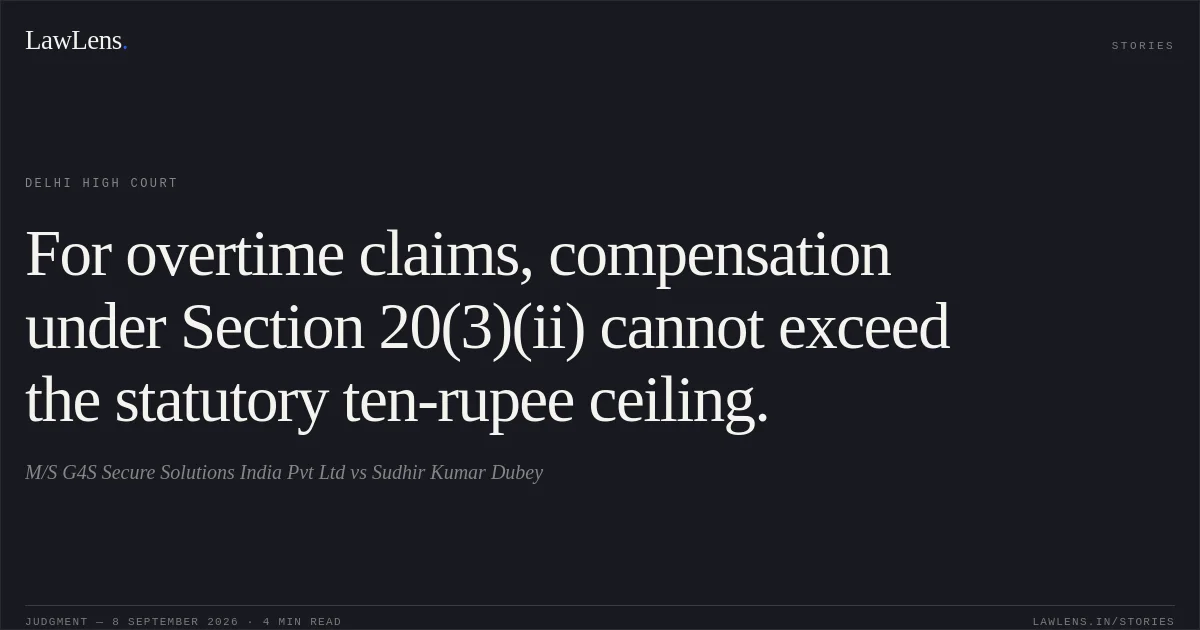
¶ 46–49 · pp. 20–21However, the Court held that the 50% compensation award exceeded the Authority’s statutory power: the claims were for overtime wages under Section 14 and therefore fell within Section 20(3)(ii), whose compensation ceiling was ₹10, rather than Section 20(3)(i).
¶ 50–57 · pp. 21–2605Holding
The petitions were partly allowed.
¶ 57–58 · pp. 26–27The Court upheld the respondents’ entitlement to differential overtime wages, the limited condonation of delay, the finding that the employment was covered by the Minimum Wages Act, and the computation of the overtime dues.
¶ 57–58 · pp. 26–27However, it set aside the compensation component calculated at 50% of the overtime amount as beyond the statutory limit under Section 20(3)(ii).
¶ 58 · p. 27In its place, the Court directed payment of interest at 7% per annum on the overtime wages from the date on which the claims accrued until realization.
¶ 58 · p. 27The petitioner was directed to comply with the modified awards within eight weeks, subject to adjustment of amounts already deposited or paid; the petitions and pending applications were accordingly disposed of.
¶ 58–60 · p. 27Original Court PDF
M/S G4S Secure Solutions India Pvt LtdvsSudhir Kumar Dubey
Click to open original judgment
Original judgment, available to read, download and summarize on LawLens.in