Facts
The petitioner and respondent no. 3 (ex-wife) were married in India in 2017 and later relocated to Canada
Source reference: para. 2Due to irreconcilable differences, they executed a Separation Agreement in 2023 and jointly sought a divorce by mutual consent before the Supreme Court of British Columbia, Canada
Source reference: para. 3The Foreign Court passed a Final Order dissolving the marriage on April 4, 2024
Source reference: para. 4The petitioner subsequently remarried and applied to the Indian Passport Authorities to delete his ex-wife's name from his passport records
Source reference: para. 5The authorities refused, citing Para 3.4.2 of the Passport Manual, which requires a declaratory decree from an Indian court even for foreign mutual consent divorces
Source reference: para. 9The petitioner filed a civil suit in Delhi, which was dismissed for lack of territorial jurisdiction as neither party resided in India at the time of the foreign decree
Source reference: para. 7Consequently, the petitioner approached the High Court seeking a mandate against the Passport Authorities
Source reference: para. 9Issues
1. Whether a decree of divorce by mutual consent passed by a Foreign Court can be acted upon by Passport Authorities for altering passport records without a separate declaratory decree from an Indian Court
Source reference: para. 12. Whether the insistence on a declaratory decree under Para 3.4.2 of the Passport Manual overrides the principles of conclusiveness under Section 13 of the CPC
Source reference: para. 24, 26Law Applied
Section 13 of the Code of Civil Procedure (CPC), 1908, which establishes that a foreign judgment is conclusive unless it falls under specific exceptions
Source reference: para. 17, 18Section 14 CPC, which creates a rebuttable presumption in favor of the jurisdiction of the foreign court
Source reference: para. 17The Supreme Court precedent in Y. Narasimha Rao v. Y. Venkata Lakshmi, which allows recognition of foreign matrimonial judgments if the respondent voluntarily submits to the jurisdiction or consents to the relief
Source reference: para. 19Hague Convention Abolishing the Requirement of Legalisation for Foreign Public Documents, 1961, noting that apostilled documents must be treated as legalized without further consular attestation
Source reference: para. 31-35Reasoning
The Court observed that the foreign decree satisfied the requirements of Section 13 CPC because both parties were habitually resident in Canada and had voluntarily submitted to the Foreign Court's jurisdiction through a joint application
Source reference: para. 20, 21It found that mutual consent is a ground recognized under Section 13B of the Hindu Marriage Act, thus aligning the foreign order with Indian matrimonial law
Source reference: para. 21The Court criticized the Passport Authorities' reliance on Clause 3.4.2 of the Passport Manual, terming it an ex lege requirement not supported by the CPC or the Y. Narasimha Rao judgment
Source reference: para. 25, 26The Court reasoned that since the document was duly apostilled in accordance with the Hague Convention, it carried a presumption of authenticity that the State could not ignore
Source reference: para. 35, 37It held that demanding a separate Indian declaratory decree in cases of undisputed mutual consent would be pedantic, mechanical, and legally untenable
Source reference: para. 37, 39Holding
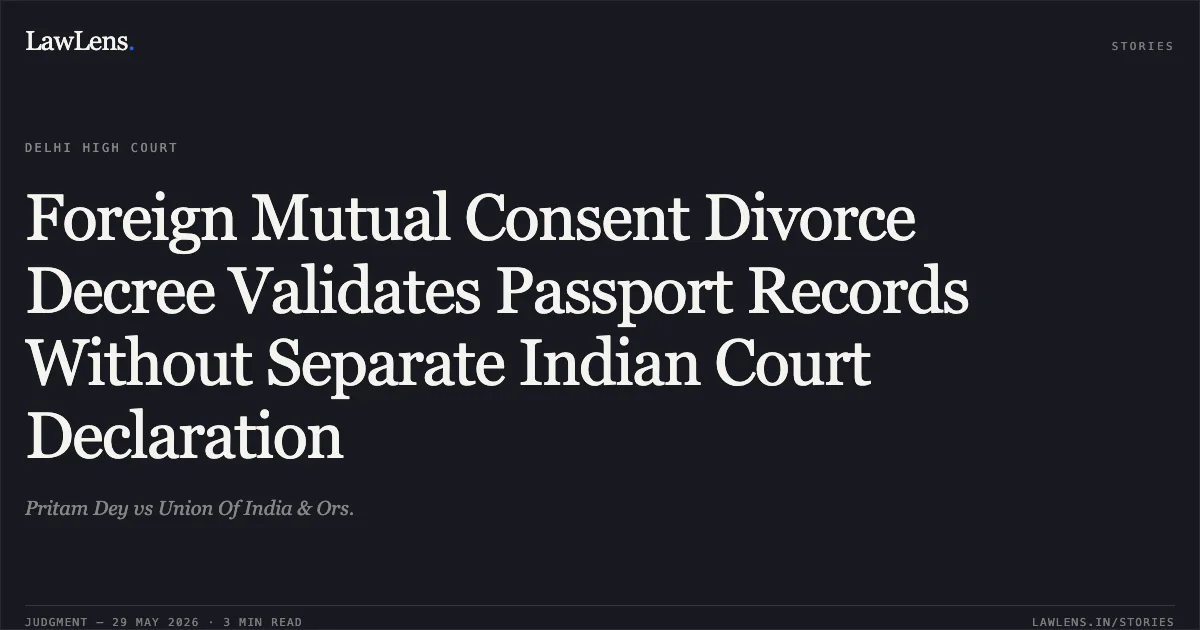
The Court answered the issue in favor of the petitioner, holding that the foreign divorce decree was conclusive and binding under Section 13 CPC
The Court issued a writ of mandamus directing the Passport Authorities to process the petitioner's request for altering his marital status in his records without insisting on a separate declaratory decree from an Indian court
Source reference: para. 40The process is to be completed within eight weeks
Source reference: para. 40Acts & Sections Cited
4 provisions across 4 statutes referred to in this judgment. Each provision opens on LawLens.
Code of Civil Procedure, 19081
Family Courts Act, 19841
Specific Relief Act, 19631
Divorce Act, 18691
Original Court PDF
Pritam DeyvsUnion Of India & Ors.
Click to open original judgment
Original judgment, available to read, download and summarize on LawLens.in