Facts
The appellant supplied ready-mix concrete (RMC) to Larsen & Toubro for a project at Lalitpur, Uttar Pradesh.
Source reference: p. 1For November 2014 to October 2015, it paid service tax of ₹24,54,611 after claiming 60% abatement under Rule 2A(ii)(A) of the Service Tax (Determination of Value) Rules, 2006.
Source reference: p. 1Relying on income-tax Form 26AS, Revenue treated the appellant as liable for ₹62,63,100 in service tax and issued a show-cause notice demanding a differential ₹38,05,487, with interest and penalties, invoking the extended period.
Source reference: p. 1The demand was confirmed by the Assistant Commissioner and substantially upheld on appeal; the Commissioner (Appeals) set aside one penalty under Section 77(1)(a).
Source reference: p. 1The appellant then appealed to the Tribunal.
Source reference: p. 1Issues
Whether the receipts reflected in Form 26AS could be treated as consideration for taxable services, and whether the appellant’s RMC activity was liable to service tax.
Source reference: pp. 2, 7Whether the appellant was entitled to the claimed abatement for the work-contract services.
Source reference: pp. 2, 7Whether the demand, including the invocation of the extended period and penalties, could be sustained.
Source reference: pp. 2, 7–8Law Applied
The Tribunal considered Rule 2A(ii)(A) of the Service Tax (Determination of Value) Rules, 2006, under which the taxable value of qualifying works-contract services is determined after the prescribed deduction or abatement.
Source reference: pp. 1–2, 7It relied on Commissioner v. Larsen & Toubro Ltd., 2015 (324) E.L.T. 646 (S.C.), for the finding that RMC produced through a batching-plant process is a manufactured, marketable commodity.
Source reference: pp. 3–7It also applied the principle, reflected in Kumar Technocrats v. Commissioner, CGST & Service Tax, Allahabad, that where services are held to be works-contract services, Rule 2A governs determination of taxable value and the permitted abatement must be allowed.
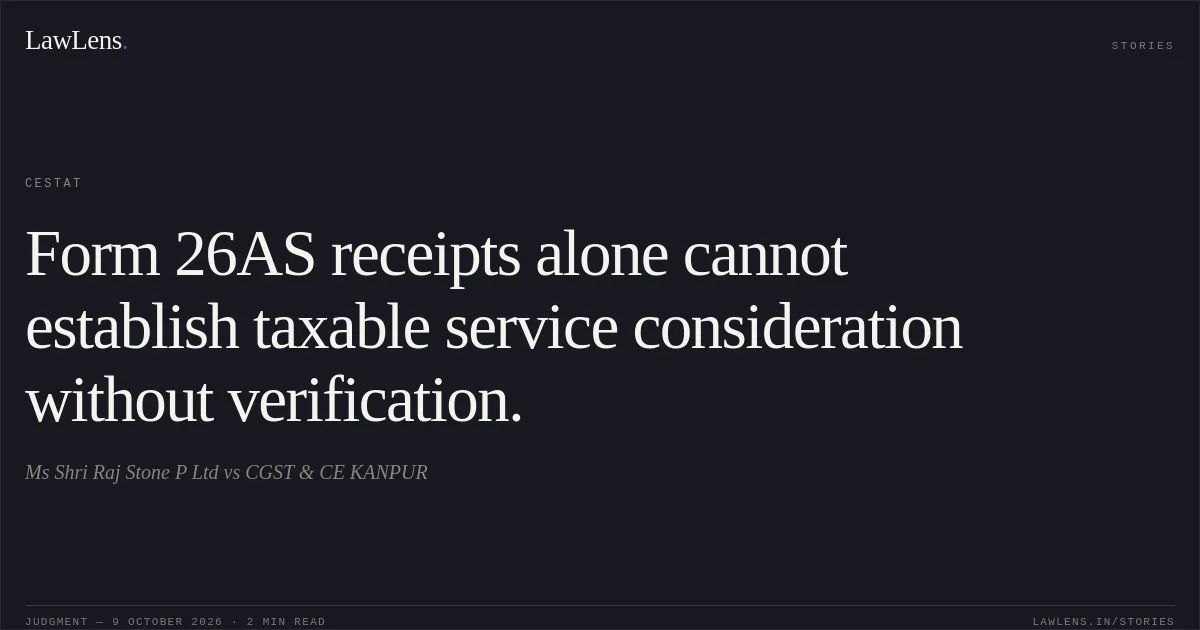
Source reference: p. 7The Tribunal further held that Form 26AS figures alone did not establish taxable consideration; Revenue had to verify whether the amounts represented consideration for taxable services.
Source reference: p. 8Reasoning
The Tribunal concluded that the appellant manufactured an excisable product, relying on the Supreme Court’s treatment of RMC in Larsen & Toubro.
Source reference: pp. 3–7It noted that the appellant had paid service tax after abatement and considered that payment to exceed the amount that would have been payable as central excise duty; it therefore found Revenue’s interest adequately protected.
Source reference: p. 7Independently, it held that if the activity were viewed as a works contract, the appellant had correctly claimed abatement under Rule 2A.
Source reference: p. 7Revenue had based its demand on Form 26AS without verifying whether the reported amounts were consideration for taxable services, making the demand unsustainable.
Source reference: p. 8Although the appellant challenged the extended period and penalties, the Tribunal did not separately analyse those grounds before setting aside the impugned order.
Source reference: pp. 2, 7–8Holding
The Tribunal held that the impugned order was not legally sustainable.
It set it aside, and allowed the appeal with consequential relief, if any, in accordance with law.
Source reference: p. 8Acts & Sections Cited
2 provisions across 1 statute referred to in this judgment. Linked provisions open on LawLens.
Finance Act, 19942
Original Court PDF
Ms Shri Raj Stone P LtdvsCGST & CE KANPUR
Click to open original judgment
Original judgment, available to read, download and summarize on LawLens.in