Facts
The petitioner sought quashing under Section 482 of the Code of Criminal Procedure, 1973, of G.R. Case No. 2793 of 2022 arising from Burdwan Police Station Case No. 587 of 2022, registered under Sections 498A, 420 and 384 of the Indian Penal Code, 1860, and Charge Sheet No. 984 of 2022 dated 28.08.2022.
Source reference: para. 1The opposite party no. 2 alleged that, after meeting the petitioner in 2019, he represented himself as an unmarried orphan, induced her to convert to Islam, and underwent a Muslim marriage ceremony with her on 02.07.2020.
Source reference: paras. 2–3The parties thereafter cohabited as husband and wife in rented premises. She later allegedly discovered that the petitioner was already married and claimed that he subjected her to physical and mental cruelty before assaulting and evicting her on 01.05.2022.
Source reference: paras. 3–4The landlord and the complainant’s parents gave statements supporting their cohabitation and the occurrence of a domestic dispute.
Source reference: paras. 4, 12, 27, 34The petitioner contended that no valid marriage existed, particularly because the complainant’s previous marriage was allegedly subsisting and no formal Muslim marriage document was produced.
Source reference: paras. 7–11A subsequent matrimonial proceeding under Section 13B of the Hindu Marriage Act was also relied upon to show the alleged subsistence of the earlier marriage.
Source reference: para. 5Issues
1. Whether prosecution under Section 498A IPC is maintainable where the parties were in a relationship in the nature of marriage but the formal marriage was absent, invalid, or legally flawed.
Source reference: para. 20(i)2. Whether the High Court should exercise its inherent jurisdiction under Section 482 CrPC to quash the charge sheet and criminal proceedings when the parties’ marital status, prior marriage, conversion, and nature of cohabitation involve disputed questions of fact.
Source reference: para. 20(ii)3. Whether the Supreme Court’s exposition in Dr. Lokesh B.H. & Ors. v. State of Karnataka & Anr. applies to acts occurring before the date of that judgment.
Source reference: para. 20(iii)Law Applied
The Court applied Section 498A IPC, which penalises cruelty by a husband or a relative of the husband, and Section 482 CrPC, which preserves the High Court’s inherent power to prevent abuse of process and secure the ends of justice.
Source reference: paras. 22, 31Relying on Reema Aggrawal v. Anupam, (2004) 3 SCC 199, the Court held that “husband” may include a person who enters into a marital relationship, assumes or feigns the status of a husband, and subjects the woman to cruelty, even where the marriage is technically invalid.
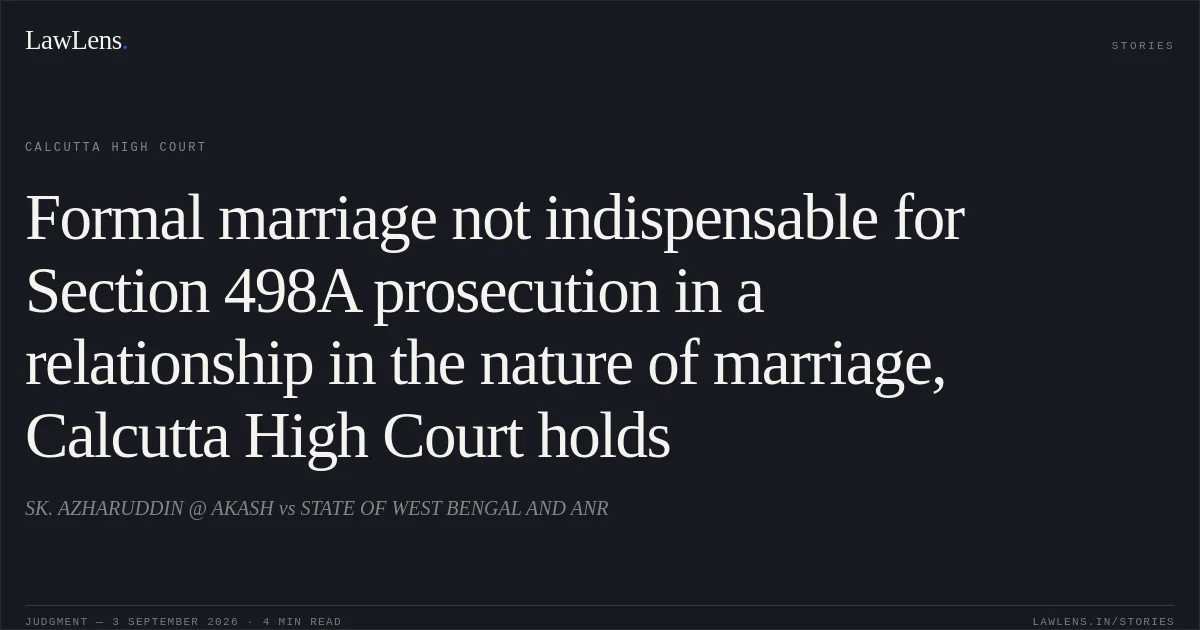
Source reference: para. 26Relying on Dr. Lokesh B.H. & Ors. v. State of Karnataka & Anr., 2026 SCC OnLine SC 1470, the Court applied a purposive interpretation of Section 498A, holding that a formal and legally flawless marriage is not an indispensable prerequisite where the relationship is in the nature of marriage and the statutory object is to prevent domestic cruelty.
Source reference: paras. 24–25The Court further applied the settled principle that proceedings should not be quashed under Section 482 CrPC where the allegations and investigation materials disclose a prima facie offence and the defence depends upon disputed questions of fact; the High Court must not conduct a mini-trial.
Source reference: paras. 32–35It also held that a judicial decision clarifying the meaning of an existing statutory provision is declaratory rather than retrospectively criminalising.
Source reference: para. 36Reasoning
The Court found that the landlord’s statement and the statements of the complainant’s parents prima facie established that the parties shared a household and were socially represented as spouses.
Source reference: paras. 27, 34The allegations that the petitioner concealed his existing marriage, induced the complainant into the relationship, and thereafter subjected her to cruelty brought the case within the protective and purposive scope of Section 498A as explained in Reema Aggrawal and Dr. Lokesh B.H.
Source reference: paras. 25–29The petitioner’s objections concerning the complainant’s prior marriage, the validity of conversion, the absence of marriage documents, and the precise nature of the relationship were treated as disputed factual matters requiring evidence and cross-examination, rather than grounds for threshold quashing.
Source reference: paras. 33–35Since the investigation had produced supporting witness statements and culminated in a charge sheet, the Court held that no manifest illegality or abuse of process was shown.
Source reference: paras. 33–35Applying the declaratory character of judicial interpretation, it also rejected the argument that Dr. Lokesh B.H. could not apply to the earlier conduct alleged in the case.
Source reference: para. 36Holding
The Court answered the first issue in the affirmative, holding that a formal, traditional, and legally unassailable marriage is not essential for maintaining a Section 498A IPC prosecution where the parties were in a relationship in the nature of marriage and the allegations disclose domestic cruelty.
It answered the second issue in the negative, holding that Section 482 CrPC could not be invoked to resolve disputed questions concerning marital status, conversion, prior marriage, or deception at the threshold.
Source reference: para. 35It further held that the interpretation in Dr. Lokesh B.H. was declaratory of the existing law and could apply to ongoing proceedings arising from earlier acts.
Source reference: para. 36Accordingly, CRR 1457 of 2024 was dismissed; interim orders, if any, were vacated; no order as to costs was made; and the Trial Court was directed to proceed expeditiously in accordance with law, uninfluenced by the incidental observations in the judgment.
Source reference: paras. 38–45Acts & Sections Cited
5 provisions across 2 statutes referred to in this judgment. Each provision opens on LawLens.
Code of Criminal Procedure, 19733
Indian Penal Code, 18602
Original Court PDF
SK. AZHARUDDIN @ AKASHvsSTATE OF WEST BENGAL AND ANR
Click to open original judgment
Original judgment, available to read, download and summarize on LawLens.in