01Facts
The petitioners participated in the West Bengal Police Constable recruitment process initiated in 2024 and challenged, in September 2026, the opportunity given to candidates formerly classified as OBC-A or OBC-B—but excluded from the revised OBC list following Kamal Chandra Das v. State of West Bengal—to seek consideration under the EWS category.
¶ 1–5, 12–16They contended that this changed the recruitment rules after the process began and disadvantaged existing EWS candidates.
¶ 6(a)–(e)The recruitment advertisement required EWS candidates to produce an income-and-asset certificate for financial year 2023–24 “or onwards”; it specified a certificate-issuance period of 1 April 2023 to 31 March 2024 and testimonial verification at interview.
¶ 6(c)–(e) · ¶ 30The State maintained that the stated financial year and issuance dates were not restrictive, and that the category-update window followed the change in OBC classification.
¶ 7(i)–(vii)The petitioners had participated in the process without challenging the advertisement.
¶ 24, 3102Issues
i.1. Whether allowing candidates excluded from the former OBC-A and OBC-B lists to seek EWS consideration after the recruitment process began impermissibly changed the rules of the game.
¶ 10–11, 17–19ii.2. Whether the advertisement’s EWS certificate requirements fixed a rigid eligibility date that prevented such candidates from relying on certificates issued later, including at the interview stage.
¶ 17–19, 27–30iii.3. Whether the petitioners could challenge these arrangements after participating in the recruitment process without protest.
¶ 24, 31–3203Law Applied
The Court applied the recruitment advertisement’s terms: an EWS certificate could relate to financial year 2023–24 “or onwards,” and testimonials were to be checked at interview.
¶ 18, 30It construed “or onwards” as extending beyond financial year 2023–24 and held that the accompanying certificate-issuance dates were indicative rather than a rigid, exclusive deadline.
¶ 18–19The Court also applied the principle that a candidate who participates in a selection process without timely objection cannot ordinarily challenge its conditions after participating.
¶ 24, 31–32It distinguished Union Public Service Commission v. Gaurav Singh, concerning the relevant date for EWS income-and-asset certificates, and Sakshi Arha v. Rajasthan High Court, concerning creamy and non-creamy layer classification, as not displacing its reading of this advertisement.
¶ 25–27It referred to Sudipta Chakraborty v. State of West Bengal in considering the significance of the recruitment notice’s terms on the crucial date.
¶ 28Provisions in the judgment · 3
the Office Memorandum (alias, unresolved) Section 4Section 5
West Bengal Police Recruitment Board Notice (alias, unresolved) Section 3
04Reasoning
The Court found that the advertisement did not confine EWS eligibility to financial year 2023–24: the words “or onwards” contemplated later financial years, while the 2023–24 issuance dates could not sensibly operate as a fixed deadline for a recruitment process continuing into 2026.
¶ 18–19Because testimonials were to be checked at interview, candidates could produce the required credentials then, subject to satisfying the applicable eligibility requirements.
¶ 30The Court considered the opportunity extended to the excluded OBC candidates a means of responding to the intervening change in classification, not an impermissible alteration of the recruitment rules; their EWS certificates did not guarantee appointment or displace other candidates’ right to compete.
¶ 15–16, 21–22It further held that the petitioners’ increased competition was not a ground to exclude otherwise eligible candidates and that their failure to object before participating weighed against their belated challenge.
¶ 20, 24, 31–3205Holding
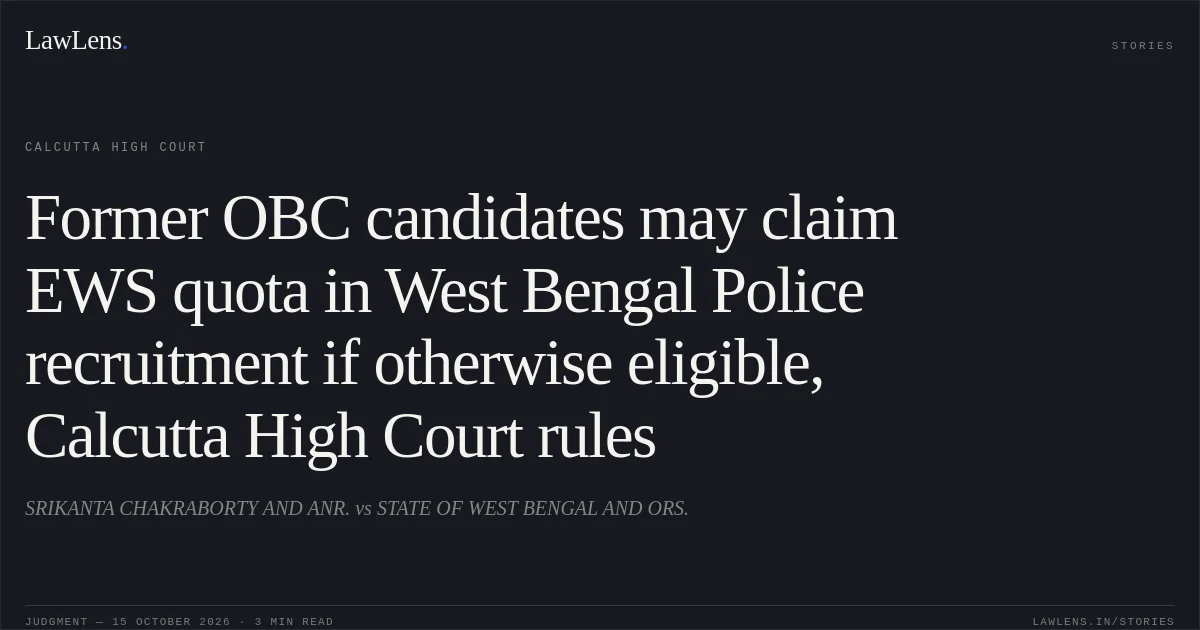
The Court held that valid EWS certificates for financial year 2023–24 or later, produced by the date of interview, were to be accepted for candidates otherwise eligible; candidates formerly classified as OBC-A or OBC-B could be considered under EWS if they met the applicable requirements.
¶ 32(A)–(B)The petitioners’ challenge failed, and the writ petition was dismissed without an order as to costs.
¶ 33–34Original Court PDF
SRIKANTA CHAKRABORTY AND ANR.vsSTATE OF WEST BENGAL AND ORS.
Click to open original judgment
Original judgment, available to read, download and summarize on LawLens.in