Facts
The parties married on 22 February 2016 through a social Hindu ceremony and registered the marriage under the Special Marriage Act, 1954.
Source reference: para. 2–3The appellant-husband instituted a suit seeking annulment under Section 25(iii) of the Act, alleging that his consent had been obtained by fraud because the respondent-wife and her family concealed her history of Idiopathic Thrombocytopenic Purpura (ITP) following splenectomy, from which she had allegedly suffered since 2007.
Source reference: para. 2–3The respondent denied concealment and asserted that the parties’ families had discussed health matters and that her father had sent her medical file, including prescriptions and blood reports, to the appellant’s father by DTDC courier on 29 January 2016.
Source reference: para. 4, 9–10The trial court dismissed the suit, holding that concealment and fraudulent intent were not proved, drawing an adverse inference from the non-examination of the appellant’s father, and rejecting the WhatsApp evidence for want of a certificate under Section 65B of the Evidence Act.
Source reference: para. 7The appellant also filed an application under Section 340 of the Code of Criminal Procedure alleging perjury by the respondent, which was rejected by the trial court.
Source reference: para. 38–39Issues
1. Whether the appellant proved that his consent to the marriage was obtained by fraud within the meaning of Section 25(iii) of the Special Marriage Act, 1954, by active concealment of the respondent’s medical condition?
Source reference: para. 17–22, 372. Whether the alleged non-disclosure of the respondent’s ITP condition constituted fraud when the appellant had the means to make reasonable inquiries before marriage?
Source reference: para. 19–20, 273. Whether the evidence on record, including the WhatsApp messages, medical papers, and the respondent’s cross-examination, established concealment, fraudulent intent, and materiality of the medical condition?
Source reference: para. 26–29, 35–374. Whether the respondent’s alleged statements in evidence warranted initiation of proceedings for perjury under Section 340 of the Code of Criminal Procedure, 1973?
Source reference: para. 38–41Law Applied
The Court applied Section 25(iii) of the Special Marriage Act, 1954, under which a marriage is voidable where consent was obtained by “coercion or fraud, as defined in the Indian Contract Act, 1872”.
Source reference: para. 17Section 17 of the Contract Act was therefore held applicable, requiring proof of active concealment, an act fitted to deceive, or silence in circumstances creating a duty to speak, coupled with an intention to deceive and induce consent.
Source reference: para. 18–19Under Section 19 of the Contract Act, a contract is not voidable where the allegedly deceived party had the means of discovering the truth with ordinary diligence.
Source reference: para. 20The burden of proving fraud lay throughout upon the appellant, and fraud had to be established by clear and cogent evidence; a decree of nullity could not be used as an alternative to divorce.
Source reference: para. 21–22Section 114, Illustration (g) of the Indian Evidence Act, 1872 permitted an adverse inference where the best available evidence was withheld, while electronic evidence required compliance with Section 65B as applied by the trial court.
Source reference: para. 25–26Proceedings under Section 340 of the Code of Criminal Procedure were held to be exceptional and discretionary, requiring a prima facie finding of deliberate and material falsehood warranting action in the interests of justice.
Source reference: para. 40–41Reasoning
The Court held that the appellant failed to prove the essential elements of fraud. His own plaint admitted that health had been discussed during the marriage negotiations, although that material admission was omitted from his affidavit-in-chief and remained unexplained.
Source reference: para. 23Since the appellant had met the respondent only once before marriage, his family—particularly his father—was central to proving what had been disclosed or concealed. The father’s non-examination justified an adverse inference under Section 114, Illustration (g) of the Evidence Act.
Source reference: para. 24–25The WhatsApp material was inadmissible for want of the requisite certificate, and the appellant’s method of creating and printing screenshots also affected its evidentiary weight.
Source reference: para. 26Even assuming that the respondent’s medical history had not been expressly disclosed, the Court found that the case involved, at most, silence. The appellant had not made any inquiry of the respondent, her family, or his own father despite having the opportunity to do so before marriage, thereby attracting the ordinary-diligence principle under Section 19 of the Contract Act.
Source reference: para. 27The appellant neither examined a doctor nor proved the medical documents through competent witnesses, and led no expert evidence that ITP post-splenectomy was materially disabling, affected cohabitation or fertility, or rendered the marriage unsafe or unworkable.
Source reference: para. 28–29The Court further held that the respondent’s unchallenged assertion that her family had disclosed the condition before marriage could not be displaced merely because the appellant disputed it; the burden remained upon him to establish fraud.
Source reference: para. 22, 36–37Since the underlying allegation of concealment was not proved, the respondent’s evidence did not disclose a deliberate falsehood warranting Section 340 proceedings. Mere contradiction, denial, or an unsuccessful defence was insufficient to establish perjury.
Source reference: para. 39–41Holding
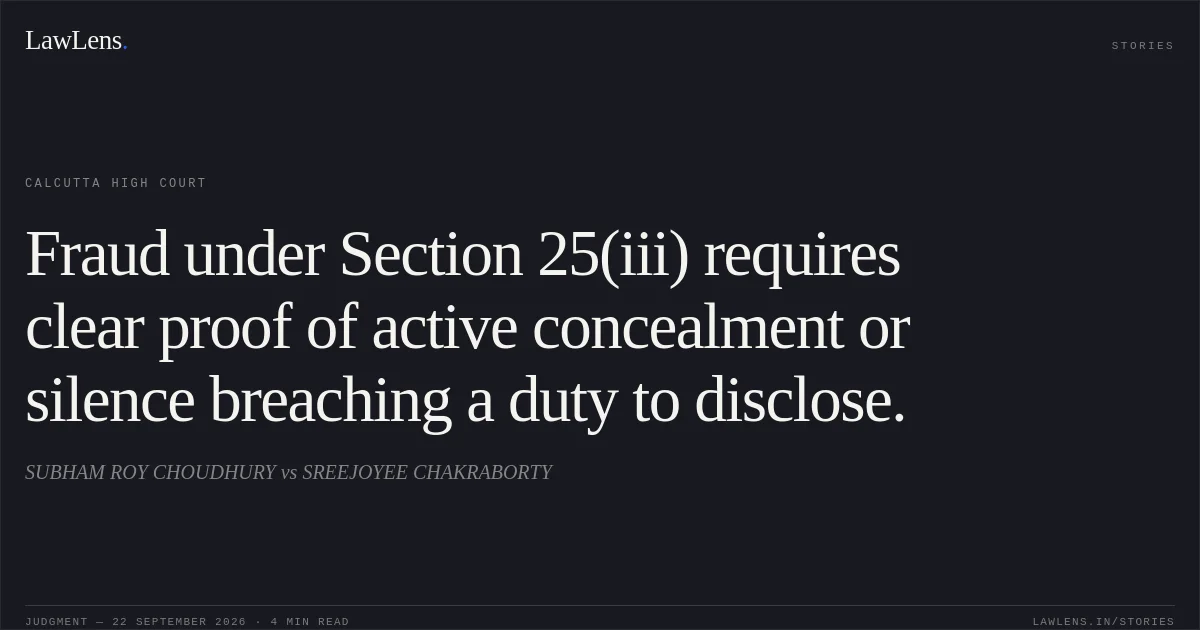
The appeal against dismissal of the annulment suit was dismissed. The Court held that the appellant failed to prove that the respondent or her family actively concealed a material medical condition with intent to deceive or induce his consent, and therefore no decree of nullity could be granted under Section 25(iii) of the Special Marriage Act.
The appeal against rejection of the Section 340 CrPC perjury application was also dismissed, as no deliberate and materially false statement warranting criminal proceedings had been established.
Source reference: para. 40–42The trial court’s judgment and decree dated 24 December 2025 were affirmed, and the appellant was directed to pay the respondent ₹1,00,000 as costs within four weeks.
Source reference: para. 42(b)–(c)Acts & Sections Cited
11 provisions across 7 statutes referred to in this judgment. Each provision opens on LawLens.
Special Marriage Act, 19541
Hindu Marriage Act, 19551
Indian Contract Act, 18721
Code of Criminal Procedure, 19732
Bharatiya Nagarik Suraksha Sanhita, 20232
Indian Penal Code, 18603
Bharatiya Nyaya Sanhita, 20231
Original Court PDF
SUBHAM ROY CHOUDHURYvsSREEJOYEE CHAKRABORTY
Click to open original judgment
Original judgment, available to read, download and summarize on LawLens.in