01Facts
The appellant, accused along with six others of mass-scale manufacture of bombs for terrorist activities, sought bail after being in custody for two years and eight months
¶ 2-3Charges were framed under the IPC, Explosive Substances Act, 1908, and the Unlawful Activities (Prevention) Act, 1967 (UAPA) on July 14, 2025
¶ 3, 7(v)The appellant’s previous bail prayer was rejected on March 17, 2025
¶ 1The NIA opposed the bail, citing the bar under Section 43D(5) of the UAPA and the seriousness of the charges against national security
¶ 4Procedural history revealed that out of 102 prosecution witnesses, only one had been partially examined over eight months due to repeated adjournments and absences of witnesses
¶ 2, 7(iv)-(v)02Issues
i.1. Whether the statutory restrictions on bail under Section 43D(5) of the UAPA can be overridden by the fundamental right to a speedy trial under Article 21 of the Constitution given the prolonged incarceration and slow trial progress
¶ 7(vi)-(vii)ii.2. Whether the appellant is entitled to bail on the grounds of parity, considering the main conspirator and other co-accused have already been enlarged on bail
¶ 7(i)-(iii)03Law Applied
The court primarily applied Section 43D(5) of the Unlawful Activities (Prevention) Act, 1967, which restricts bail if the accusations are prima facie true
¶ 4Article 21 of the Constitution of India, which guarantees the right to life and liberty
¶ 7(vii)Union of India v. K.A. Najeeb (2021), establishing that Constitutional Courts can grant bail despite statutory restraints if the trial is unlikely to conclude within a reasonable period
¶ 7(vi)Gulfisha Fatima v. State (Govt. of NCT of Delhi) (2026) regarding the assessment of individual roles over mechanical parity
¶ 6, 8Provisions in the judgment · 7 · Linked ones open on LawLens
Unlawful Activities (Prevention) Act, 1967 Section 18
Indian Penal Code, 1860 Section 201Section 304
Explosive Substances Act, 1908 Section 4Section 5Section 6
Narcotic Drugs and Psychotropic Substances Act, 1985 Section 37
04Reasoning
The Court observed that the appellant had been incarcerated for 32 months with negligible trial progress; only one of 102 witnesses was partially examined since charges were framed
¶ 2, 7(iv)The Court dismissed the NIA’s claim that the trial would conclude in ten months as improbable based on the past record of adjournments
¶ 7(v)Regarding parity, the Court noted that the "main conspirator" (Imdadul Hoque) and five other co-accused facing identical charges had already been granted bail
¶ 7(i)-(iii)While acknowledging that parity is not mechanical, the Court found no legitimate reason to deny the appellant the same privilege given the identical nature of charges
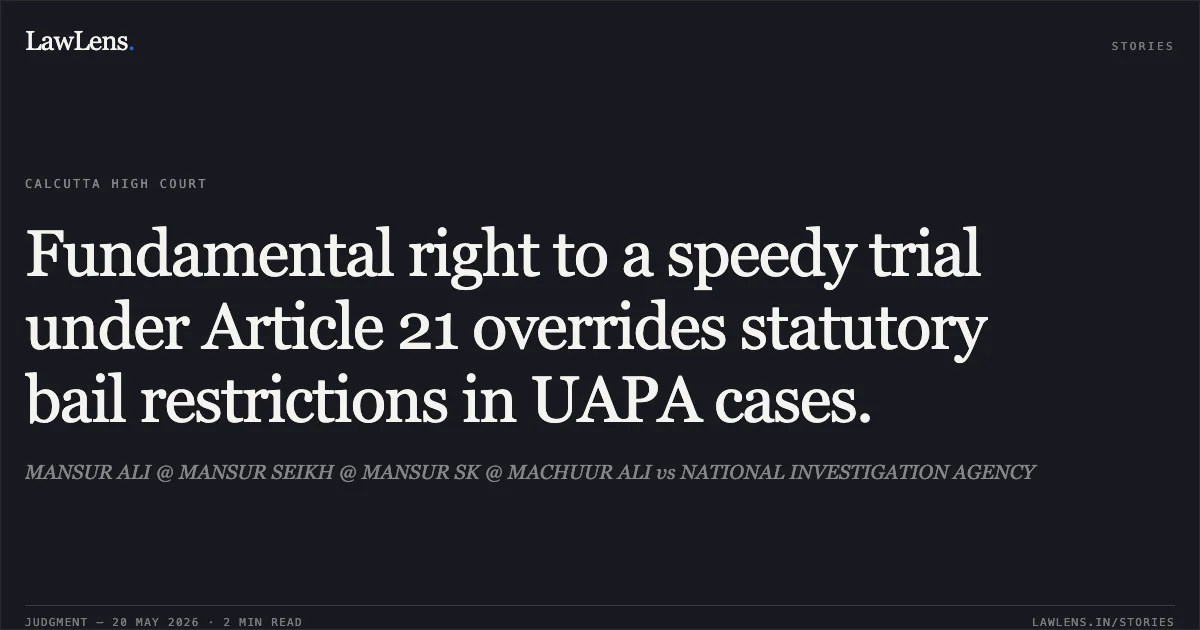
¶ 7(iii), 8The Court concluded that the fundamental right under Article 21 overrides statutory bars like Section 43D(5) to prevent unconscionable detention without conviction
¶ 7(vi)-(vii)05Holding
It held that prolonged incarceration without the prospect of a timely trial justifies the exercise of constitutional jurisdiction to grant bail regardless of UAPA restrictions
¶ 7(vi)-(vii)The Court allowed the appeal and granted bail to the appellant. The appellant was ordered to be released on a bond of Rs. 50,000/- with two sureties, subject to stringent conditions including remaining within the jurisdiction of New Town PS, weekly reporting to the IC, and allowing NIA to monitor mobile calls
¶ 10, 11The Court clarified that these observations are limited to the bail disposal and shall not influence the trial
¶ 12Original Court PDF
MANSUR ALI @ MANSUR SEIKH @ MANSUR SK @ MACHUUR ALIvsNATIONAL INVESTIGATION AGENCY
Click to open original judgment
Original judgment, available to read, download and summarize on LawLens.in