01Facts
The petitioners, accused Nos. 5 and 8, were charge-sheeted under Sections 420, 465, 468, and 471 read with Section 34 of the IPC, after the police dropped Sections 192A and 120B IPC that were alleged in the FIR.
¶ 2The prosecution alleges that, under the guise of preventive maintenance of computers in the Taluk Office, Malur, the petitioners accessed the "SQL" server and made an entry deleting an earlier entry, which favoured accused Nos. 1 to 4.
¶ 3The Jurisdictional Magistrate had permitted further investigation, and the trial Magistrate took cognizance on 27.11.2019 in Criminal Case No. 980/2019.
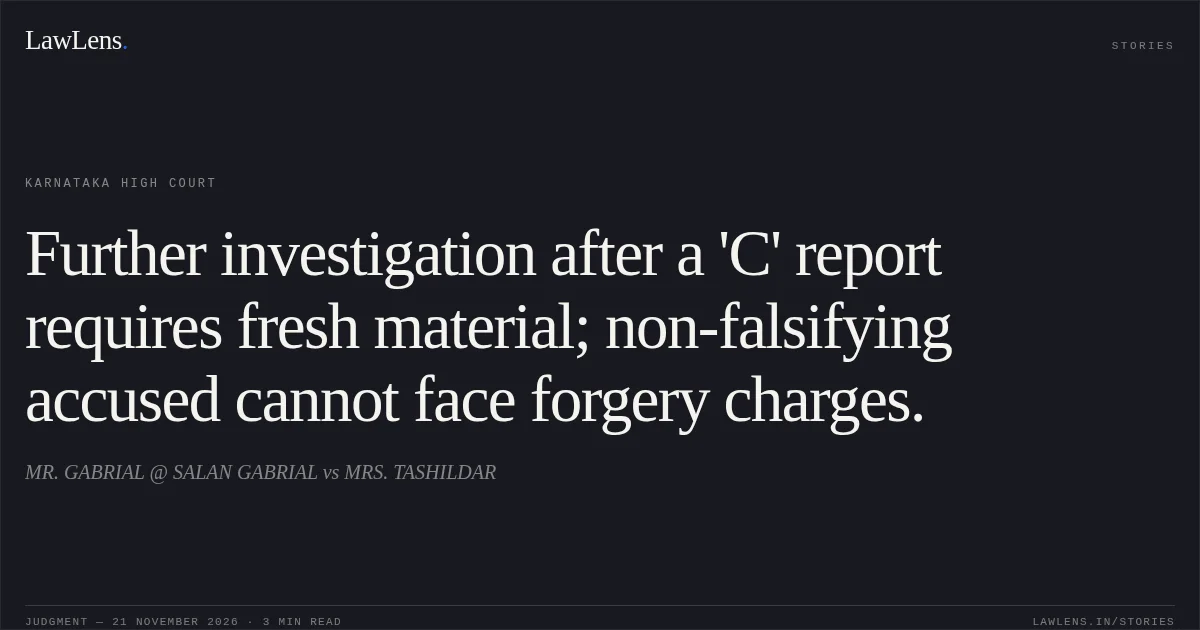
¶ 3–4The Investigating Officer had earlier filed a 'C' report (closure report), relying on the statement of the Tahsildar.
¶ 7, 12Later, based on the statement of accused No. 6, Sunil, further investigation was conducted and a charge sheet filed.
¶ 7, 13, 16The petitioners sought quashing of the cognizance order and the pending proceedings under Articles 226 and 227 of the Constitution.
¶ 1, 5The State contended that the further investigation was justified and that the petitioners accessed the server to make the entries.
¶ 9–1002Issues
i.1. Whether further investigation after filing a 'C' report, based on the statement of an accused (No. 6), constitutes "fresh material" or "credible information" justifying a charge sheet under Section 173(8) CrPC.
¶ 14–16ii.2. Whether the statement of the co-accused can form a valid basis for charge-sheeting the petitioners, given its character under Section 27 of the Evidence Act and as a confession.
¶ 17iii.3. Whether, even taking the allegations as true, the material discloses offences under Sections 420, 465, 467, 468, and 471 read with Section 34 IPC against the petitioners.
¶ 18–2403Law Applied
Section 173(8) CrPC preserves the Investigating Officer's power of further investigation after a 'C' report, but such investigation requires fresh material or credible information.
¶ 14–15Section 27 of the Evidence Act and the rule on confessions are applied to test the evidentiary character of an accused's statement.
¶ 17Sections 468 and 471 IPC require falsification of a document, and Section 34 IPC requires common intention and participation in the offence.
¶ 18–19The conflicting reports of the Tahsildar are relevant to the sustainability of the charge sheet.
¶ 20–21No Supreme Court or High Court precedent is expressly cited in the judgment.
Provisions in the judgment · 9 · Linked ones open on LawLens
Indian Penal Code, 1860 Section 34Section 192Section 420Section 424Section 465Section 467Section 468Section 471
Code of Criminal Procedure, 1973 Section 173
04Reasoning
The statement relied upon to conduct further investigation was that of accused No. 6, which was not shown to be a statement admissible under Section 27 of the Evidence Act or a confession, so its use as a basis for the charge sheet against these petitioners was open to question.
¶ 17Even assuming the co-accused's statement to be true, the petitioners did not falsify any document, so Sections 468 and 471 were not attracted.
¶ 18The charge sheet did not spell out how the petitioners shared a common intention to cheat the real owners or to cause wrongful gain to the later entrant, so Sections 420 and 34 were not made out.
¶ 19The Tahsildar had first treated the documents as genuine in the 'C' report and later reversed that position based only on the accused's statement, which remained unexplained in the charge sheet.
¶ 20–21The charge sheet disclosed no improper or illegal use of the SQL server, and the petitioners' conduct at most consisted of entering data as directed.
¶ 22–2305Holding
On the face of the allegations, no offence is made out against the petitioners, and the allegations against them in the charge sheet cannot be sustained in law.
¶ 24The Writ Petition is allowed, and the pending proceedings against the petitioners in Criminal Case No. 980/2019 are quashed. The quashing shall not prejudice the prosecution against the remaining accused.
¶ 25(i)–(ii)Original Court PDF
MR. GABRIAL @ SALAN GABRIALvsMRS. TASHILDAR
Click to open original judgment
Original judgment, available to read, download and summarize on LawLens.in