01Facts
Manubhai Vankar was travelling as a passenger in an auto-rickshaw from Sai Mandir to Himmatnagar on 12 December 2011 when another rickshaw, allegedly driven rashly and negligently by Opponent No. 1, collided with it near Virpur village. Manubhai died at the spot.
p. 2 · ¶ 3.1An FIR was registered at Himmatnagar Rural Police Station in C.R. I-68 of 2011 against the other rickshaw’s driver.
p. 2 · ¶ 3.1His widow and son filed a claim petition under Section 166 of the Motor Vehicles Act, 1988, seeking Rs.15 lakhs, asserting that the deceased was a mason earning Rs.10,000 per month and was the family’s sole breadwinner.
p. 2 · ¶ 3.1The Motor Accident Claims Tribunal awarded Rs.5,29,000 with interest at 9% per annum against Opponent Nos.1 to 3 and exonerated Opponent Nos.4 to 6.
p. 1 · ¶ 1The claimants appealed under Section 173 of the Motor Vehicles Act, contending that the deceased’s income had been assessed too low, that future prospects had not been awarded, and that the amounts under the non-pecuniary heads were inadequate.
p. 3 · ¶ 4The High Court proceeded on the basis that the deceased was 45 years old, had no permanent source of income, and left two dependants.
p. 4 · ¶ 7–902Issues
i.1. Whether the Tribunal assessed the deceased’s income inadequately for computing the loss of dependency.
p. 3 · ¶ 4 · p. 4 · ¶ 7ii.2. Whether the claimants were entitled to an addition towards future prospects despite the deceased having no permanent employment.
p. 4 · ¶ 7–9iii.3. Whether the compensation under consortium, funeral expenses, and loss of estate required enhancement in accordance with governing Supreme Court precedents.
p. 3 · ¶ 4 · p. 4 · ¶ 9–10iv.4. Whether the Tribunal’s findings exonerating Opponent Nos.4 to 6 and fixing liability upon Opponent No.3 required interference.
p. 3 · ¶ 5–6 · p. 6 · ¶ 1403Law Applied
The Court applied Sections 166 and 173 of the Motor Vehicles Act, 1988, governing claims for compensation arising from motor accidents and appeals against awards.
p. 2 · ¶ 3.3It relied on Sarla Verma v. Delhi Transport Corporation, which provides principles for deductions towards personal expenses and selection of the appropriate multiplier; National Insurance Co. Ltd. v. Pranay Sethi, which standardised additions for future prospects and conventional heads of compensation; and Magma General Insurance Co. Ltd. v. Nanu Ram, recognising separate entitlements to spousal and parental consortium.
p. 3 · ¶ 4 · p. 4 · ¶ 9–10The Court also relied on V. Pathmavathi v. Bharti AXA General Insurance Co. Ltd. for the principle that future prospects are an integral component of “just compensation” and are not restricted to persons in permanent government employment.
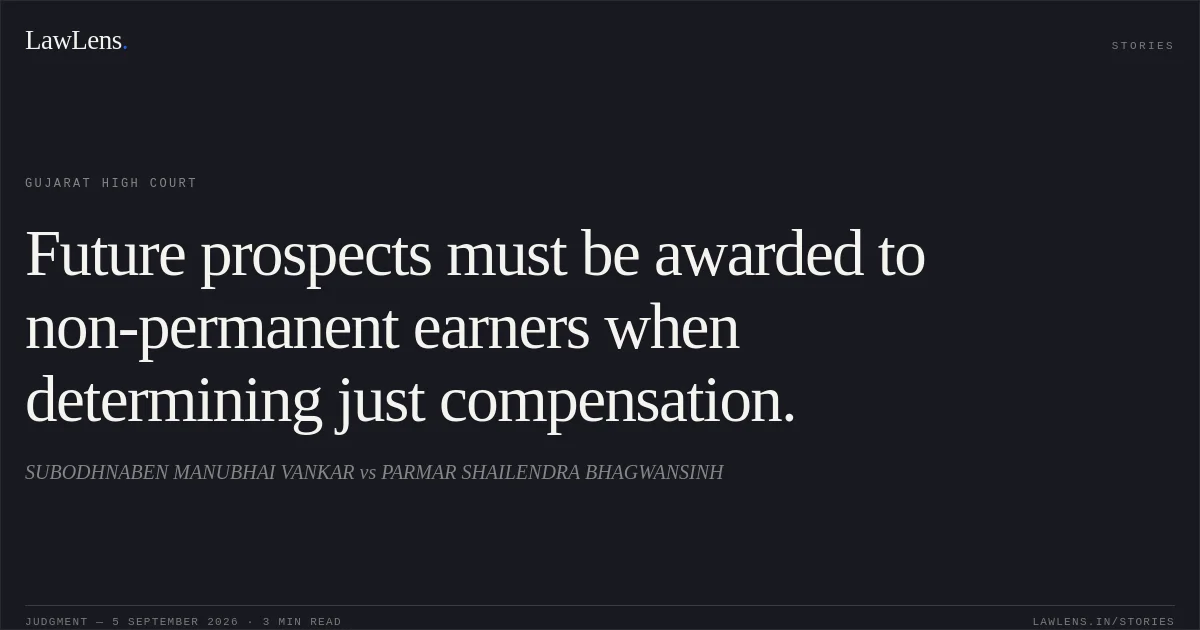
p. 4 · ¶ 8Accordingly, a self-employed or non-permanently employed deceased aged 45 was entitled to a 25% addition for future prospects, deduction of one-third for personal expenses where there were two dependants, and a multiplier of 14.
p. 4 · ¶ 9Provisions in the judgment · 2 · Linked ones open on LawLens
Motor Vehicles Act, 1988 Section 166Section 173
04Reasoning
The Court found that the Tribunal had assessed the deceased’s income on the lower side.
p. 4 · ¶ 7Although the claimants had not produced concrete documentary evidence of income, the deceased’s stated occupation as a mason justified fixing his monthly income at Rs.5,000, corresponding to the minimum wage for a skilled worker.
p. 4 · ¶ 7Since he was 45 years old and had no permanent employment, the Court added 25% towards future prospects under the principles in Pranay Sethi and V. Pathmavathi.
p. 4 · ¶ 7–9From the resulting monthly income of Rs.6,250, one-third was deducted towards personal expenses because there were two dependants, leaving a monthly dependency of approximately Rs.4,167.
p. 5 · ¶ 10Applying the multiplier of 14, the loss of dependency was calculated at Rs.7,00,056, as against Rs.5,04,000 awarded by the Tribunal.
p. 5 · ¶ 10The Court further enhanced the conventional compensation to Rs.96,400 for consortium, Rs.18,150 for funeral expenses, and Rs.18,150 for loss of estate, recognising spousal consortium for the widow and parental consortium for the son.
pp. 5–6 · ¶ 10As negligence and the Tribunal’s exoneration of Opponent Nos.4 to 6 were not challenged, the Court did not disturb those findings.
p. 3 · ¶ 6 · p. 6 · ¶ 1405Holding
The appeal was allowed.
pp. 5–6 · ¶ 10–11The total compensation was enhanced from Rs.5,29,000 to Rs.8,32,756, resulting in additional compensation of Rs.3,03,756.
pp. 5–6 · ¶ 10–11Opponent No.3, United India Insurance Company Ltd., was directed to deposit the enhanced amount with interest at 9% per annum from the date of filing of the claim petition until realization, within twelve weeks of receiving the order.
p. 6 · ¶ 14The Tribunal was directed to disburse the awarded amount, with accrued interest, to the claimants after verification and compliance with the applicable procedure, subject to deduction of court fees where payable.
p. 6 · ¶ 15–16Original Court PDF
SUBODHNABEN MANUBHAI VANKARvsPARMAR SHAILENDRA BHAGWANSINH
Click to open original judgment
Original judgment, available to read, download and summarize on LawLens.in