Facts
The petitioner sought quashing of FIR Crime No. 13/2022 registered at Police Station Gola Ka Mandir, Gwalior, initially for offences under Sections 376, 506 and 34 of the IPC, along with consequential proceedings in S.T. No. 197/2022, on the basis of a compromise.
Source reference: para. 1The prosecutrix alleged that the petitioner called her to his house, administered an intoxicating substance, and, along with another accused, committed rape upon her.
Source reference: para. 2She further alleged that the accused recorded the incident, threatened to kill her and her husband, and later threatened to circulate the video unless she submitted to further sexual relations.
Source reference: para. 2During investigation, Sections 376-D of the IPC and Sections 67 and 67-A of the Information Technology Act, 2000, were also added.
Source reference: para. 6The parties filed compromise applications supported by affidavits, and the Principal Registrar verified their identities, signatures, and the voluntary nature of the settlement.
Source reference: paras. 3–4Issues
Whether the High Court could exercise its inherent jurisdiction under Section 528 of the BNSS to quash the FIR and consequential criminal proceedings for offences under Sections 376, 376-D, 506 and 34 of the IPC and Sections 67 and 67-A of the Information Technology Act solely on the basis of a compromise between the accused and the prosecutrix?
Source reference: para. 9Whether a voluntary and duly verified compromise could justify quashing proceedings involving allegations of gang rape, creation or circulation of an obscene video, and criminal intimidation, given their serious societal impact?
Source reference: paras. 10–16Law Applied
The Court applied Section 528 of the BNSS, which preserves the High Court’s inherent power to prevent abuse of process and secure the ends of justice, but requires that such power be exercised sparingly and with caution.
Source reference: para. 10It considered the offences under Sections 376 and 376-D of the IPC, Section 506 of the IPC, and Sections 67 and 67-A of the Information Technology Act, 2000.
Source reference: no citationRelying on Gian Singh v. State of Punjab, (2012) 10 SCC 303, the Court held that heinous offences such as rape, murder and dacoity, having serious societal ramifications, cannot ordinarily be quashed merely on the basis of compromise.
Source reference: para. 12Narinder Singh v. State of Punjab, (2014) 6 SCC 466 was relied upon for the principle that serious offences, particularly under Section 376 IPC, fall outside the category of cases amenable to quashing on settlement.
Source reference: para. 13Under State of Madhya Pradesh v. Laxmi Narayan, (2019) 5 SCC 688, criminal proceedings involving heinous offences or offences having an adverse impact on society cannot be quashed merely because the victim and accused have settled.
Source reference: para. 14Reasoning
The Court accepted that the compromise had been voluntarily entered into and duly verified, but held that this factor was insufficient to justify quashing.
Source reference: paras. 3–4, 16The allegations involved gang rape after administration of an intoxicating substance, recording of an obscene video, threats to circulate the video, and threats to kill the prosecutrix and her husband.
Source reference: paras. 2, 11The addition of Section 376-D IPC and Sections 67 and 67-A of the Information Technology Act reinforced the grave and non-private character of the alleged offences.
Source reference: paras. 6, 11Applying the principles in Gian Singh, Narinder Singh and Laxmi Narayan, the Court reasoned that rape and gang rape are offences against the dignity of women and society at large, rather than merely private disputes.
Source reference: paras. 11–16Consequently, the prosecutrix’s consent to the compromise could not override the broader public interest in prosecution.
Source reference: paras. 11–16Holding
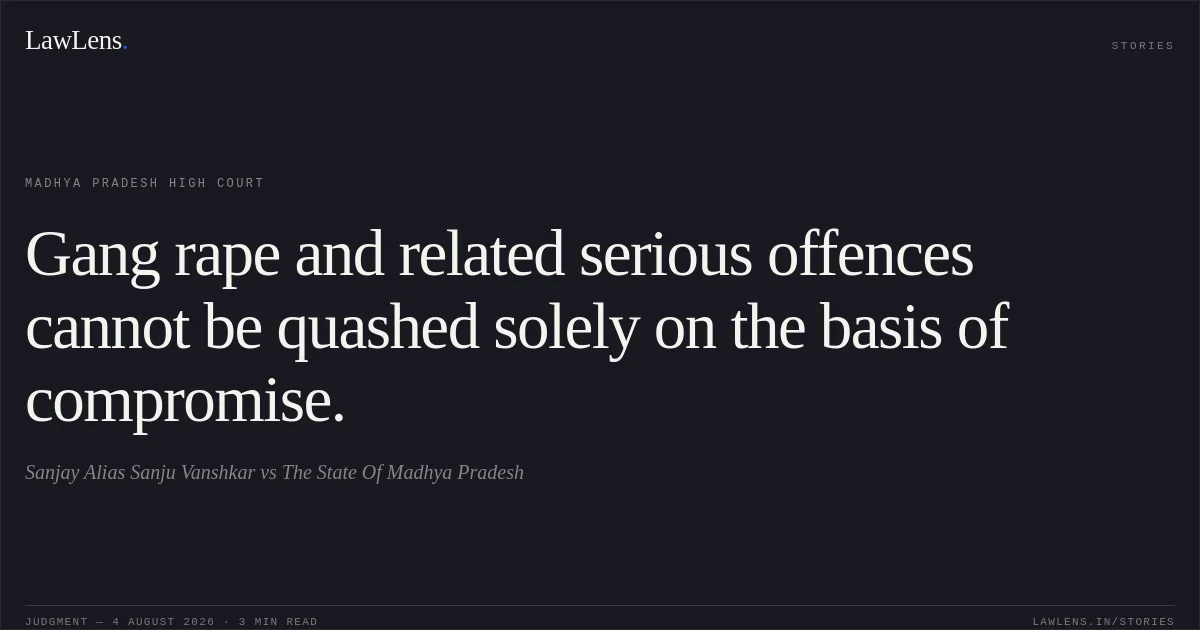
The Court held that the FIR and consequential criminal proceedings relating to the alleged offences of rape, gang rape, criminal intimidation and offences under the Information Technology Act could not be quashed solely on the basis of compromise.
It declined to exercise its inherent jurisdiction under Section 528 of the BNSS and dismissed the petition.
Source reference: no citationThe compromise applications, I.A. Nos. 7165/2026 and 7167/2026, were also disposed of.
Source reference: para. 18Acts & Sections Cited
5 provisions across 3 statutes referred to in this judgment. Each provision opens on LawLens.
Bharatiya Nagarik Suraksha Sanhita, 20231
Indian Penal Code, 18603
Information Technology Act, 20001
Original Court PDF
Sanjay Alias Sanju VanshkarvsThe State Of Madhya Pradesh
Click to open original judgment
Original judgment, available to read, download and summarize on LawLens.in