01Facts
The petitioner, appointed Assistant Executive Engineer (Civil) on 10.07.2001 through a UPSC-conducted examination, was promoted to Executive Engineer on 01.10.2009 and posted at Leh, Jammu and Kashmir.
¶ 3While serving as Officer Commanding, 51 Road Construction Company, Leh, an accident involving explosives occurred, which was attributed to mishandling by personnel under his command.
¶ 3A Memorandum of Charges dated 21.03.2012 was issued; the petitioner denied the allegations on 13.04.2012 and sought a personal hearing.
¶ 3The Disciplinary Authority appointed an Inquiring Authority on 07.06.2012, which held the charges proved. The report was served on 09.02.2015, and the petitioner submitted a representation on 21.02.2015.
¶ 3By order dated 27.11.2015, the Disciplinary Authority held the charges partially proved and imposed the penalty of withholding three increments without cumulative effect.
¶ 3The petitioner later moved to Guwahati, where he has been attached as Officer on Special Duty, East, since 10.02.2015.
¶ 3The petitioner sought quashing of the Memorandum of Charges, the Enquiry Report, and the punishment order, and exoneration with consequential benefits.
¶ 202Issues
i.1. Whether the disciplinary proceedings and penalty are vitiated for non-compliance with the DoPT guidelines (OM dated 10.05.2011 and 05.03.2014) requiring consultation with the UPSC on the Inquiry Report and the petitioner's representation before the final order.
¶ 4, 12-13ii.2. Whether consultation with the UPSC was mandatory before imposing a minor penalty under Rule 11(iv) read with Rule 16(e) of the CCS (CCA) Rules, 1965, in the case of a civilian member of the Border Roads Organisation (BRO).
¶ 5iii.3. Whether Clause 5(2) of the UPSC (Exemption from Consultation) Regulations, 1958, as clarified by the OM dated 24.10.2019, exempts the petitioner from UPSC consultation.
¶ 6-7, 16, 1803Law Applied
Rule 16(e) and Rule 11(iv) of the CCS (CCA) Rules, 1965, which require UPSC consultation before major penalties and bar minor penalties absent such consultation where it is necessary.
¶ 5Clause 5(2) of the UPSC (Exemption from Consultation) Regulations, 1958 provides that UPSC consultation is unnecessary in disciplinary matters affecting a person belonging to a Defence service (Civilian).
¶ 6The DoPT OMs of 10.05.2011 and 05.03.2014 prescribe forwarding the Inquiry Report and representation to the UPSC, furnishing its advice, and allowing a further representation before a final decision; the Court treated these as statutory and mandatory in character.
¶ 4, 15The MoD OM dated 24.10.2019 clarifies that Clause 5(2) applies to serving GREF officers of the BRO in disciplinary proceedings under the CCS (CCA) Rules.
¶ 7, 16Article 33 of the Constitution, as applied in R. Viswan v. Union of India (1983) 3 SCC 401, treats BRO civilian members as members of the Armed Forces for the purposes of fundamental rights, and R. Viswan recognises a dual disciplinary authority under the Army Act and the CCS (CCA) Rules.
¶ 9-10Mohammed Ansari v. Union of India (2017) 3 SCC 740 holds that GREF is an integral part of the Armed Forces, reaffirming this position.
¶ 10, 19The coordinate bench decision in Randhir Kumar & Ors. v. Union of India (WP(C) No. 4861/2024, dated 14.07.2026) was relied upon.
¶ 10Provisions in the judgment · 1 · Linked ones open on LawLens
Army Act, 1950 Section 29
04Reasoning
The Court first accepted that the DoPT OMs of 2011 and 2014 carry statutory force and required UPSC consultation in ordinary cases.
¶ 15It then held that the petitioner's status as a civilian member of the BRO brought him within Clause 5(2) of the 1958 Regulations, as clarified by the 2019 MoD OM.
¶ 17-18In reaching this conclusion, the Court noted that the Inquiry Authority had recommended departmental rather than court-martial proceedings, because the petitioner was civilian personnel, which confirmed that the CCS (CCA) Rules applied.
¶ 17The Court then reasoned that BRO civilians are members of the Armed Forces under Article 33 and that BRO came under the Ministry of Defence in 2015, so Clause 5(2) "squarely applies" and UPSC consultation was not required.
¶ 18The Court relied on Ansari to confirm GREF's integration with the Armed Forces.
¶ 19The judgment does not expressly decide the petitioner's contention that the 2019 OM cannot govern proceedings initiated in 2012, although the Court applied it to the petitioner's case.
¶ 13, 16, 18The Court also does not reconcile its statement that the petitioner is not a regular member of the armed forces with its reliance on Article 33 status.
¶ 17, 1805Holding
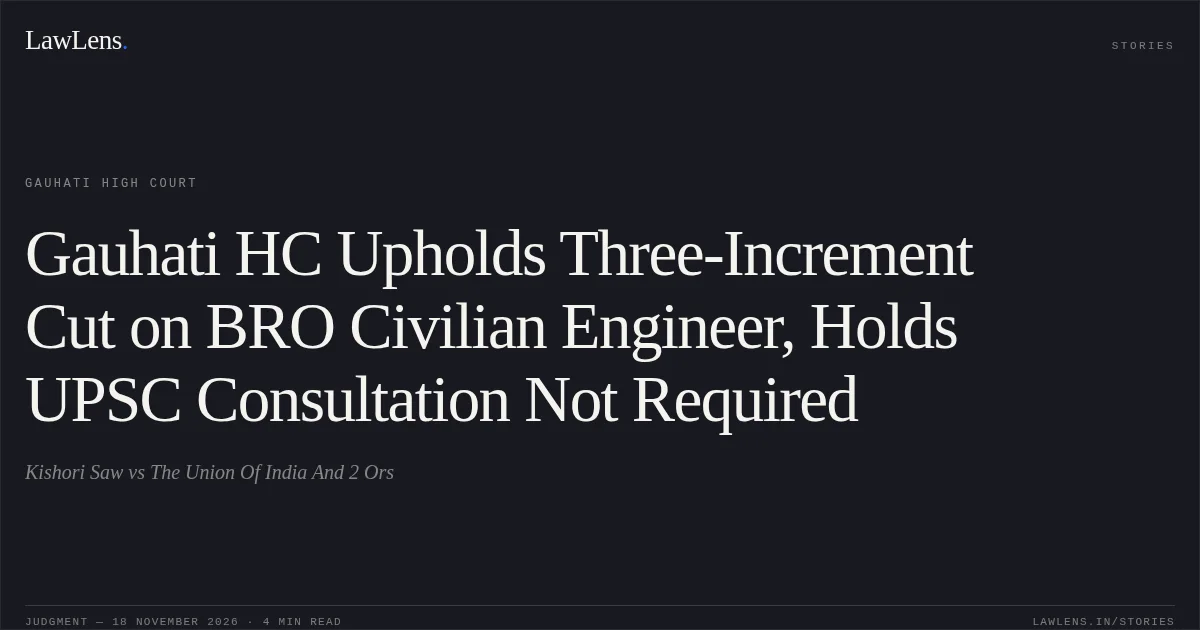
The Court held that the petitioner's challenge lacks merit. Under Clause 5(2) of the UPSC (Exemption from Consultation) Regulations, 1958, as clarified by the MoD OM dated 24.10.2019, no UPSC consultation was necessary before the penalty was imposed, so the DoPT-based procedural objection fails.
¶ 18, 20The Court dismissed the writ petition and upheld the Enquiry Report and the punishment order dated 27.11.2015 (withholding three increments without cumulative effect).
¶ 20No order as to costs was made.
¶ 21Original Court PDF
Kishori SawvsThe Union Of India And 2 Ors
Click to open original judgment
Original judgment, available to read, download and summarize on LawLens.in