Facts
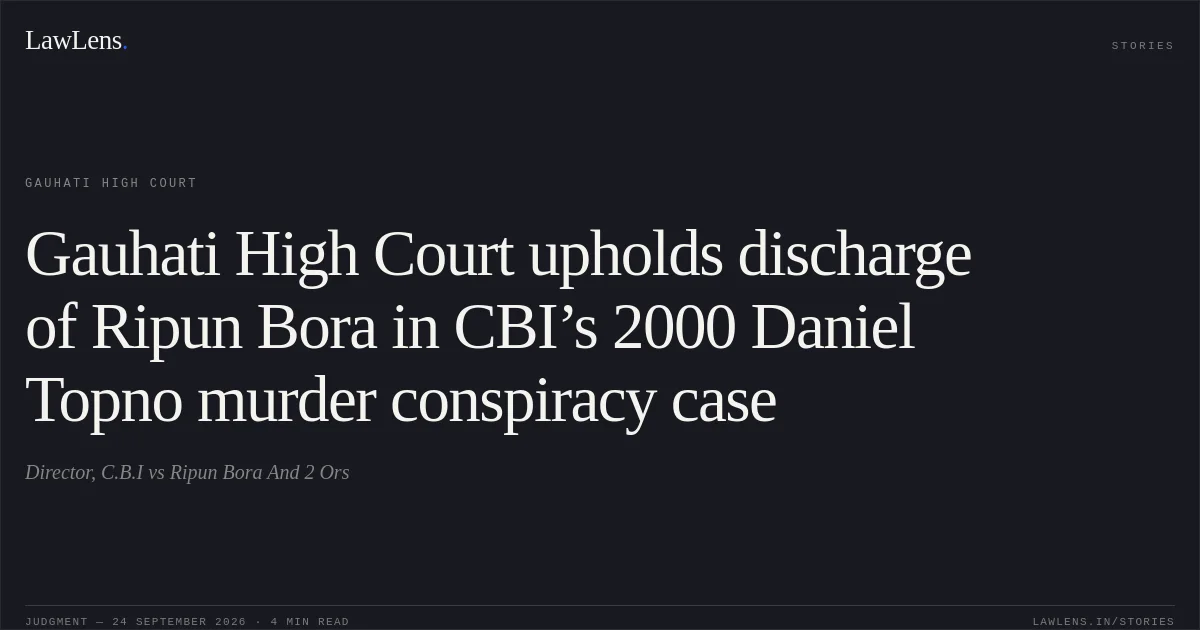
Daniel Topno, a tea-tribe leader, was murdered by unknown persons on 27 September 2000 while returning home by bicycle. An FIR was registered at Gohpur Police Station under Section 302 IPC.
Source reference: pp.3–6The Assam Police and thereafter the CID investigated the matter and filed a charge-sheet against Narayan Gour and Uma Kanta Mizar alias Kale Mizar. On a subsequent direction of the Gauhati High Court, the CBI investigated the case and filed a charge-sheet against Ripun Bora under Sections 120B/302 IPC and against Kamal Nath and Pulin Phukan under Section 302 IPC.
Source reference: pp.3–6Charges were initially framed against the accused, but the order was set aside by the High Court and the matter was remanded for fresh consideration.
Source reference: pp.5–6The Sessions Judge thereafter discharged Ripun Bora and Pulin Phukan under Section 227 CrPC, holding that the material did not disclose sufficient grounds to proceed against them.
Source reference: pp.6, 25–30The CBI challenged the discharge order in the present revision petition under Sections 397/401 read with Section 482 CrPC and Article 227 of the Constitution.
Source reference: p.3Issues
1. Whether the Sessions Judge acted illegally, improperly, or perversely in discharging Ripun Bora and Pulin Phukan under Section 227 CrPC?
Source reference: pp.17–24, 31–352. Whether the alleged confession of co-accused Kamal Nath, who was not being jointly tried with the respondents, could be relied upon to frame charges against them under Section 30 of the Evidence Act?
Source reference: pp.33–363. Whether the alleged disclosure by Kale Mizar to police officer N. Singh constituted legally sufficient material to establish a prima facie case or grave suspicion against the respondents?
Source reference: pp.25–28, 31–334. Whether the alleged confession of Kamal Nath could be relied upon despite its allegedly exculpatory character and non-compliance with the safeguards governing recording of confessions under Section 164 CrPC?
Source reference: pp.36–41Law Applied
The Court applied Sections 397/401 and 482 CrPC concerning revisional and inherent jurisdiction, and Section 227 CrPC governing discharge of an accused.
Source reference: pp.17–25At the stage of discharge, the court must sift the prosecution material to determine whether a prima facie case or grave suspicion exists, without conducting a mini-trial or determining the ultimate probative value of the evidence; however, the material must disclose a legally sustainable basis for proceeding.
Source reference: pp.17–25The Court relied on Prafulla Kumar Samal v. State of Bihar, P. Vijayan v. State of Kerala, M.E. Shivalingamurthy v. CBI, Amit Kapoor v. Ramesh Chander, and Sudershan Singh Wazir v. State (NCT of Delhi) on the limited scope of discharge and revisional review.
Source reference: pp.17–25Under Sections 25 and 30 of the Evidence Act, a confession made to a police officer is inadmissible, and a co-accused’s confession may be considered against another accused only where the accused persons are jointly tried for the same offence; in any event, such confession is weak evidence and cannot ordinarily constitute the sole basis for framing a charge.
Source reference: pp.33–36A self-exculpatory statement is not a confession capable of supporting a prosecution against another accused.
Source reference: pp.36–38The safeguards under Section 164 CrPC must be complied with in substance, including ensuring voluntariness, freedom from police influence, and adequate time for reflection; material non-compliance undermines the reliability of the confession.
Source reference: pp.38–41Reasoning
The High Court held that the CBI’s witness statements did not directly implicate Ripun Bora or Pulin Phukan in the conspiracy or murder.
Source reference: pp.31–33The only material concerning Ripun Bora was N. Singh’s account of an alleged statement made by Kale Mizar during police interrogation. This material was not independently recorded, was absent from the relevant case diary and contemporaneous investigation records, and was inconsistent with Kale Mizar’s earlier police statement.
Source reference: pp.31–33Since it originated from an alleged police confession and was not supported by independent evidence, it could not establish a legally sufficient prima facie case.
Source reference: pp.31–33The Court further held that Kamal Nath was not being jointly tried with the respondents because his case had been referred to the Juvenile Justice Board. Consequently, his statement could not be used under Section 30 of the Evidence Act against the respondents.
Source reference: pp.33–41In addition, the statement was treated as exculpatory because Kamal Nath did not implicate himself in the offence while allegedly blaming others.
Source reference: pp.36–38The Court also found deficiencies in the procedure followed while recording the Section 164 statement, particularly the failure to ensure a fresh and adequate period of reflection and freedom from investigative influence.
Source reference: pp.38–41Although the Court reiterated that a trial court must not conduct a mini-trial at the stage of framing charge, it held that the present case contained no admissible or independent material giving rise to grave suspicion.
Source reference: pp.41–43The alleged electoral motive attributed to Ripun Bora was found to be a presumption based on another presumption concerning Daniel Topno’s past electoral performance, and therefore could not independently justify framing a charge.
Source reference: pp.41–43Holding
The High Court answered the issues against the CBI.
It held that the Sessions Judge’s order discharging Ripun Bora and Pulin Phukan under Section 227 CrPC was neither illegal, improper, nor perverse.
Source reference: pp.44–47The alleged police disclosure of Kale Mizar was inadmissible and unsupported; Kamal Nath’s statement could not be used under Section 30 of the Evidence Act because he was not jointly tried with the respondents, and the statement was exculpatory and procedurally unreliable.
Source reference: pp.44–47The revision petition was accordingly dismissed, with the parties directed to bear their own costs, and the record was ordered to be returned to the court below.
Source reference: p.47Acts & Sections Cited
9 provisions across 2 statutes referred to in this judgment. Each provision opens on LawLens.
Code of Criminal Procedure, 19738
Indian Penal Code, 18601
Original Court PDF
Director, C.B.IvsRipun Bora And 2 Ors
Click to open original judgment
Original judgment, available to read, download and summarize on LawLens.in