Facts
Opposite Party No. 2, Archana Kumari, alleged that she married Petitioner No. 1 on 28 January 2013 and that her family gave cash, money through bank transfer, and other articles as dowry. She alleged that the petitioners demanded a gold chain and motorcycle, subjected her to physical and mental cruelty for dowry, denied her food, assaulted her family members, retained her belongings, and ultimately ousted her from the matrimonial home. She claimed to have been residing with her parents since 19 January 2014.
Source reference: pp. 2–3, para. 3The complainant initially filed Complaint Case No. 834(C) of 2015, which was referred for investigation under Section 156(3) of the Code of Criminal Procedure, 1973. The matter was registered as Bhojpur Mahila P.S. Case No. 75 of 2016 for offences under Sections 498A/34 of the Indian Penal Code and Sections 3/4 of the Dowry Prohibition Act. Following investigation, the police submitted a final form/charge-sheet dated 29 February 2016. The complainant thereafter filed a protest petition, which was treated as Complaint Case No. 1408(C) of 2016.
Source reference: pp. 3–4, para. 4The Sub-Divisional Judicial Magistrate, Bhojpur at Ara, took cognizance of offences under Sections 498A/34 IPC and Section 4 of the Dowry Prohibition Act by order dated 25 May 2018. The petitioners sought quashing of that order and all consequential proceedings under Section 482 CrPC.
Source reference: p. 1, para. 2The petitioners relied upon an ex parte divorce decree passed by the Family Court, Ara, in Matrimonial Case No. 155 of 2015, dated 26 November 2016, which was not challenged by the complainant. They also relied upon the complainant’s undertaking/declaration expressing that she did not wish to continue her matrimonial relationship with Petitioner No. 1. It was further argued that the allegations against the in-laws were general and omnibus in nature.
Source reference: pp. 4–5, paras. 5–6Issues
Whether the cognizance order dated 25 May 2018 and the consequential criminal proceedings under Sections 498A/34 IPC and Section 4 of the Dowry Prohibition Act should be quashed under Section 482 CrPC as an abuse of the process of court?
Source reference: p. 1, para. 2; pp. 10–11, paras. 9–10Whether the general and omnibus allegations against the petitioner-in-laws, considered alongside the dissolution of the marriage and the complainant’s stated unwillingness to continue the matrimonial relationship, justified exercise of the High Court’s inherent jurisdiction?
Source reference: pp. 4–5, paras. 5–6; pp. 10–11, para. 9Law Applied
The Court exercised its inherent jurisdiction under Section 482 CrPC to prevent abuse of the process of court and secure the ends of justice. The alleged substantive offences were under Sections 498A and 34 IPC, concerning cruelty by the husband or his relatives and acts done in furtherance of common intention, and Section 4 of the Dowry Prohibition Act, concerning demand for dowry.
Source reference: p. 1, para. 2Relying on Abhishek v. State of Madhya Pradesh, the Court reiterated that quashing jurisdiction must be exercised sparingly and that the High Court ordinarily should not assess the reliability or genuineness of allegations at the quashing stage.
Source reference: pp. 5–6, para. 7However, under State of Haryana v. Bhajan Lal, proceedings may be quashed where the allegations, even if accepted at face value, do not disclose an offence, are inherently improbable, or are manifestly mala fide and instituted to wreak vengeance.
Source reference: pp. 8–10, para. 7The Court also relied on Kahkashan Kausar v. State of Bihar, Preeti Gupta v. State of Jharkhand, and Neelu Chopra v. Bharti for the principle that vague, general, and omnibus allegations against the husband’s relatives, without particulars of individual roles, may amount to abuse of process.
Source reference: pp. 6–8, paras. 13–15Mahmood Ali v. State of U.P. was relied upon for the proposition that, in cases alleging frivolous or vexatious prosecution, the Court may examine the surrounding circumstances with care and read beyond the bare allegations in the complaint.
Source reference: p. 8, para. 16Reasoning
The Court noted that the complainant’s marriage with Petitioner No. 1 had already been dissolved by an ex parte divorce decree in 2016, which had not been challenged and had substantially attained finality. The complainant had also expressly declared that she did not wish to continue the matrimonial relationship with Petitioner No. 1.
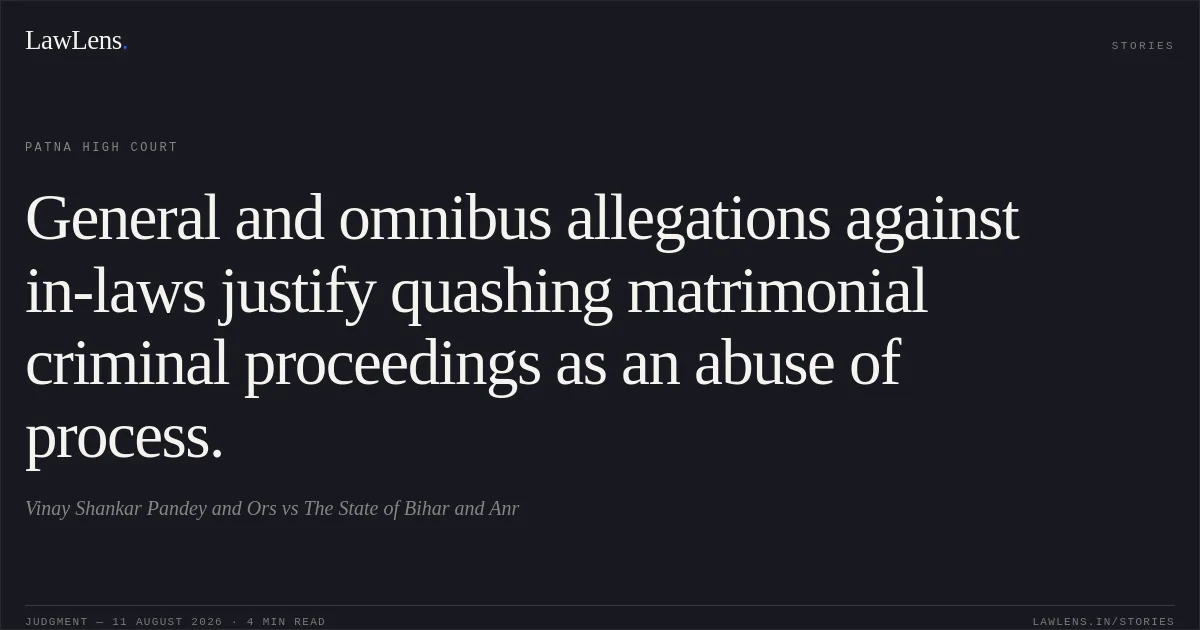
Source reference: p. 10, para. 9Against Petitioner Nos. 2 and 3, who were the in-laws, the allegations of mental and physical cruelty were found to be general and omnibus, without sufficiently specific particulars establishing their individual participation in the alleged offences.
Source reference: p. 10, para. 9Applying the principles in Bhajan Lal, Kahkashan Kausar, Preeti Gupta, and Neelu Chopra, the Court concluded that continuation of the prosecution in these circumstances would serve no legitimate purpose and would amount to abuse of the process of law.
Source reference: pp. 6–10, paras. 13–17; p. 10, para. 9Holding
The High Court allowed the petition under Section 482 CrPC. It set aside and quashed the cognizance order dated 25 May 2018 passed by the Sub-Divisional Judicial Magistrate, Bhojpur at Ara, in Complaint Case No. 1408(C) of 2016, together with all consequential proceedings against the petitioners.
The Court directed that a copy of the judgment be transmitted to the trial court along with the records, if any.
Source reference: p. 11, para. 11Acts & Sections Cited
5 provisions across 3 statutes referred to in this judgment. Each provision opens on LawLens.
Indian Penal Code, 18601
Dowry Prohibition Act, 19611
Code of Criminal Procedure, 19733
Original Court PDF
Vinay Shankar Pandey and OrsvsThe State of Bihar and Anr
Click to open original judgment
Original judgment, available to read, download and summarize on LawLens.in