Facts
Opposite Party No. 2 alleged that she married Amit Suman on 21 May 2011 and that, after marriage, her husband and in-laws demanded ₹3 lakh for establishing an air-conditioned flower shop. She alleged repeated cruelty, assault, dowry demands, an attempt to burn her with kerosene, and her ouster from the matrimonial home on 14 August 2013 after her stridhan was allegedly retained. A subsequent panchayati on 27 March 2015 allegedly failed because the accused insisted upon payment of ₹2 lakh for her return.
Source reference: paras. 3(I)–(VII), pp. 2–4After recording the complainant’s solemn affirmation and the statements of three enquiry witnesses, the learned Sub-Divisional Judicial Magistrate, Patna City, took cognizance on 4 July 2016 against the petitioners and others for offences under Sections 498-A, 341 and 323 of the Indian Penal Code and Sections 3/4 of the Dowry Prohibition Act. The four petitioners, who were the complainant’s in-laws, invoked the High Court’s inherent jurisdiction seeking quashing of the cognizance order and consequential proceedings, contending that the allegations against them were general and omnibus.
Source reference: paras. 4–6, pp. 4–5Issues
Whether the allegations against the petitioners disclosed specific acts of cruelty, dowry demand, wrongful restraint or assault sufficient to sustain cognizance under Sections 498-A, 341 and 323 IPC and Sections 3/4 of the Dowry Prohibition Act?
Source reference: paras. 4, 7, pp. 4–6Whether continuation of the criminal proceedings against the petitioners, in the absence of specific and individualized allegations, would amount to an abuse of the process of law warranting exercise of the High Court’s inherent jurisdiction?
Source reference: para. 8, p. 6Law Applied
The Court considered the offences under Sections 498-A, 341 and 323 of the Indian Penal Code and Sections 3/4 of the Dowry Prohibition Act, which respectively concern cruelty by a husband or his relatives, wrongful restraint, voluntarily causing hurt, and giving, taking or demanding dowry.
Source reference: para. 2, p. 1It applied the inherent jurisdiction of the High Court to quash criminal proceedings where the allegations, even if taken at face value, do not disclose the commission of an offence or where continuation of the prosecution would constitute an abuse of process. Relying on State of Haryana v. Bhajan Lal, 1992 Supp (1) SCC 335, particularly guidelines 1 and 5, the Court held that proceedings may be quashed where the allegations do not make out an offence or are so vague and inherently insufficient that continuation is legally unjustified.
Source reference: para. 8, p. 6The Court also relied on Abhishek v. State of Madhya Pradesh, 2023 SCC OnLine SC 1083, which cautions that allegations against the husband’s relatives in matrimonial prosecutions must be examined with care and circumspection, particularly where no specific role or instance is attributed to them.
Source reference: para. 6, p. 5Reasoning
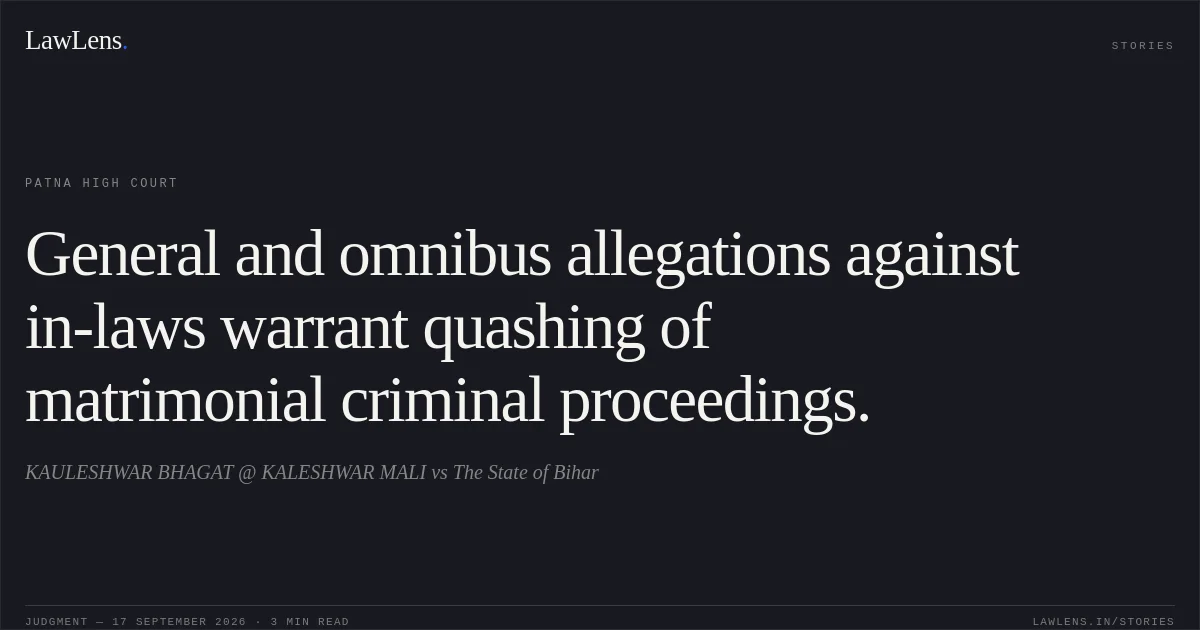
The Court found that the allegations against the four petitioners were general and omnibus. Although the complaint referred broadly to dowry demands and matrimonial cruelty, it did not identify what particular act was committed by each petitioner, when the act occurred, or how any individual petitioner subjected the complainant to cruelty or made a dowry demand.
Source reference: para. 7, p. 6Applying the principle that relatives should not be prosecuted merely on the basis of generalized matrimonial allegations, the Court held that the complaint and accompanying materials failed to disclose the necessary individualized basis for continuing the prosecution against these petitioners. In the circumstances, continuation of the proceedings fell within the categories recognized in Bhajan Lal as abuse of the process of law.
Source reference: para. 8, p. 6Holding
The High Court answered the issues in favour of the petitioners. It held that the absence of specific allegations against them made the prosecution legally unsustainable and that continuation of the criminal proceedings would amount to an abuse of process.
Accordingly, the cognizance order dated 4 July 2016 and all consequential proceedings were quashed qua all four petitioners. The criminal miscellaneous petition was allowed, and the judgment was directed to be communicated to the trial court along with the record, if any.
Source reference: paras. 9–11, pp. 6–7Acts & Sections Cited
4 provisions across 2 statutes referred to in this judgment. Each provision opens on LawLens.
Indian Penal Code, 18602
Original Court PDF
KAULESHWAR BHAGAT @ KALESHWAR MALIvsThe State of Bihar
Click to open original judgment
Original judgment, available to read, download and summarize on LawLens.in