Facts
The informant alleged that, following her marriage in 2010, her husband and his family members demanded ₹4,00,000 as dowry and subjected her to physical and mental cruelty. She also alleged assault, threats and harassment, including incidents after she left the matrimonial home.
Source reference: pp. 2–6; para. 1–5On these allegations, Kochas (Parsathua) P.S. Case No. 135 of 2016 was registered under Sections 341, 323, 504, 506 and 498-A IPC and Sections 3 and 4 of the Dowry Prohibition Act. The Magistrate took cognizance on 19 June 2018. The petitioners sought quashing under Section 482 CrPC.
Source reference: pp. 2–6; para. 1–5During the petition, petitioner no. 1 died; the application as to him was dismissed as withdrawn and infructuous. The petition therefore continued only for the mother-in-law and brother-in-law.
Source reference: pp. 2–6; para. 1–5Issues
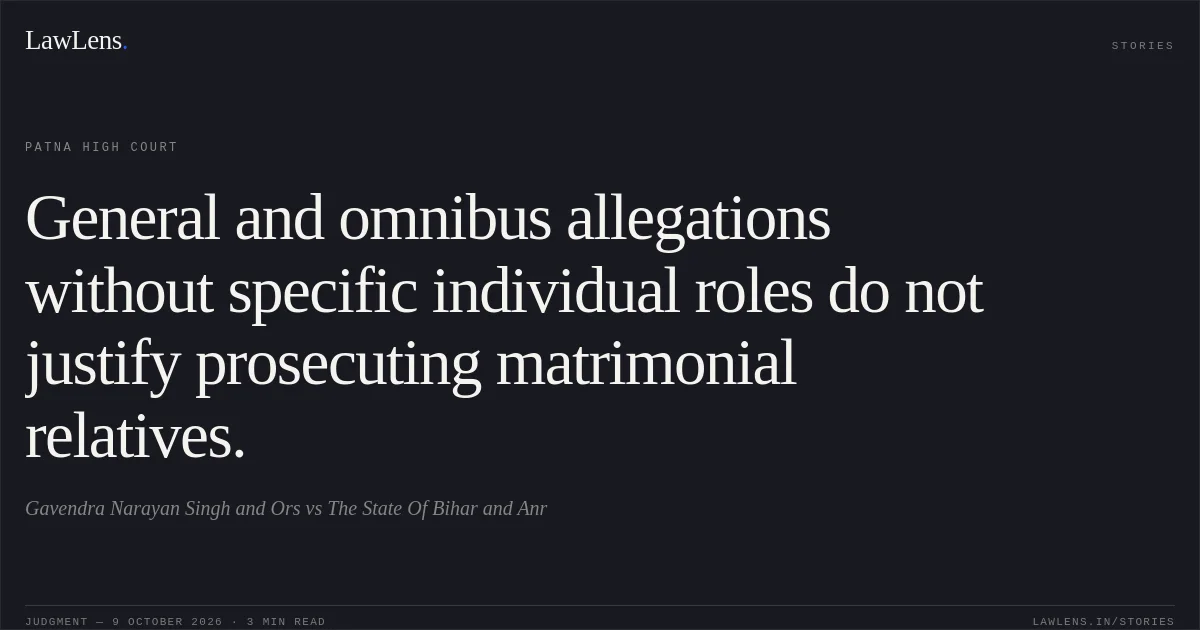
Whether the allegations, taken at face value, disclosed a prima facie case against petitioner nos. 2 and 3, or were general and omnibus allegations insufficient to justify their prosecution.
Source reference: pp. 13–17; paras. 21–29Whether continuation of the criminal proceedings against petitioner nos. 2 and 3 amounted to an abuse of process warranting exercise of the High Court’s inherent jurisdiction under Section 482 CrPC.
Source reference: pp. 20–23; paras. 35–42Law Applied
Section 482 CrPC preserves the High Court’s inherent power to prevent abuse of process and secure the ends of justice, to be exercised sparingly; the categories in State of Haryana v. Bhajan Lal, 1992 Supp (1) SCC 335, include cases where allegations, even if accepted, do not make out an offence or where proceedings are manifestly mala fide.
Source reference: pp. 10–11, 20–21; paras. 16–17, 36The Court relied on Abhishek v. State of Madhya Pradesh, 2023 SCC OnLine SC 1083; Kahkashan Kausar v. State of Bihar, (2022) 6 SCC 599; Neelu Chopra v. Bharti, (2009) 10 SCC 184; Geeta Mehrotra v. State of U.P., (2012) 10 SCC 741; and K. Subba Rao v. State of Telangana, (2018) 14 SCC 452, for the principles that each accused’s role must be discernible and that relatives should not be prosecuted on general, omnibus allegations alone.
Source reference: pp. 11–19; paras. 17–19, 25–34Criminal liability ordinarily depends on an accused’s own participation; relationship to the principal accused does not, by itself, establish liability.
Source reference: pp. 12–13, 21; paras. 20, 37–38Reasoning
The Court found that the dowry-demand and cruelty allegations against petitioner no. 2 were collective, without identifying when, where or how she personally made a demand or committed cruelty.
Source reference: pp. 13–15; paras. 22–26Although the FIR named petitioner no. 3 among persons alleged to have visited the informant’s village and threatened her family, it did not attribute a distinct act, threat or assault to him individually.
Source reference: pp. 16–17; paras. 27–29The Court distinguished the impermissible assessment of evidence at the quashing stage from the question whether the allegations, even accepted as true, disclosed individual participation. Applying the cited precedents and the Bhajan Lal categories, it concluded that the allegations against these petitioners were too general to sustain prosecution.
Source reference: pp. 17–23; paras. 30–42Holding
The Court held that continuation of the proceedings against petitioner nos. 2 and 3 would amount to abuse of process.
It quashed the Magistrate’s order dated 19 June 2018 and all consequential proceedings in Kochas (Parsathua) P.S. Case No. 135 of 2016, insofar as they concerned Basanti Devi and Vishal Kumar Singh @ Vishal Kumar Kashyap @ Minku Singh. The application was allowed to that extent. As to petitioner no. 1, the petition had already been dismissed as withdrawn and infructuous following his death.
Source reference: pp. 2, 23–24; paras. 1–3, 43–45Acts & Sections Cited
8 provisions across 3 statutes referred to in this judgment. Each provision opens on LawLens.
Indian Penal Code, 18604
Code of Criminal Procedure, 19732
Original Court PDF
Gavendra Narayan Singh and OrsvsThe State Of Bihar and Anr
Click to open original judgment
Original judgment, available to read, download and summarize on LawLens.in