Facts
The complainant, Priyanka Devi, alleged that her marriage with petitioner no. 1, Manoj Kumar, was solemnised on 26 November 2015 after her family paid approximately ₹15 lakh as dowry and incurred substantial marriage expenses.
Source reference: pp. 3–6, para. 7She alleged that, after marriage, her husband and his family members subjected her to dowry-related cruelty, physical and mental harassment, pressure to undergo abortion, assault, abuse, and attempts to exclude her from the matrimonial home.
Source reference: pp. 3–6, para. 7On the basis of the complaint, the learned Sub-Divisional Judicial Magistrate, Patna, took cognizance on 13 August 2018 for offences under Sections 498A and 354 of the Indian Penal Code and Section 4 of the Dowry Prohibition Act against all the accused.
Source reference: pp. 3–6, para. 7The accused petitioners invoked the High Court’s inherent jurisdiction to challenge the cognizance order.
Source reference: pp. 6–7, para. 8During the hearing, the petition was withdrawn insofar as petitioner no. 1 was concerned.
Source reference: p. 2, para. 2Issues
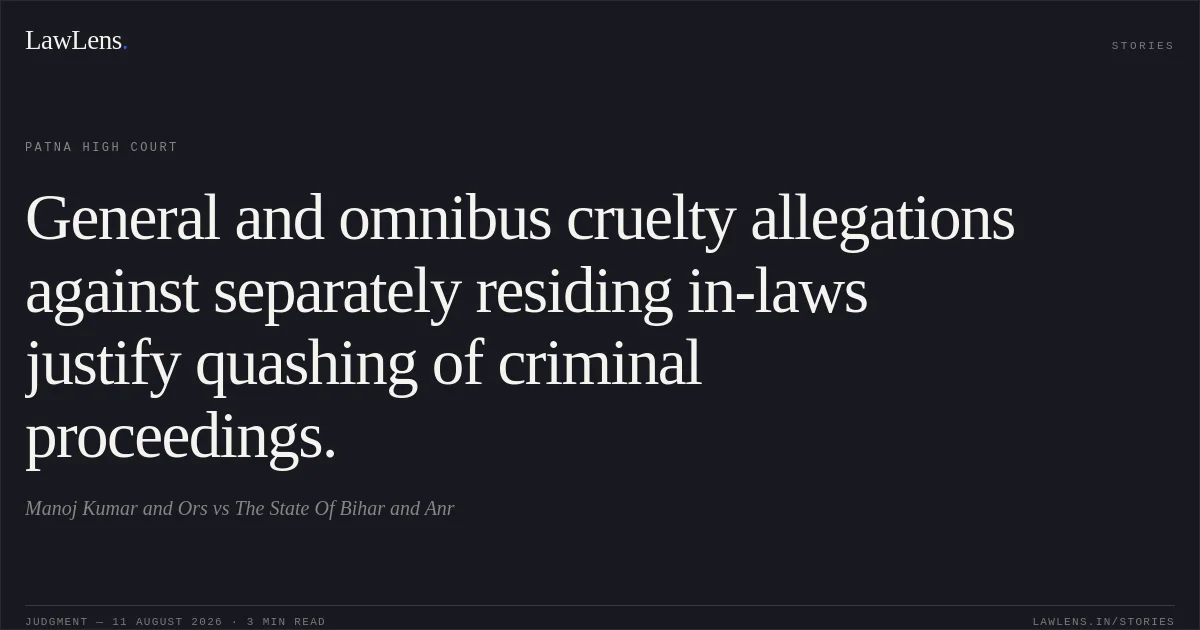
Whether the cognizance order dated 13 August 2018 and the consequential criminal proceedings against petitioner nos. 2, 5, 6 and 7 should be quashed under the High Court’s inherent jurisdiction where the allegations against them were general and omnibus and they were stated to be living separately from the complainant and her husband
Source reference: pp. 6–7, 13, paras. 8, 11Whether continuation of the prosecution against the said relatives, in the absence of specific allegations attributing distinct acts to each accused, would amount to abuse of the process of court
Source reference: pp. 7–12, para. 10Law Applied
The Court considered the offences alleged under Sections 498A and 354 of the Indian Penal Code and Section 4 of the Dowry Prohibition Act, and exercised its inherent jurisdiction under Section 482 of the Code of Criminal Procedure to prevent abuse of process and secure the ends of justice.
Source reference: pp. 7–12, para. 10Relying on Abhishek v. State of Madhya Pradesh, 2023 SCC OnLine SC 1083, and the principles in V. Ravi Kumar v. State, Neeharika Infrastructure (P) Ltd. v. State of Maharashtra, Kahkashan Kausar v. State of Bihar, Preeti Gupta v. State of Jharkhand, Neelu Chopra v. Bharti, Mahmood Ali v. State of U.P., and State of Haryana v. Bhajan Lal, the Court held that quashing must ordinarily be exercised sparingly, but may be warranted where the complaint, even if accepted at face value, does not disclose a specific case against the accused; where allegations are absurd or inherently improbable; or where criminal proceedings are manifestly malicious or constitute an abuse of process.
Source reference: pp. 7–12, para. 10In matrimonial prosecutions, courts must scrutinise general and omnibus allegations against relatives carefully, and the complaint should disclose the particulars of the offence and the role played by each accused.
Source reference: pp. 7–12, para. 10Reasoning
The Court observed that petitioner nos. 2, 5, 6 and 7 were relatives of the complainant’s husband who were stated to be living separately and not connected with the couple’s daily domestic affairs.
Source reference: pp. 6–7, para. 8Petitioner no. 2 was employed in Delhi and residing at Asansol; petitioner no. 5 was his wife; petitioner no. 6 was their daughter; and petitioner no. 7 was a doctor residing separately at Hajipur.
Source reference: pp. 6–7, para. 8Although the complaint contained detailed allegations primarily concerning the complainant’s husband, the allegations against these four relatives were treated as general and omnibus allegations of cruelty, without sufficient particulars identifying the individual acts attributable to each of them.
Source reference: pp. 7–12, paras. 10–11Applying the principles in Abhishek and the related Supreme Court authorities concerning the impermissible implication of all matrimonial relatives, the Court concluded that continuation of the prosecution against these petitioners would constitute an abuse of the process of court.
Source reference: pp. 7–12, paras. 10–11Holding
The petition was dismissed as withdrawn insofar as petitioner no. 1, Manoj Kumar, was concerned.
The proceedings concerning petitioner nos. 3 and 4 had already become infructuous.
Source reference: p. 2, para. 4As regards petitioner nos. 2, 5, 6 and 7, the High Court quashed and set aside the cognizance order dated 13 August 2018 in Complaint Case No. 607C/2018, along with all consequential proceedings, on the ground that the allegations against them were general and omnibus and that they were living separately from the complainant and her husband.
Source reference: pp. 2, 13, paras. 3–4, 11The petition was accordingly allowed, and a copy of the judgment was directed to be communicated to the trial court with the records, if any.
Source reference: p. 13, paras. 12–13Acts & Sections Cited
5 provisions across 3 statutes referred to in this judgment. Each provision opens on LawLens.
Indian Penal Code, 18601
Dowry Prohibition Act, 19611
Code of Criminal Procedure, 19733
Original Court PDF
Manoj Kumar and OrsvsThe State Of Bihar and Anr
Click to open original judgment
Original judgment, available to read, download and summarize on LawLens.in