Facts
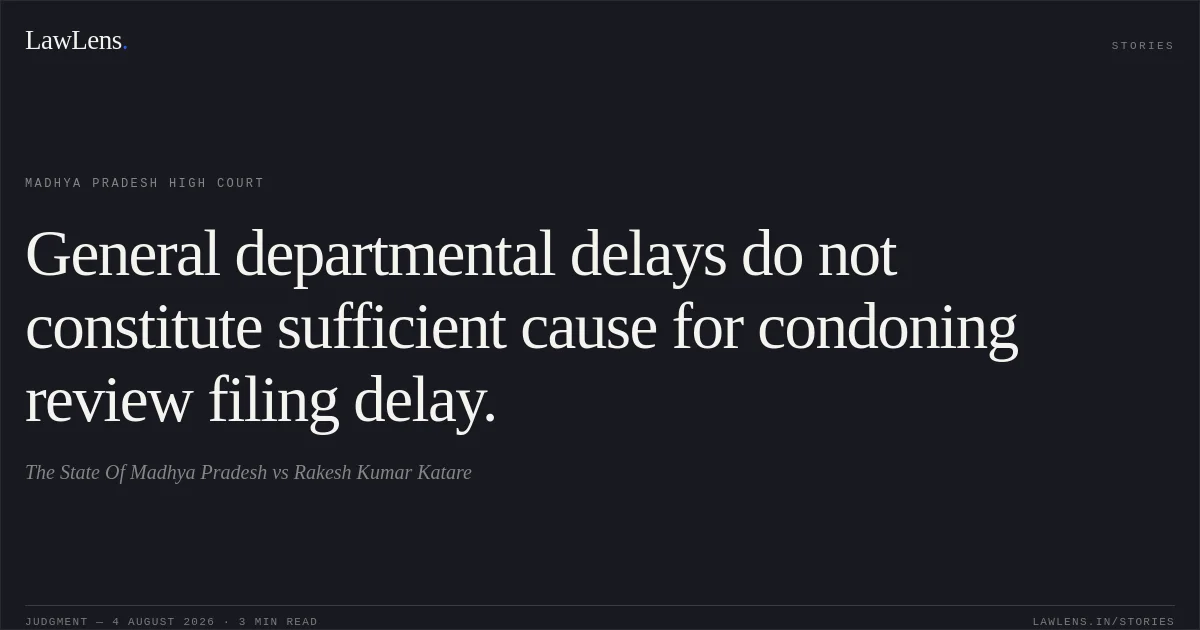
The State of Madhya Pradesh filed a review petition challenging the order dated 02.04.2019 passed in W.P. No. 6400/2019. The petition was filed with an admitted delay of approximately 304 days.
Source reference: para. 2The State attributed the delay to departmental approvals, legal opinion, and the intervening prosecution of Writ Appeal No. 1573/2019, which was withdrawn on 14.10.2019 with liberty to seek review before the Single Judge.
Source reference: para. 2On merits, the State contended that the respondent was a deputationist whose lien remained with the Panchayat and Rural Development Department; that deputation was ordinarily limited to two years, extendable up to four years; and that the respondent had remained on deputation for nearly ten years and could therefore be repatriated. The respondent did not appear and was proceeded against ex parte.
Source reference: paras. 3–4Issues
Whether the State had shown sufficient cause under Section 5 of the Limitation Act for condonation of the 304-day delay in filing the review petition?
Source reference: paras. 6–8Whether the original order dated 02.04.2019 suffered from an error apparent on the face of the record warranting review?
Source reference: paras. 9–11Whether the State’s challenge concerning the respondent’s deputation tenure, repatriation, and reliance on Ashok Kumar Ratilal Patel v. State of Gujarat, (2012) 7 SCC 757, could be reconsidered in review jurisdiction?
Source reference: paras. 3, 10Law Applied
The Court applied Section 5 of the Limitation Act, under which delay may be condoned only upon a satisfactory showing of “sufficient cause”; governmental procedures and official formalities, without a specific and convincing explanation for the entire period of delay, do not automatically constitute sufficient cause.
Source reference: paras. 7–8It further applied the settled principles governing review jurisdiction: review is permissible only for an error apparent on the face of the record, discovery of new and important evidence unavailable despite due diligence, or an analogous sufficient ground; review cannot function as an appeal or permit rehearing merely because another view is possible.
Source reference: para. 9The Court also held that liberty granted by an appellate court to pursue review does not itself extend or condone the statutory limitation period.
Source reference: para. 8Reasoning
The Court found that the State’s explanation for the 304-day delay was general and lacked particulars, including any day-to-day or satisfactory explanation for the entire period.
Source reference: paras. 6–8The fact that the State had pursued a writ appeal and obtained liberty to file a review did not dispense with the requirement of explaining the delay or establish sufficient cause under Section 5.
Source reference: paras. 6–8On the merits, the State’s arguments concerning the respondent’s status as a deputationist, the applicable deputation tenure, repatriation, and the alleged erroneous reliance on Ashok Kumar Ratilal Patel sought reconsideration of issues already addressed in the original order.
Source reference: paras. 9–11These contentions required reappreciation of factual and legal matters and did not identify any patent or self-evident error, new evidence, or other permissible ground for review.
Source reference: paras. 9–11The alleged concession by the Government Advocate likewise did not, by itself, establish an error apparent on the face of the record.
Source reference: paras. 9–11Holding
The Court held that the State failed to establish sufficient cause for condoning the 304-day delay and that the original order disclosed no error apparent on the face of the record warranting review.
Accordingly, I.A. No. 3427/2020 under Section 5 of the Limitation Act was dismissed, and the review petition was consequently dismissed as barred by limitation.
Source reference: para. 12Acts & Sections Cited
1 provisions across 1 statute referred to in this judgment. Each provision opens on LawLens.
Limitation Act, 19631
Original Court PDF
The State Of Madhya PradeshvsRakesh Kumar Katare
Click to open original judgment
Original judgment, available to read, download and summarize on LawLens.in