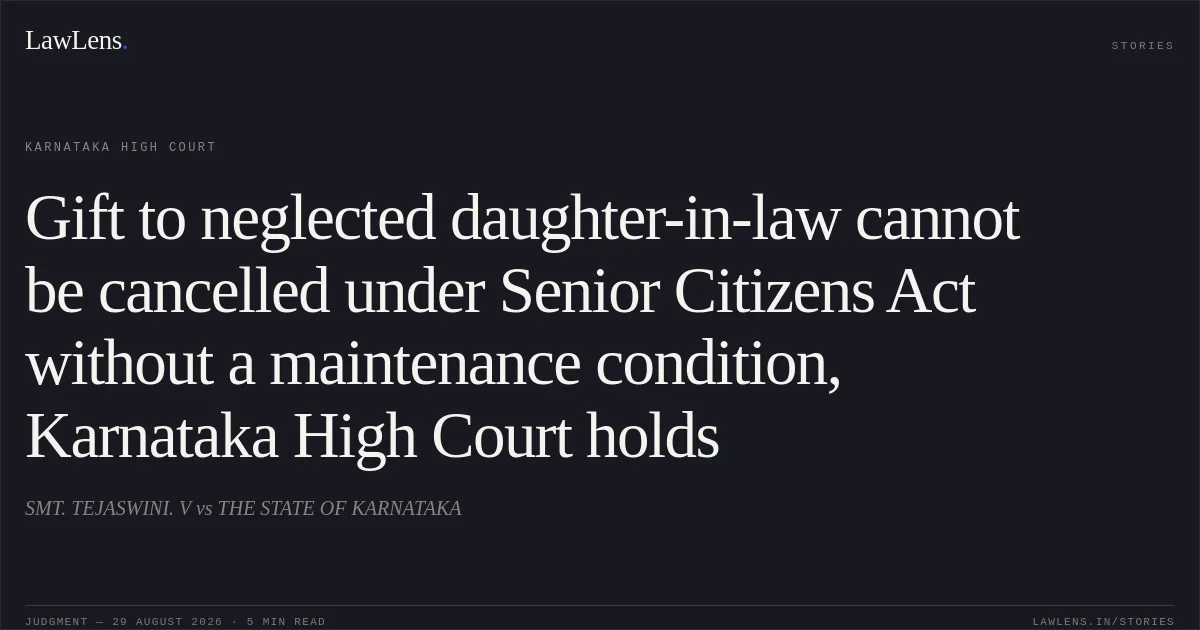
Facts
The petitioner, daughter-in-law of Respondent No. 3, married his son, D. Gopi, on 20 June 2010 and lived with them in the disputed property.
Source reference: paras. 2–4She alleged matrimonial harassment and neglect by her husband, including failure to provide for her and their minor son.
Source reference: paras. 2–4Respondent No. 3 first executed a Will dated 12 June 2019 and subsequently a registered gift deed dated 14 October 2020 in favour of the petitioner and her minor son, allegedly to secure their maintenance and future after the husband failed to support them.
Source reference: paras. 2–4Respondent No. 3 later applied under Section 23 of the Maintenance and Welfare of Parents and Senior Citizens Act, 2007, alleging that the gift was conditional upon the petitioner maintaining him and that she had failed to provide him basic amenities and physical needs.
Source reference: para. 5The petitioner disputed the maintainability of the proceedings, contending that Respondent No. 3 was below sixty years of age when the gift and application were made, that the gift deed contained no maintenance condition, and that a daughter-in-law was not a “child” or “relative” under the Act.
Source reference: paras. 6–11The Tribunal allowed the application and cancelled the gift deed by order dated 15 December 2023, leading to the present writ petition.
Source reference: para. 10Issues
1. Whether the transferor under Section 23 must have been a senior citizen on the date of execution of the transfer, or whether attaining sixty years by the date of application or consideration is sufficient
Source reference: para. 17(i)2. Whether the Tribunal was required to decide the petitioner’s objections regarding maintainability and jurisdiction as preliminary issues
Source reference: para. 17(ii)3. Whether Section 23 can be invoked without an express or implied condition requiring the transferee to provide the transferor’s basic amenities and physical needs
Source reference: para. 17(iii)4. Whether Respondent No. 3 could maintain proceedings under Section 23 against the petitioner, his daughter-in-law, having regard to the statutory definitions of “children,” “parent,” “relative” and “senior citizen”
Source reference: para. 17(iv)5. Whether the legislative scheme and history of the Act restrict the remedy under Section 23 to senior citizens, excluding parents below sixty irrespective of their status as parents
Source reference: para. 17(v)6. Whether Respondent No. 3 satisfied the statutory prerequisites for invoking Section 23 and whether the Tribunal committed a jurisdictional error in cancelling the gift deed
Source reference: para. 17(vi)7. Whether the Tribunal’s order cancelling the gift deed was legally sustainable and what relief should follow
Source reference: para. 17(vii)Law Applied
Section 23(1) of the Maintenance and Welfare of Parents and Senior Citizens Act, 2007 applies where a senior citizen transfers property by gift or otherwise subject to a condition that the transferee will provide basic amenities and basic physical needs, and the transferee subsequently refuses or fails to do so; both the maintenance condition and its breach are essential ingredients
Source reference: para. 21.3Under Section 2(h), a senior citizen is a citizen of India who has attained sixty years or above, but the Court held that the transferor need not have been sixty on the date of transfer; the relevant enquiry is ordinarily made with reference to the application, and a marginal shortfall may be cured if the applicant attains sixty before consideration
Source reference: paras. 19.8–19.14Sections 2(a), 2(d) and 2(g) define “children,” “parent” and “relative”; a daughter-in-law is not a “child,” and the extended category of “relative” applies only to a childless senior citizen
Source reference: paras. 22.3–22.6The Court relied on Smt. Shoba v. Dr. Anil P. Kumar, W.P. No. 202832/2019, for the proposition that the donor need not be a senior citizen on the date of execution, and on Kamalakant Mishra v. Additional Collector, 2025 SCC OnLine SC 2077, for the principle that the Act is beneficial welfare legislation requiring liberal construction to advance the protection of elderly persons
Source reference: paras. 19.8, 19.12The Court also considered the legislative history of Section 2(h), including deletion of the proposed words “and includes parent whether or not a senior citizen,” and held that Section 23 is directed to senior citizens, not every parent irrespective of age
Source reference: paras. 23.2–23.10Reasoning
The Court rejected the petitioner’s argument that Respondent No. 3 was disqualified because he was fifty-seven when the gift was executed and fifty-nine when the application was filed.
Source reference: paras. 19.9–19.12Although the application was filed before he turned sixty, he attained sixty before the Tribunal decided the matter; treating the marginal age deficit as fatal would defeat the beneficial purpose of the Act and result in the futile dismissal and immediate refiling of the proceedings
Source reference: paras. 19.9–19.12The Court held that the age objection therefore did not oust the Tribunal’s jurisdiction or require separate preliminary determination
Source reference: paras. 20.4–20.6However, Section 23 could operate only if the gift was made subject to a condition requiring the transferee to maintain the transferor.
Source reference: paras. 21.4–21.10The gift deed contained no such condition, and the surrounding circumstances showed that Respondent No. 3 transferred the property to secure the petitioner’s and minor grandson’s maintenance because his son was neglecting them.
Source reference: paras. 21.4–21.10The transaction was therefore the opposite of a gift conditional upon the petitioner maintaining Respondent No. 3
Source reference: paras. 21.4–21.10Although the petitioner’s status as daughter-in-law was not, by itself, an absolute bar because Section 23 refers generally to a “transferee,” Respondent No. 3’s living son was the person falling within the statutory category of “child” primarily responsible for his maintenance.
Source reference: paras. 22.5–22.9More importantly, the gift lacked the statutory maintenance condition and was made for the petitioner’s protection
Source reference: paras. 22.5–22.9The Tribunal had cancelled the gift without recording a finding that such a condition existed, thereby exercising Section 23 power without its legal foundation
Source reference: paras. 21.8, 24.2–24.3Holding
The Court held that Respondent No. 3 was not disqualified merely because he was below sixty on the date of the gift or application; attaining sixty before consideration was sufficient in the circumstances
Nevertheless, the gift deed was outside Section 23 because it contained no express or implied condition requiring the petitioner to maintain Respondent No. 3 and was executed to secure the petitioner’s and minor child’s maintenance
Source reference: paras. 21.10, 22.10The writ petition was allowed, the Tribunal’s order dated 15 December 2023 in Case No. MSC/CR/96/2022 was quashed, and the registered gift deed dated 14 October 2020 was restored to full legal effect
Source reference: para. 25.5(i)–(iii)Any independent maintenance remedy available to Respondent No. 3 against his son was left open
Source reference: para. 25.5(iv)In view of the allegation that the petitioner had been married at approximately fifteen years of age, the Court directed the competent authorities under the Prohibition of Child Marriage Act, 2006 to verify the allegation and take action in accordance with law, without expressing any finding on its truth
Source reference: para. 25.5(v)–(vi)Acts & Sections Cited
7 provisions across 1 statute referred to in this judgment. Each provision opens on LawLens.
Maintenance and Welfare of Parents and Senior Citizens Act, 20077
Original Court PDF
SMT. TEJASWINI. VvsTHE STATE OF KARNATAKA
Click to open original judgment
Original judgment, available to read, download and summarize on LawLens.in
![A police constable cannot be removed for unauthorized absence without a Rule 359-compliant inquiry.. Mohammad Sidiq Khan vs D/o Home Ut Of Jammu & Kashmir. CAT - ['Srinagar']. LawLens](/stories/thumbnails/a-police-constable-cannot-be-removed-for-unauthorized-absence-without-a-rule-359-compliant-7b43fc316bd94f22a62676153bbc9d54.webp)
![A Review DPC lacks authority to determine or alter inter se seniority.. SAURABH KUMAR vs REVENUE. CAT - ['Patna']. LawLens](/stories/thumbnails/a-review-dpc-lacks-authority-to-determine-or-alter-inter-se-seniority-4b21640f20af46fcabdfc8273d2ce959.webp)