01Facts
The Jammu and Kashmir Cooperative Consumer Federation Ltd. ("CONFED") was wound up pursuant to Cabinet Decision dated 15.07.1999, which contemplated adjustment of its employees in Government service
¶ 2The respondents did not opt for the Golden Handshake Scheme and were absorbed in the Cooperative Department vide Government Order No. 26-Coop of 2007 dated 26.10.2007
¶ 2Five of the ten absorbed employees filed SWP No. 812/2008, which was allowed on 22.04.2011, upheld by the Division Bench (LPA No. 202/2011) and by the Supreme Court, and the Supreme Court upheld the contempt-proceeding direction for computation and release of arrears for the period up to 26.10.2007 (Civil Appeal No. 239 of 2022)
¶ 2 · ¶ 8The respondents filed SWP No. 1387/2008 seeking similar relief. The writ Court disposed of it on 30.09.2016 in terms of the judgment in SWP No. 812/2008, recording the appellants' stand that the cases were identical
¶ 2 · ¶ 7The appellants did not release arrears and rejected the claim by order dated 27.02.2019
¶ 2The respondents' challenge (WP(C) No. 683/2023) was allowed on 02.08.2024, quashing the orders dated 27.02.2019 and 18.07.2019 insofar as they concerned the respondents
p. 1 · ¶ 1By order dated 28.05.2025 in CM No. 5105/2024, the writ Court directed the appellants to ascertain the actual unpaid period and release arrears accordingly
pp. 1–2 · ¶ 1The appellants contended that there was no employer-employee relationship before 26.10.2007, the "no work, no pay" principle applied, Section 152 CPC did not permit the 2025 order, and the claim was barred by delay and laches
¶ 3The respondents relied on the parity with SWP No. 812/2008
¶ 402Issues
i.1. Whether respondents, whose writ petition was disposed of in terms of the judgment in SWP No. 812/2008, can be denied the benefits extended to the petitioners therein.
¶ 6ii.2. Whether the "no work, no pay" principle and the plea of delay and laches bar the respondents' claim for arrears.
¶ 9iii.3. Whether the writ Court could issue the subsequent direction dated 28.05.2025 under Section 152 CPC.
¶ 1003Law Applied
The Court relied on the principle of finality of judgments: an unchallenged judgment attains finality, and parties cannot reopen the issue indirectly or take a stand contrary to one accepted in earlier proceedings.
¶ 7The Court applied Article 14 of the Constitution, which forbids discriminatory treatment between persons similarly situated; having accepted identity of the cases, the appellants could not adopt different standards.
¶ 8The Court rejected the "no work, no pay" plea, holding that employees whose services were affected by a Government decision to wind up an institution, and who were absorbed pursuant to that decision, cannot be made to suffer for delay in its implementation.
¶ 9The Court recognised the doctrine of delay and laches, holding it inapplicable where the claimants pursued their remedies in 2008 and 2018 and the claim arose upon rejection in 2019.
¶ 9Regarding Section 152 CPC, the Court stated that the power is confined to correcting clerical or arithmetical errors and cannot be used to review or alter substantive adjudication.
¶ 10Provisions in the judgment · 1 · Linked ones open on LawLens
Code of Civil Procedure, 1908 Section 152
04Reasoning
The Court first found that the respondents and the SWP No. 812/2008 petitioners were employees of the same institution, absorbed under the same Government order. The appellants had categorically accepted the similarity of the two sets of employees before the writ Court in SWP No. 1387/2008, and the 30.09.2016 judgment was never challenged, so it was final.
¶ 7Because the appellants had already released arrears to the SWP No. 812/2008 employees under the contempt directions, denying the same benefit to the respondents would amount to discrimination under Article 14.
¶ 8The "no work, no pay" plea failed because the respondents' non-service arose from the Government's own winding-up decision, and their non-payment was attributable to the appellants' delay in implementing it.
¶ 9The delay plea failed because the respondents had actively litigated since 2008 and the cause of action arose only on the 2019 rejection.
¶ 9On the 2025 order, the Court accepted that Section 152 CPC does not permit substantive alteration, but held that the order did not enlarge the original relief; it merely required verification of the actual unpaid period.
¶ 10The Court further safeguarded against double payment by directing adjustment of amounts already paid for the same period.
¶ 1005Holding
The respondents cannot be denied the benefits granted to the petitioners in SWP No. 812/2008, and the appeal is without merit.
¶ 6 · ¶ 11The judgment dated 02.08.2024 in WP(C) No. 683/2023 and the order dated 28.05.2025 in CM No. 5105/2024 are upheld, subject to the clarifications that (i) no double payment shall be made, (ii) the appellants shall verify service records, salary registers and other material to determine the actual unpaid period for each respondent, (iii) amounts already paid for the corresponding period shall be adjusted, and (iv) admissible arrears shall be released up to 26.10.2007.
¶ 10–11The appeal is dismissed.
¶ 11Original Court PDF
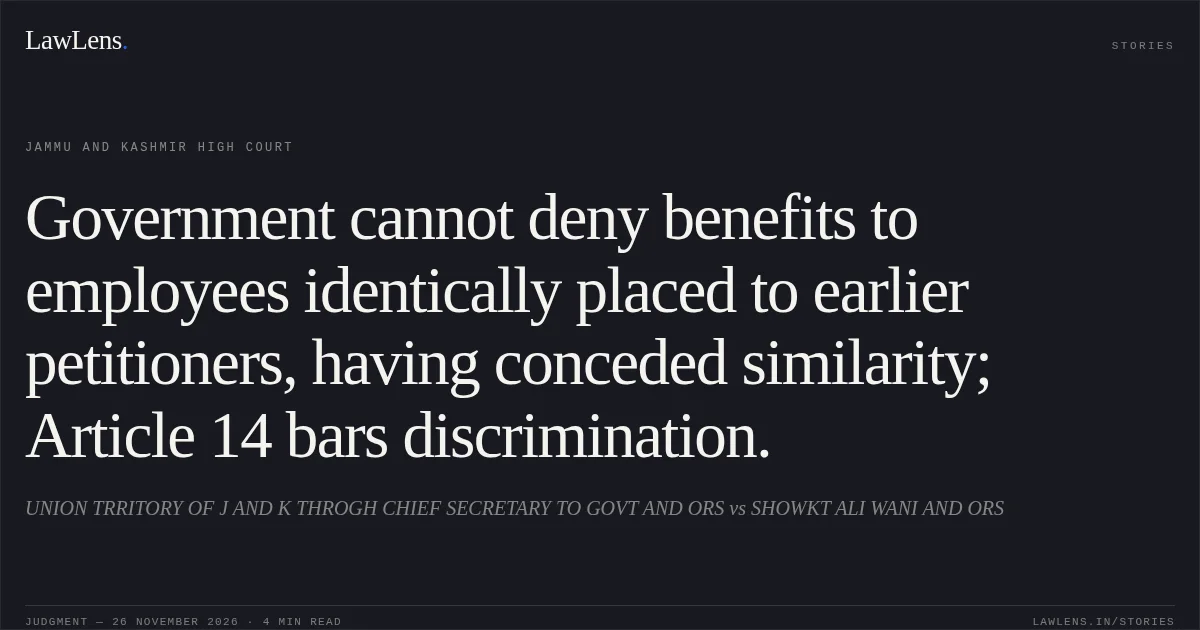
UNION TRRITORY OF J AND K THROGH CHIEF SECRETARY TO GOVT AND ORSvsSHOWKT ALI WANI AND ORS
Click to open original judgment
Original judgment, available to read, download and summarize on LawLens.in