Facts
The petitioner owned six vehicles—AS-01-DZ-0704, AS-01-FZ-0749, AS-01-HC-4645, AS-01-GA-8318, AS-01-EY-7418 and AS-01-HC-2918—which were hired by the respondent authorities during 2024 for emergency purposes, including maintenance of law and order.
Source reference: p.3, para. 3After release of the vehicles, the petitioner submitted bills amounting to ₹24,69,214/- but the payment was not released despite repeated approaches.
Source reference: p.4, para. 4The respondents stated that, during verification, the petitioner had not submitted updated registration certificates, insurance documents, GST (3B) forms, driving licences and declaration certificates, and had been asked to furnish the requisite documents.
Source reference: p.4, para. 5The petitioner consequently invoked the writ jurisdiction of the High Court under Article 226 of the Constitution of India.
Source reference: p.4, para. 4Issues
Whether the petitioner was entitled to payment for the vehicles admittedly hired and utilised by the respondent authorities, subject to verification of his claim and supporting documents.
Source reference: p.5, para. 6Whether the respondent authorities could be directed to verify the petitioner’s claim and release the amount found payable within a prescribed time.
Source reference: p.5–6, para. 8Law Applied
The Court applied the principles governing exercise of writ jurisdiction under Article 226 of the Constitution of India, particularly in cases involving inaction by public authorities concerning an admitted governmental liability.
Source reference: p.4, para. 4It held that where the hiring of the petitioner’s vehicles by the respondent authorities was admitted, payment was due upon proper verification of the claim and production of the prescribed supporting documents.
Source reference: p.5, para. 6No specific statutory provision or judicial precedent was relied upon in the judgment.
Source reference: no citationReasoning
The Court treated the respondents’ admission that the vehicles had been hired by the Police Commissionerate as establishing the petitioner’s prima facie entitlement to payment.
Source reference: p.5, para. 6However, because the respondents identified deficiencies in the supporting documentation, the Court did not direct immediate payment of the entire amount claimed.
Source reference: p.5, para. 8Instead, it required the petitioner to submit the registration certificates, insurance documents, GST (3B) forms, driving licences and declaration certificates, along with a certified copy of the judgment, so that the claim could be properly verified.
Source reference: p.5, para. 8(i)The Court balanced the petitioner’s claim to payment against the respondents’ obligation to verify the actual amount payable.
Source reference: p.5–6, para. 8(ii)Holding
The writ petition was disposed of with directions.
The petitioner was required to submit the prescribed documents and a certified copy of the judgment to the Director General of Police, Assam.
Source reference: p.5, para. 8(i)Upon receipt, the respondents were directed to verify the petitioner’s entitlement and pay the amount found payable, whether the full claimed amount of ₹24,69,214/- or any lesser amount.
Source reference: p.5–6, para. 8(ii)The entire exercise was directed to be completed within six months from the date of submission of the documents.
Source reference: p.6, para. 8(iii)Original Court PDF
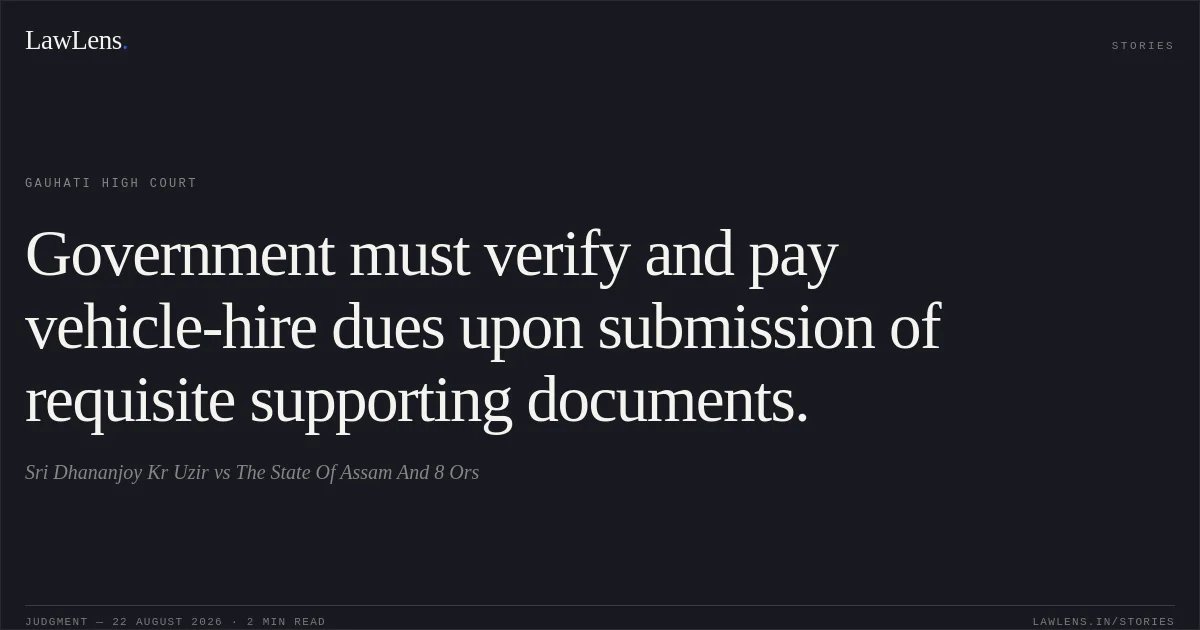
Sri Dhananjoy Kr UzirvsThe State Of Assam And 8 Ors
Click to open original judgment
Original judgment, available to read, download and summarize on LawLens.in