01Facts
The State of Jharkhand and the Director, Employment and Training, appealed under the Letters Patent against the judgment dated 19.12.2024 of the learned Single Judge in W.P.(S) No. 4658 of 2022.
¶ 2The appeal was filed with a 234-day delay, for which I.A. No. 12947 of 2025 sought condonation.
¶ 2The only explanation offered was the movement of files between tables and officers, described as "complex administrative processes, interdepartmental coordination, financial calculations, and legal consultations," which the Court found unverifiable and not deliberate.
¶ 3In a parallel matter, LPA No. 624 of 2025, the Court had already rejected a similar condonation application by order dated 27.10.2026.
¶ 6Respondents filed an affidavit showing that an identical judgment in W.P.(S) No. 4839 of 2022 had been implemented by the State without appeal. This assertion was not countered.
¶ 13–14One of the original petitioners had died without receiving benefits under the impugned order due to the delay.
¶ 802Issues
i.1. Whether the 234-day delay in filing the appeal can be condoned on the basis of the administrative file-movement explanation offered by the State.
¶ 3–4, 12ii.2. Whether the State's failure to appeal in W.P.(S) No. 4839 of 2022, while contesting the present matter, bears on the condonation of delay, given the State's unequal treatment of similarly placed employees.
¶ 13–1403Law Applied
The Limitation Act's mandate, which Parliament enacted, cannot be "flouted or frustrated" by bureaucratic procedure.
¶ 4Union of India v. Jahangir Byramji Jeejeebhoy, 2024 SCC OnLine SC 489; State of Odisha v. Managing Committee of Namatara Girls High School, 2026 SCC OnLine SC 191; and Postmaster General v. Living Media India Ltd., (2012) 3 SCC 563, as applied in LPA No. 624 of 2025.
¶ 6Under Living Media, delay is not condoned mechanically for the Government. Without a plausible explanation and demonstrated diligence, impersonal machinery and traditional noting procedures cannot justify delay, and limitation binds the Government.
¶ 7Under Shivamma (Dead) by LRs v. Karnataka Housing Board, 2025 SCC OnLine SC 1969, condonation should not be granted on frivolous grounds. The State must show good faith and vigilance, and constitutional courts must not become surrogates for State laxity.
¶ 9–10Limitation ensures finality, and litigants must not be subjected to perpetual litigation.
¶ 11Substantial justice cannot prejudice the opposite party.
¶ 804Reasoning
The Court held that the appellants' explanation, which relied entirely on internal file movement and inter-departmental processes, did not constitute sufficient cause. It treated this as the kind of "bureaucratic procedure" that Living Media and Shivamma reject, and it found that the State's averments reflected a belief that limitation did not apply to it.
¶ 4–5Because the respondents' affidavit stating that the State had implemented an identical judgment without appeal went unrebutted, the Court found that the State was treating similarly placed employees unequally. This strengthened the conclusion that no sufficient cause existed.
¶ 14The Court also weighed prejudice to the respondents, including the death of one petitioner before receiving the benefits of the impugned order, and held that delay could not be excused as a matter of generosity.
¶ 8Relying on the reasoning in LPA No. 624 of 2025, the Court applied the same principles to dismiss the present condonation application.
¶ 6, 1205Holding
No sufficient cause was shown for the 234-day delay, and the State's unequal treatment of similarly placed employees further weighed against condonation.
¶ 12, 14The Court declined to condone the delay and dismissed I.A. No. 12947 of 2025. The LPA was disposed of as not surviving. All other pending I.A.s were disposed of as not surviving, with no order as to costs.
¶ 15–16Original Court PDF
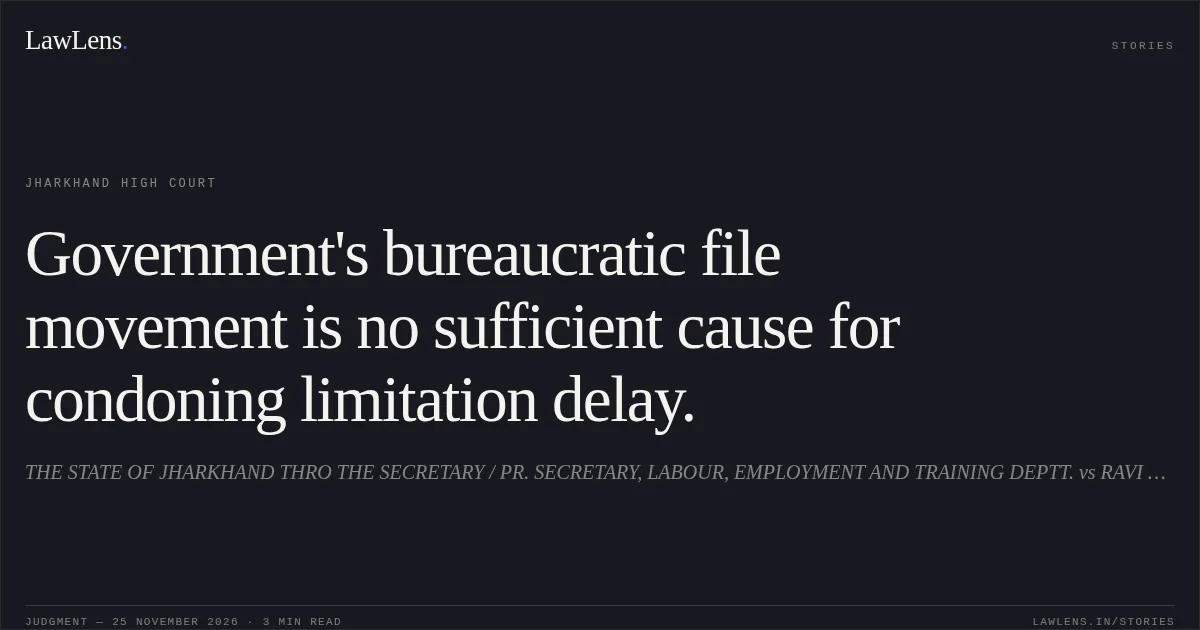
THE STATE OF JHARKHAND THRO THE SECRETARY / PR. SECRETARY, LABOUR, EMPLOYMENT AND TRAINING DEPTT.vsRAVI SHANKAR
Click to open original judgment
Original judgment, available to read, download and summarize on LawLens.in