Facts
The appellant-plaintiff sought a declaration that his correct date of birth was 02.07.1969, instead of 01.12.1968, and a mandatory injunction directing correction of the latter date in his service records, service book, matriculation certificate and connected documents.
Source reference: paras. 1–2; pp. 1, 4–6He had passed matriculation in 1985, where his date of birth was recorded as 01.12.1968 on the basis of the examination form filled by him.
Source reference: para. 2; pp. 4–6The same date was subsequently reflected in the Haryana Board records and his service book when he joined the Education Department as an S.S. Master on 13.11.1997.
Source reference: para. 2; pp. 4–6In March 2008, after approximately 23 years from matriculation and 11 years of service, he claimed to have discovered the alleged correct date from the village Chowkidar register and a birth certificate.
Source reference: para. 2; pp. 4–6The Trial Court decreed the suit on 07.06.2010 and directed correction of the date of birth.
Source reference: paras. 1, 5–6; pp. 1, 4–5The First Appellate Court allowed the respondents’ appeal on 08.11.2011, holding the claim to be highly belated and based on an unexplained, self-created cause of action, and dismissed the suit.
Source reference: paras. 1, 5–6; pp. 1, 4–5The plaintiff preferred the present Regular Second Appeal.
Source reference: paras. 1, 5–6; pp. 1, 4–5Issues
1. Whether the appellant was entitled to a declaration that his date of birth was 02.07.1969 instead of 01.12.1968, on the basis of the birth certificate and village Chowkidar register?
Source reference: para. 4; p. 32. Whether the appellant could seek correction of his date of birth after an unexplained delay of more than two decades, notwithstanding Rule 2.5 of the Punjab Civil Services Rules, 1994 and the notification dated 20.12.2000?
Source reference: paras. 7, 13–15; pp. 4, 9–133. Whether the judgment of the First Appellate Court suffered from misreading of evidence or involved any substantial question of law warranting interference in second appeal?
Source reference: para. 16; p. 14Law Applied
The Court applied Rule 2.5 of the Punjab Civil Services Rules, 1994, governing correction of a government servant’s date of birth.
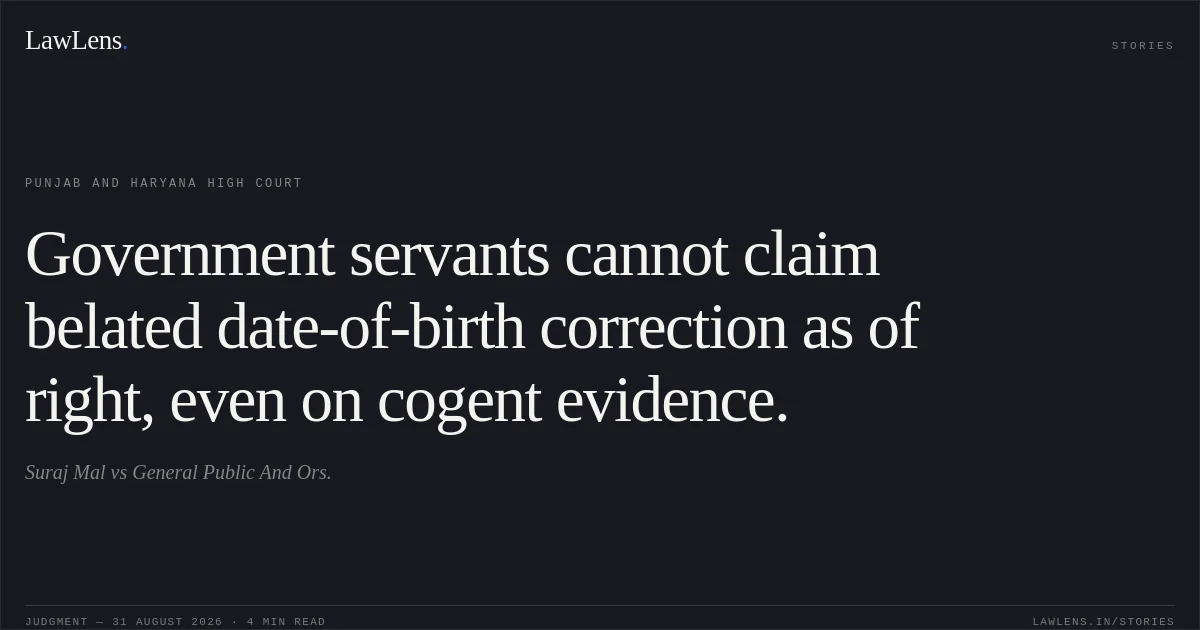
Source reference: paras. 13–15; pp. 8–13The applicable principles require such a request to be made within the prescribed period—ordinarily two years from entry into government service—and treat the date declared at entry as conclusive thereafter; even where no express limitation applies, the claim must be made within a reasonable time and may be rejected on grounds of delay, laches and acquiescence.
Source reference: paras. 13–15; pp. 8–13The Court relied on State of Haryana v. Satish Kumar Mittal, 2010 (9) SCC 337, holding that a belated claim cannot be granted as of right merely because supporting evidence exists, and that courts should require clear, clinching and conclusive material rather than evidence making the claim merely plausible.
Source reference: paras. 13–15; pp. 8–13It also relied on Union of India v. Harnam Singh, 1993 (2) SCC 162, concerning the importance and finality of the date of birth in service records, State of U.P. v. Shiv Narayan Upadhyaya, 2005 (6) SCC 49, requiring conclusive proof presented within a reasonable time, and Karnataka Rural Infrastructure Development Ltd. v. T.P. Nataraja, 2021 (4) SCT 162, summarising that correction is governed by the applicable rules, is not claimable as a matter of right, and may be refused on delay and laches.
Source reference: paras. 13–15; pp. 8–13Reasoning
The Court held that the appellant himself had furnished 01.12.1968 in his matriculation examination form in 1985 and had thereafter permitted the same date to remain unchallenged in his Board records and service book for over two decades.
Source reference: paras. 10–12; pp. 5–7Although the birth certificate and Chowkidar register lent some support to the alternative date, the appellant neither explained why he inspected the decades-old register only in March 2008 nor established the circumstances in which the alleged error was discovered.
Source reference: para. 11; pp. 6–7The evidence therefore rendered his claim merely plausible, not conclusive, and could not outweigh his repeated prior declarations and prolonged acquiescence.
Source reference: para. 15; pp. 12–13The Court further found that the 20.12.2000 notification did not create an unconditional right to seek correction after two years.
Source reference: paras. 14–14.2; pp. 9–12It only permitted consideration of belated applications through a special inquiry and prescribed verification requirements, including examination of official birth records and entries relating to siblings; the subsequent notification dated 13.08.2001 restored the strict two-year limitation.
Source reference: paras. 14–14.2; pp. 9–12The appellant’s 2008 claim was governed by the post-2001 position, and there was no material showing compliance with the special procedure even under the 2000 notification.
Source reference: para. 14.2; pp. 11–12Accordingly, the First Appellate Court had correctly rejected the stale claim, and no perversity, misreading of evidence or substantial question of law arose.
Source reference: paras. 15–16; pp. 13–14Holding
The High Court answered the issues against the appellant.
It held that the appellant was not entitled to correction of his date of birth because the claim was raised after an unexplained delay of approximately 23 years, was inconsistent with the date repeatedly declared by him, and was unsupported by sufficiently conclusive evidence or compliance with the applicable service-rule procedure.
Source reference: paras. 14.2–16; pp. 11–14The judgment and decree of the First Appellate Court dated 08.11.2011 were upheld, the Regular Second Appeal was dismissed, and all pending miscellaneous applications were disposed of.
Source reference: paras. 16–17; p. 14Acts & Sections Cited
1 provisions across 1 statute referred to in this judgment. Each provision opens on LawLens.
Code of Civil Procedure, 19081
Original Court PDF
Suraj MalvsGeneral Public And Ors.
Click to open original judgment
Original judgment, available to read, download and summarize on LawLens.in