Facts
The petitioner’s brother, Shiv Kumar Bariha, served as a Constable in the 5th Battalion, Chhattisgarh Armed Force, and died in harness on October 31, 2021
Source reference: para. 2The petitioner applied for a compassionate appointment, which was rejected by respondent No. 3 via an order dated February 11, 2022
Source reference: para. 2The rejection was grounded on the fact that another brother of the petitioner, Kalapram Bariha, was already employed in government service
Source reference: para. 2The petitioner challenged this rejection, contending that the employed brother did not provide financial support and that the authorities failed to conduct an inquiry into the family's actual financial condition before passing the order
Source reference: para. 3Issues
1. Whether a dependent of a deceased government servant is eligible for compassionate appointment under Clause 6A of the policy if another family member is already in government service.
Source reference: para. 62. Whether the Court can direct an inquiry into the financial dependency or support provided by an existing government-employed family member when the policy expressly bars appointment in such cases.
Source reference: para. 8Law Applied
The court applied Clause 6A of the Chhattisgarh Compassionate Appointment Policy, which stipulates that if any member of a deceased government servant’s family is already in government service, other members are ineligible for compassionate appointment
Source reference: para. 6It relied on the Division Bench judgment in State of Chhattisgarh v. Muniya Bai (Writ Appeal No. 33 of 2022), which held that the policy does not envisage inquiries into the financial condition of family members
Source reference: para. 4, 6the court followed the Full Bench decision in State of Chhattisgarh & Ors. v. Umesh Thakur (Writ Appeal No. 236 of 2022), which established that when a policy bar exists, the Writ Court cannot exercise jurisdiction under Article 226 to direct an inquiry into dependency or financial support, as doing so would amount to impermissibly rewriting the policy
Source reference: para. 8Reasoning
The Court observed that the petitioner’s brother is a government employee, directly triggering the exclusionary mandate of Clause 6A
Source reference: para. 6The Court reasoned that compassionate appointments must be granted strictly according to the prevailing policy and cannot be directed in contravention of its terms
Source reference: para. 9Applying the principles from Umesh Thakur, the Court noted that once it is established that a family member is in government service, any plea regarding lack of financial support or maintenance is legally insufficient to bypass the policy's express prohibition
Source reference: para. 7-8The Court emphasized that it lacks the authority to "rephrase" or "reword" the government scheme to include financial inquiries not originally contemplated by the executive
Source reference: para. 8Consequently, because the petitioner's brother was already in government service, the respondent's rejection was found to be consistent with the established legal framework and policy
Source reference: para. 10Holding
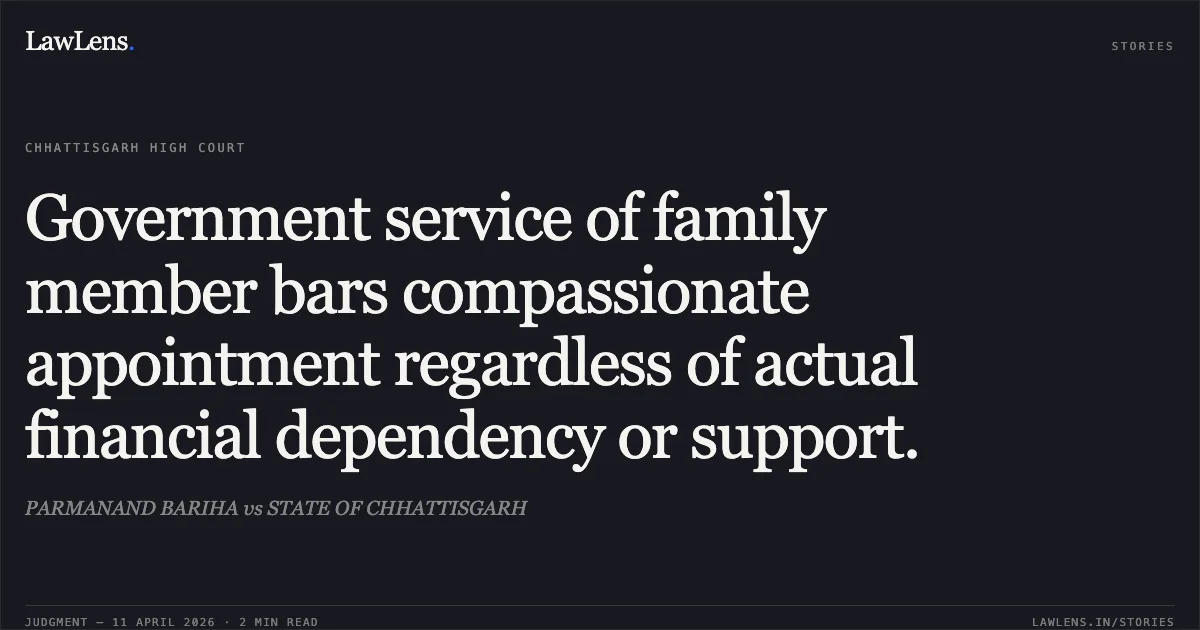
The Court answered the issues in the negative, holding that the petitioner is ineligible for compassionate appointment due to his brother's government employment
The Court affirmed that no inquiry into financial dependency is permissible when the policy contains an express bar
Source reference: para. 8The writ petition was dismissed as being devoid of merit, and no order as to costs was made
Source reference: para. 10Original Court PDF
PARMANAND BARIHAvsSTATE OF CHHATTISGARH
Click to open original judgment
Original judgment, available to read, download and summarize on LawLens.in