01Facts
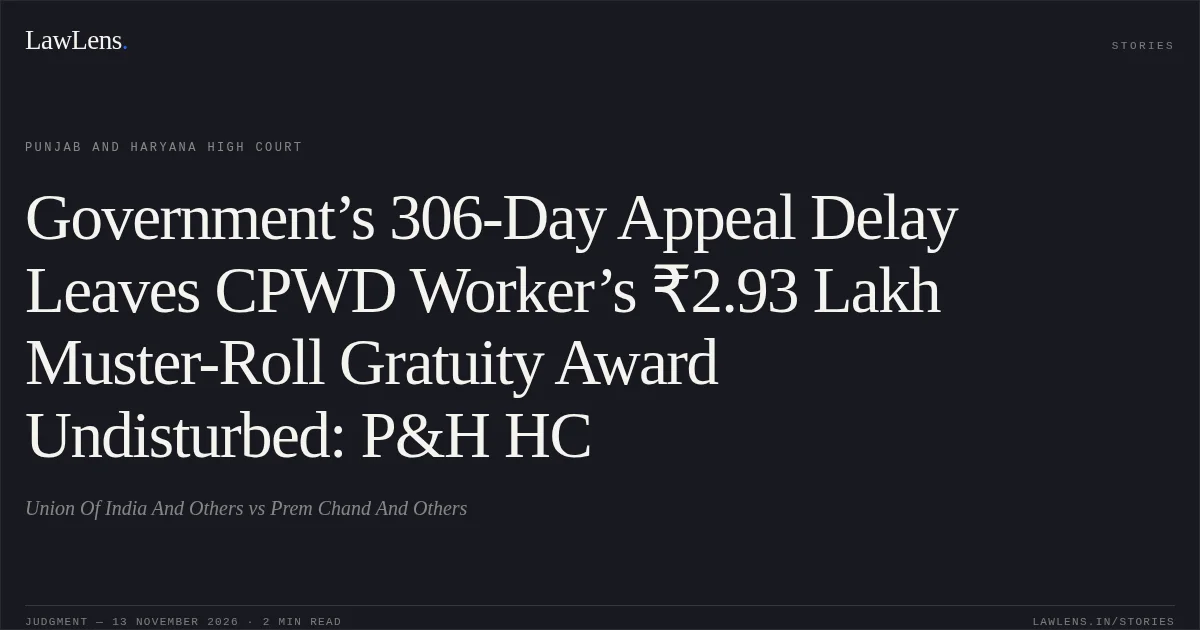
Respondent Prem Chand worked for the CPWD on a muster-roll basis from 10 September 1984 until his services were regularized on 16 April 1993.
After retiring in 2023, he received retirement gratuity for his regular service under the Central Civil Services Pension Rules and claimed separate gratuity under the Payment of Gratuity Act, 1972 for his muster-roll service.
The Controlling Authority ordered payment of ₹2,93,448 with interest, calculating the amount by reference to his wages at retirement.
¶ 2–3The Union’s statutory appeal, filed on 17 February 2026, was returned by the Appellate Authority on grounds of limitation and non-compliance with the statutory pre-deposit requirement.
¶ 2, 11, 13The Union then challenged the orders of both authorities under Articles 226/227 of the Constitution.
¶ 102Issues
i.Whether the Appellate Authority could entertain the Union’s appeal filed beyond the maximum limitation period prescribed by Section 7(7) of the Payment of Gratuity Act, 1972.
¶ 7–10ii.Whether the appeal could be admitted without the employer satisfying the statutory pre-deposit requirement.
¶ 1303Law Applied
Section 7(7) of the Payment of Gratuity Act, 1972 allows an appeal within 60 days of receipt of the Controlling Authority’s order and permits a further extension of up to 60 days for sufficient cause; the resulting 120-day period is the statutory outer limit.
¶ 8The Appellate Authority cannot extend that limit by applying the Limitation Act, 1963.
¶ 9–10In The Punjab State Cooperative Supply & Marketing Federation Ltd. v. Appellate Authority under the Payment of Gratuity Act and others, LPA-1000-2021 (O&M), decided 7 December 2022, a Division Bench of the High Court held that the Limitation Act cannot enlarge the appeal period beyond the limit set by Section 7(7).
¶ 10Further, the second proviso to Section 7(7) bars admission of an employer’s appeal unless the employer produces the Controlling Authority’s certificate confirming deposit of the gratuity amount or deposits that amount with the Appellate Authority.
¶ 13Provisions in the judgment · 2 · Linked ones open on LawLens
Limitation Act, 1963 Section 5Section 29
04Reasoning
The Union’s appeal recorded receipt of the Controlling Authority’s order on 17 April 2025. Even using that date, the appeal filed on 17 February 2026 was 306 days later—well beyond the 120-day statutory maximum.
¶ 11The administrative steps cited to explain the delay could not confer jurisdiction to extend that limit.
¶ 12The Union had also neither produced the required deposit certificate nor deposited the gratuity amount when filing the appeal.
¶ 13Although it challenged the calculation of gratuity, including the use of its employee’s 2023 wages and the treatment of muster-roll service, those merits could not be considered in an appeal that was time-barred.
¶ 14The Court found no jurisdictional error or procedural illegality warranting intervention under Articles 226/227.
¶ 1505Holding
The Court held that the Appellate Authority lacked jurisdiction to entertain the appeal filed beyond Section 7(7)’s 120-day outer limit and noted that the mandatory pre-deposit requirement was also unmet.
¶ 11–13It declined to interfere with the Appellate Authority’s order dated 10 March 2026 and dismissed the writ petition; pending miscellaneous applications were also disposed of.
¶ 16–18Original Court PDF
Union Of India And OthersvsPrem Chand And Others
Click to open original judgment
Original judgment, available to read, download and summarize on LawLens.in