Facts
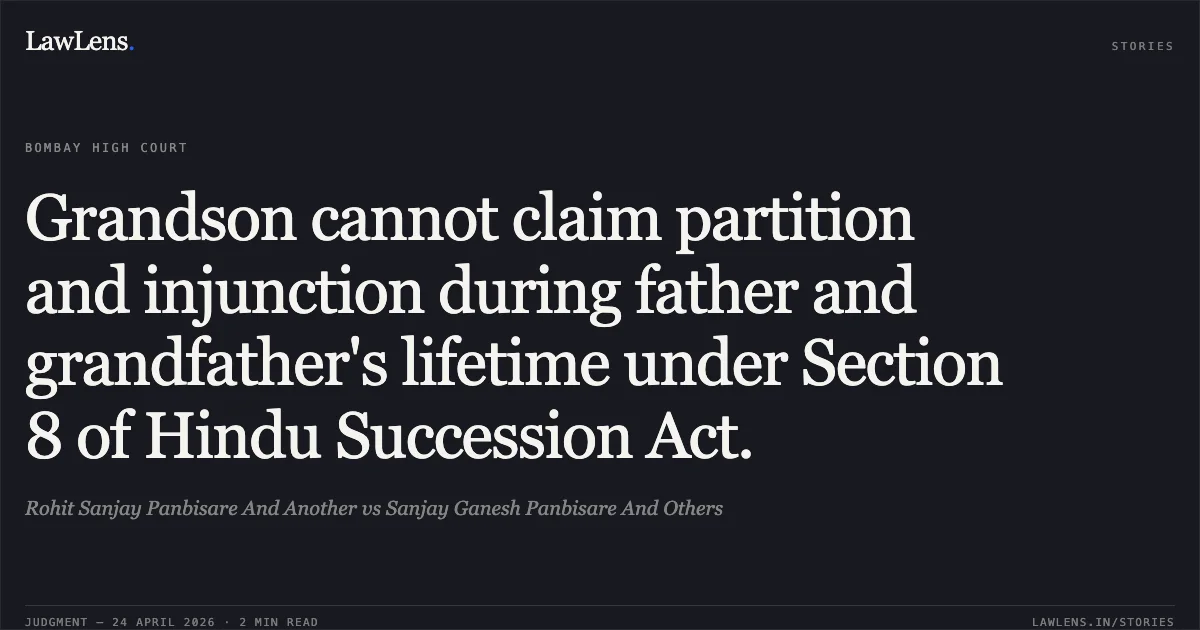
The Petitioners (original plaintiffs), being the son and wife of Respondent No. 1, filed a suit for partition, separate possession, and a declaration to nullify a sale deed regarding agricultural land in Gat No. 224
Source reference: p. 3The property originally belonged to the great-grandfather, Ramlal, who partitioned it between his sons, Mohan and Ganesh (Respondent No. 5/Grandfather)
Source reference: p. 4-5The Trial Court initially granted a temporary injunction restraining the Respondents from creating third-party interests
Source reference: p. 5However, the District Court reversed this order in Misc. Civil Appeal No. 76 of 2025, holding that the plaintiffs failed to prove a prima facie case of existing rights during the lifetime of the father and grandfather
Source reference: p. 5-6The Petitioners challenged this reversal via the present Writ Petition.
Source reference: no citationIssues
1. Whether a grandson can maintain a suit for partition and seek temporary injunction regarding property inherited by his grandfather under the Hindu Succession Act, 1956, while his father and grandfather are still alive
Source reference: p. 9, para 112. Whether property inherited by a male Hindu from his paternal ancestor post-1956 retains its coparcenary character or becomes self-acquired property in his hands
Source reference: p. 10, para 13Law Applied
The Court applied Sections 4, 6, and 8 of the Hindu Succession Act, 1956. Section 4 provides the Act’s overriding effect over old Hindu Law
Source reference: p. 8, para 11Under Section 8, property of a male Hindu dying intestate devolves upon Class-1 heirs (including the son, but excluding the grandson of a living son)
Source reference: p. 8-9, para 11The Court relied on Uttam v. Saubhag Singh (2016) 4 SCC 68, establishing that joint family property distributed under Section 8 ceases to be joint and is held as tenants-in-common
Source reference: p. 9, para 12It further cited Arshnoor Singh v. Harpal Kaur AIR 2019 SC 3098, which clarifies that if a person inherits property from paternal ancestors post-1956, it becomes self-acquired property rather than coparcenary property
Source reference: p. 10, para 13Reasoning
The Court observed that the plaintiffs' pleadings were silent on the date of the great-grandfather's (Ramlal's) death and whether the property was ancestral or self-acquired in Ramlal's hands
Source reference: p. 5, para 6; p. 8, para 10In the absence of these details, the Court presumed the succession opened post-1956. Consequently, when the grandfather (Ganesh) received the property through partition or succession from his father, he took it as an absolute owner under Section 8, and the property lost its coparcenary character
Source reference: p. 8, para 10; p. 11, para 15Since the Petitioners’ father (Respondent No. 1) is still alive, the right to inheritance has not opened, and the grandson (Petitioner No. 1) possesses no birthright in the property of his living grandfather
Source reference: p. 11, para 16Therefore, the Petitioners failed to establish a prima facie case or a cause of action for partition or injunction
Source reference: p. 11, para 16Holding
It held that under the statutory scheme of the 1956 Act, a grandson has no locus to claim partition against his grandfather during the lifetime of his father when the property has devolved as per Section 8
The High Court dismissed the Writ Petition and upheld the District Court's order. Rule discharged
Source reference: p. 12, para 17Acts & Sections Cited
8 provisions across 2 statutes referred to in this judgment. Each provision opens on LawLens.
Hindu Succession Act, 19565
Code of Civil Procedure, 19083
Original Court PDF
Rohit Sanjay Panbisare And AnothervsSanjay Ganesh Panbisare And Others
Click to open original judgment
Original judgment, available to read, download and summarize on LawLens.in